January 19, (THEWILL) — The Federal Government of Nigeria has taken its investment growth driven model to the 56th Annual Meeting of the World Economic Forum, WEF, in Davos, Switzerland, starting today, Monday 19 and ending on Thursday, 23, 2026.
Vice President Kashim Shettima, who arrived in Davos on Sunday will present Nigeria’s 2026 economic outlook at the WEF meeting.
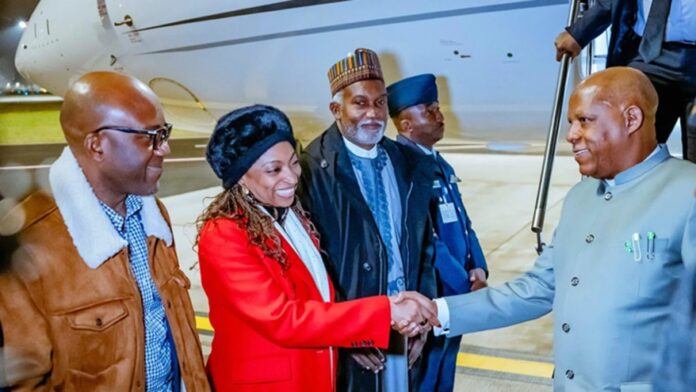
Mr Stanley Nkwocha, Senior Special Assistant on Media and Communications to the Vice President, on Sunday said Shettima had arrived in Davos to lead the Nigerian delegation at the annual global economic forum.
On arrival, the Vice-President was received by Foreign Affairs Minister Amb. Yussuf Tuggar, Trade and Investment Minister Dr Jumoke Oduwole and Nigerian mission officials.

Nkwocha said Shettima will participate in plenary sessions on responsible deployment of Artificial Intelligence, quantum computing and biotechnology.
“Throughout the week, the Vice President will hold bilateral meetings with heads of state, top executives and international development finance leaders. This is to deepen partnerships aligned with the Renewed Hope Agenda of President Bola Tinubu,” Nkwocha said.
He explained that WEF 2026 marks a milestone in Nigeria’s global economic diplomacy with the official debut of ‘Nigeria House Davos.’
For the first time, the Nigerian Government has established a sovereign pavilion on the Davos Promenade, he said.
“This facility, a product of a successful Public-Private Partnership, will serve as a hub for ministerial engagements, investment roundtables and cultural diplomacy throughout the week,” Nkwocha said.
Speaking further on the meeting, Oduwole said Nigeria will present investment opportunities at the inauguration of Nigeria House in Davos.
“We will showcase four playbooks on President Tinubu’s efforts to re-engineer the Nigerian economy. We will present our solid minerals, climate-sustainable agriculture, creative, and digital sectors to investors worldwide.”
THEWILL reports that this global engagement is coming against the backdrop of some significant improvement in reforms measures so far taken by the government.
For example, real GDP growth of about 4.3 per cent is expected in 2026, as against 3.86 per cent as at Q3 in 2025 Also, inflation has moderated gradually at 14.45 in November 2025 as against 17.6 per cent previously while the naira remains broadly stable at N1.436.31/$ against N1.542/$.
Also, FX reserve has shown significant improvement at $45.54 billion as at December 2025 against $40.9 billion in the previous year. Market capitalisation stands at $99.4 trillion as at December, 2025 as against $66.76 trillion, previously. Currently, oil production has tipped at 1.44 million barrels per day as at November, 2025 as against 1.33mbpd. The Central’s Bank’s Monetary rate is 27 percent as against 27.25 per cent previously.
Against this backdrop, foremost management consulting firm, Pricewaterhouse Coopers, PwC, in its Nigeria Economic Outlook in 2026, stated that projected GDP growth will be supported by higher crude oil production and stronger performance in dominant services sectors, as inflation is expected to moderate gradually, reflecting the Central Bank of Nigeria’s tight monetary stance, rebasing effects and improved foreign-exchange stability. The naira is projected to remain broadly stable, underpinned by ongoing FX reforms and improved portfolio inflows. With inflation easing, monetary policy may ease cautiously, while policy discipline remains critical.
“Some practical imperatives for business leaders in 2026 are to make selective investment bets in attractive sectors and regions, scenario-planning for macroeconomic and geopolitical shocks, adapting business models and cost structures for resilience, accelerating digital transformation and responsible AI adoption, and strengthening regulatory and tax compliance as reforms move from design to execution,” the Outlook says. It, however, maintained that fiscal constraints persist, reinforcing the importance of capital efficiency and balance-sheet discipline.
Felix Ifijeh is a journalist with years of professional reporting experience. Known for his keen news sense, compelling storytelling and commitment to accurate, impactful reporting, he has built a reputation for turning leads into clear, engaging, and well-structured reports that resonate with readers. His work reflects deep newsroom experience and a commitment to accurate, impactful journalism.