October 12, (THEWILL) — The National Council on Climate Change (NCCC) has approved and validated the Just Transition Guidelines and Action Plan (JT-GAP), a policy framework designed to guide Nigeria’s transition to a green, inclusive, and climate-resilient economy.
The framework, developed by the Centre for Climate Change and Development (CCCD), Alex Ekwueme Federal University, Ndufu-Alike, Ebonyi State, was produced with technical support from the International Labour Organization (ILO), the United Nations Development Programme (UNDP), and the United Nations Industrial Development Organization (UNIDO).
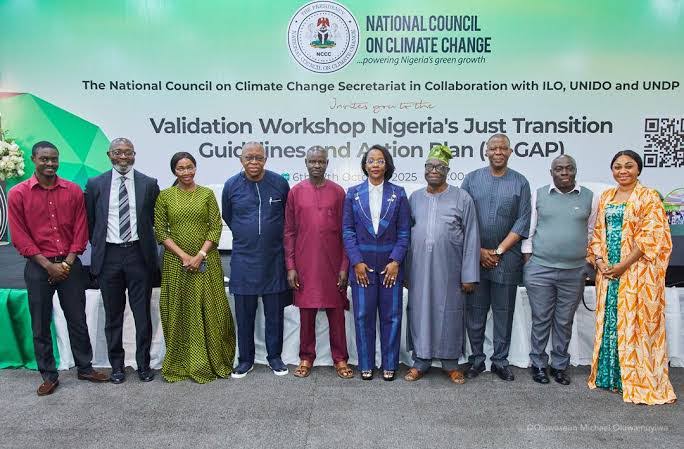
A statement signed by Assistant Project Manager, Paul Ogwu, said the validation exercise took place on October 6 and 7, 2025, at the Nigerian Air Force Conference Centre, Kado, Abuja.

The two-day session featured a technical review of the JT-GAP draft, led by Professor Emmanuel Oladipo on behalf of the Lead Consultant, Professor Chukwumerije Okereke.
The session also highlighted key themes such as gender inclusion, youth empowerment, and social equity, presented by the Project Manager, Dr. Austine Sadiq Okoh.
The final day of the workshop brought together representatives from government ministries and agencies, multilateral institutions, civil society organisations, women and youth groups, persons with disabilities, labour unions, and private sector actors.
Dignitaries in attendance included the Director-General of the NCCC, Mrs. Tenioye Majekodunmi; Senior Special Assistant to the President on Climate Finance and Stakeholder Engagement, Mr. Ibrahim Shelleng; the Chairman and Deputy Chairman of the House Committee on Climate Change; the Special Adviser to the President on Ease of Doing Business; and representatives of state governments and international partners.
Majekodunmi described the JT-GAP as a “comprehensive, evidence-based document that reflects Nigeria’s commitment to an equitable energy transition and decarbonisation pathway.”
She explained that the framework aligns with Nigeria’s Nationally Determined Contributions (NDCs), Energy Transition Plan (ETP), and long-term net-zero targets, adding that it was developed through a rigorous process of national and international consultations.
“The Just Transition is not merely an environmental agenda but a people-centred development vision that ensures economic growth, social justice, and environmental sustainability move hand in hand,” Majekodunmi said.
She called on stakeholders to take collective ownership of the document and support its timely implementation across sectors.
Lead Consultant, Professor Chukwumerije Okereke, said the JT-GAP provides a blueprint for integrating justice and equity into Nigeria’s climate transition, ensuring that green growth does not come at the expense of jobs and livelihoods.
“Our report offers a roadmap for Nigeria to align climate ambition with development priorities, protect workers and vulnerable communities, and mitigate transition risks such as job losses and stranded assets,” Okereke stated.
The validation of the JT-GAP, participants noted, represents a milestone in Nigeria’s climate policy landscape and a major step toward achieving a just, inclusive, and sustainable low-carbon future.

Felix Ifijeh is a journalist with years of professional reporting experience. Known for his keen news sense, compelling storytelling and commitment to accurate, impactful reporting, he has built a reputation for turning leads into clear, engaging, and well-structured reports that resonate with readers. His work reflects deep newsroom experience and a commitment to accurate, impactful journalism.