A large number of micro, small and medium enterprises (MSMEs) have migrated to the cashless ecosystem amid scarcity of Naira notes. The development has accentuated the 95 percent Financial Inclusion target of the Governor of Central Bank of Nigeria, Godwin Emefiele, which was unveiled four years ago.
Emefiele had put financial inclusion at the forefront of his 5-point agenda in his second-term programme as the CBN governor in June 2019, when he chose 2024 as the target year to achieve 95 percent financial inclusion.
“Over the next five years, through initiatives and policy measures, such as the Shared Agent Network (SANEF) and the payment service banks, we intend to broaden access to financial services to individuals in under-served parts of the country. Our ultimate objective is to ensure that 95 per cent of eligible Nigerians have access to financial services by 2024,” Emefiele stated in his world press conference on June 24, 2019.

The CBN had since then intensified the financial inclusion target through several channels. These include the Payments Vision 2025 document published in 2022 stating that the use of cash payments will drastically reduce in the country by 2025. It explained that by 2025, the country will have a cashless and efficient electronic payment system infrastructure to service all the sectors of the economy.
The CBN in 2020 gave an official nod to telecommunications (telecos) operators’ push to operate Payment Service Banks (PSB). Beneficiaries of the payment service bank liberalisation policy include Globacom, 9Mobile, MTN Nigeria and Airtel Africa.
Essentially, the structure of the PSBs include the fact that they shall, among other requirements, operate mostly in the rural areas and the unbanked locations. They are to target financially excluded persons with not less than 25 percent financial service touch-points in such rural areas as defined by the CBN from time to time.
In October 2021, President Muhammadu Buhari unveiled Nigeria’s digital currency, e-Naira, targeted at boosting GDP and deepening financial inclusion. Quite remarkably, within a few days, the e-Naira recorded more than 2.5 million average daily visits, with 33 banks integrated on the platform, offering e-Naira wallets. Additionally, there was about half a billion naira successfully minted and held by more than 200,000 customers who were fully on board.
During the launch, President Buhari said the adoption of new CBN digital currency was estimated to increase Nigeria’s GDP by $29 billion over the next 10 years, adding, “We have become the first country in Africa and one of the first in the world to introduce a digital currency to our citizens..
Emefiele had also disclosed in October 2022, that the e-Naira recorded a total of N8 billion transactions in the first one year it was launched. The CBN governor also said the Central Bank Digital Currency (CBDC) was part of the apex bank’s plan to make Nigeria fully a cashless economy.
A recent report by the Nigeria Inter-Bank Settlement System (NIBSS) showed that the volume of financial transactions performed electronically in Nigeria rose significantly in the first two months of the year as individuals and businesses battle severe Naira scarcity – a fallout of the Naira re-design policy announced on October 26, 2022.
According to the NIBSS, the volume of mobile money transactions for the month of February rose to 183.69 million from 105.13 million recorded in the preceding month of January, representing a 70 percent increase. Similarly, value of transactions during the period rose by 7.8 percent.
Again, volume had risen from 108.13 million transactions with a value of N2.37 trillion in January, to 183.69 million transactions with a value of N2.55 trillion, the report stated.
The data suggested that more Nigerians used electronic channels such as bank applications and USSD to pay for items that normally would have been cash-based during the cash crunch.
According to the February NIP data, the NIP channel recorded 787.93 million transactions with a value of N36.78 trillion compared to 541.65 million transactions that were done via NIP in January with a value of N38.77 trillion..
“When compared to the data recorded in the comparable period of 2022, the NIP recorded a significant increase in volume, which was up by 121 per cent, while value rose by 35.32 per cent. In February last year, NIP transactions stood at 355.61 million transactions valued at N27.18 billion,” the report stated.
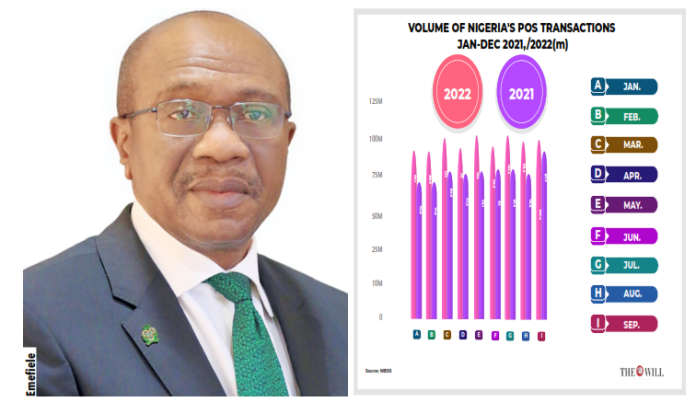
Following the same growth trajectory, transactions held via point of sale (PoS) terminals rose in February. According to the NIBSS statistics, the volume of PoS transactions rose by 17.8 per cent while value of transactions on the channel rose by 9.4 per cent.
The NIBSS which monitors cashless transactions through the Nigeria Instant Payment (NIP) System and POS terminals further stated that a total of 113.53 million transactions valued at N883.45 billion was recorded at the end of February, compared to 96.35 million transactions valued at N807.16 billion that was recorded in January this year.
Furthermore, the PoS channel transactions in February 2023, showed a 27.7 and 53.6 per cent increase in the value and value of transactions respectively, as against the e-transaction of equivalent period in 2022 during which 88.9 million transactions valued at N575.96 billion was recorded.
Mr Kayode Akintude, a financial analyst, said the increased volume in e-payment transactions was a fallout of the lingering scarcity of cash in the economy which, incidentally, is deepening the cashless policy of the CBN. He said the e-transaction expansion cascades down to smaller businesses making it possible for the MSMEs to benefit from.
“Nigerians may be looking at the inconveniences they go through on a daily basis to access cash for their day-to-day transactions, the economy and the people will be the ultimate gainer because it will boost GDP and increase government tax revenue significantly,” Akintude told THEWILL by telephone.
Findings revealed that the majority of the e-transaction converts are operators in the MSME space. These include the roadside shop owners, commercial vehicle operators, petty traders, itinerant hawkers and newspaper vendors.
At the Iyana-Ipaja motor park in Lagos, commuters were given the cash or e-payment options by the park operators, amid standby PoS agents. At Oshodi, intra-city commercial buses offer e-payment transactions for as low as a fare of N100. The Lagos Bus Rapid Transit (BRT), a modern urban transport outfit, operates an e-card payment system.
Ndubisi Nwokoma, Professor of Financial Economics, University of Lagos observed that the Naira re-design policy will impact significantly on the nation’s cashless policy and change the culture of carrying cash about. He stated that many Nigerians “down the ladder” are now moving
towards digital transactions, including the commercial vehicle operators, petty traders and pepper sellers in the market.
“This policy has been able to help us to push for having a cashless economy. This is something we have to acknowledge. This policy may not solve all the problems of the CBN, but it has encouraged people to embrace the cashless economy. Those in the lower rung of the society can transact their businesses – use the services of commercial buses, buy pepper, buy yam, buy tomatoes in the market”, said Nwokoma, on a national television programme, monitored by THEWILL recently.\
Petrol station and supermarket operators who spoke to this newspaper applauded the cashless policy and the significant increase in e-payment transactions. According to them, they now record more sales and less “leakages” at the end of the day (perpetrated by unscrupulous employees).
However, many people complain about the increasing number of transaction failures which lead to huge crowd of customers at the banks seeking to resolve different kinds of transaction challenges such as wrong or multiple debits or hanging fund transfers. This has been identified as a major challenge in the promotion of the cashless policy.
Fielding questions at the post-Monetary Policy Committee (MPC) press briefing in Abuja Tuesday (March 21, 2023), Emefiele admitted that there are challenges in the e-transaction channels and promised that the apex bank would address it in order to deepen financial inclusion through the cashless policy.
“I must apologise. Yes, online channels fail. But no doubt it is as a result of the deluge of online transactions that hit the banking industry. But it is being resolved.
“On a daily basis, our Payment System Management Department monitors the online payment platforms so as to make sure that when there is a downtime, they are quickly resolved so that transactions can go on smoothly,” the CBN governor said.

Sam Diala is a Bloomberg Certified Financial Journalist with over a decade of experience in reporting Business and Economy. He is Business Editor at THEWILL Newspaper, and believes that work, not wishes, creates wealth.