
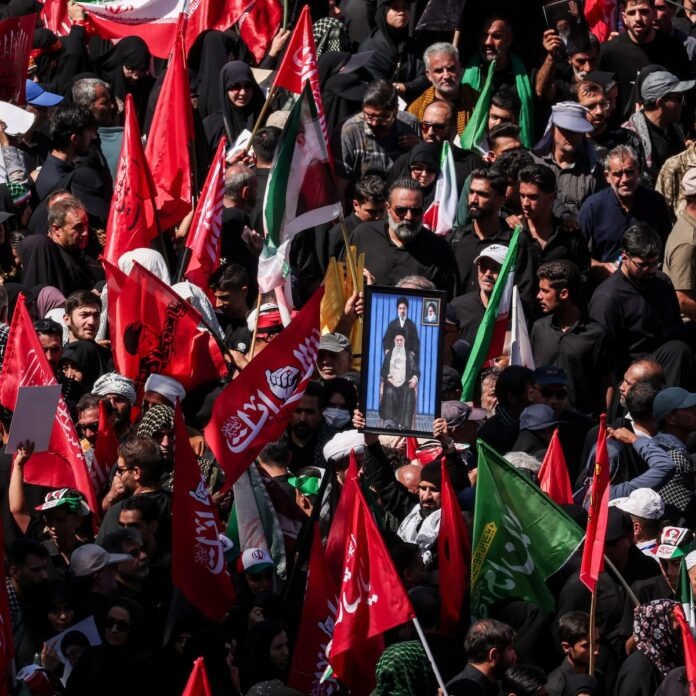
July 12, (THEWILL) — The United States has launched a fresh wave of airstrikes against Iran after Tehran attacked a commercial cargo vessel in the Strait of Hormuz, as Iran’s new Supreme Leader, Mojtaba Khamenei, vowed to avenge the death of his father, the late Ayatollah Ali Khamenei.
The latest US military action followed an attack by Iran’s Islamic Revolutionary Guard Corps (IRGC) on the Cyprus-flagged container ship M/V GFS Galaxy, which was transiting the strategic Strait of Hormuz.
According to the US Central Command (CENTCOM), the strikes were carried out on Saturday on the orders of President Donald Trump after the vessel sustained heavy damage during the Iranian assault.

“A civilian crew member is missing and the vessel is unable to continue the journey due to an onboard fire and significant engine room damage”, CENTCOM said in a statement posted on X.
The US military accused Iran of once again violating previous understandings aimed at protecting international commercial shipping through one of the world’s busiest maritime corridors.
“Iran was provided another opportunity to demonstrate adherence to the Memorandum of Understanding after being held accountable for earlier attacks on commercial vessels but has again failed. In response, the United States is imposing a heavy cost by continuing to degrade Iran’s ability to attack civilian mariners and commercial ships freely transiting the strait”, the Command stated.
Earlier on Saturday, Iran acknowledged attacking a vessel it claimed was using an “unauthorised route” through the Strait of Hormuz and announced the closure of the vital waterway until further notice.
The Revolutionary Guards alleged that several vessels ignored Iranian directives to alter their course.
According to the IRGC, multiple ships “disregarded our warnings and instructions to correct their course and proceed along the approved route”, adding that one vessel “was struck by a warning shot and brought to a stop.”
Tehran also warned that it could launch attacks against additional enemy bases across the region if further military action was taken against Iran.
Shortly after the US announced the latest strikes, Iranian state television and local media reported multiple explosions across the country’s southern coastal region.
State television reported three explosions in Bandar Abbas and two in Sirik, while Mehr News Agency said blasts were heard on Qeshm Island. Other media outlets also reported explosions in Bushehr Province, Deir, Asalwiya and the port city of Jask.
US Defence Secretary, Pete Hegseth, defended the military operation, saying Iran had brought the consequences upon itself.
“Iran made a poor choice. Now they pay”, Hegseth wrote on social media.
The renewed exchange of military strikes came despite fresh diplomatic efforts between Iran and Oman aimed at preventing further disruption to maritime traffic through the Strait of Hormuz.
Oman’s Foreign Ministry confirmed that Iranian Foreign Minister Abbas Araghchi met his Omani counterpart on Saturday, with both sides agreeing to continue discussions at the technical and political levels on ensuring safe navigation through the strategic waterway.
Before the latest US strikes, Araghchi said the talks focused on establishing “appropriate mechanisms for ensuring the safe passage of ships.”
However, he also accused Washington of violating the interim ceasefire arrangement by ending waivers that previously allowed Iran to sell crude oil in US dollars.
“Reality check: There can only be mutual compliance”, Araghchi wrote on social media.
Adding a new dimension to the crisis, Iran’s new Supreme Leader, Mojtaba Khamenei, issued his first public statement since the funeral of his father, the late Ayatollah Ali Khamenei, pledging revenge for his father’s killing during the opening phase of the conflict on February 28.
“Such revenge is the will of our nation and must certainly be carried out”, Khamenei declared in a statement broadcast on state television, just hours after President Trump threatened additional missile strikes if Iran continued its attacks.
The Strait of Hormuz, which links the Persian Gulf to the Gulf of Oman and the Arabian Sea, remains one of the world’s most strategically important maritime routes, with nearly one-fifth of global oil and liquefied natural gas shipments traditionally passing through the narrow channel before the outbreak of hostilities.
Iran’s decision to shut the waterway has intensified fears of renewed disruptions to global energy supplies and international shipping despite oil prices retreating from wartime highs.

Felix Ifijeh is a journalist with years of professional reporting experience. Known for his keen news sense, compelling storytelling and commitment to accurate, impactful reporting, he has built a reputation for turning leads into clear, engaging, and well-structured reports that resonate with readers. His work reflects deep newsroom experience and a commitment to accurate, impactful journalism.
