
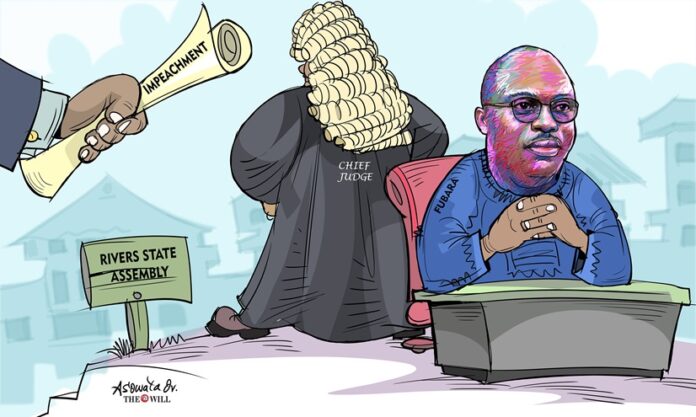
January 18, (THEWILL) — The renewed impeachment threat against Rivers State Governor, Siminalayi Fubara and his deputy, Prof Ngozi Odu, has once again reignited political tensions in the oil-rich state.
THEWILL, however, gathered that while the governor and the lawmakers have resolved to battle it out in the law courts, the ultimate resolution, barring any other intervention, lies with the State Chief Judge, Justice Simeon Chibuzor-Amadi. He is said to have acknowledged receipt of the State House of Assembly’s impeachment notice against the governor and his deputy before the weekend interim court order restraining him from acting.
ASSEMBLY PUSHES AHEAD AMID LEGAL CONSTRAINTS
On Friday, January 16, the House of Assembly directed Justice Simeon Chibuzor-Amadi to set up a panel to investigate allegations of gross misconduct against the governor and his deputy.

A few hours after the legislative directive, Justice Florence Fiberesima of the Rivers State High Court sitting in Port-Harcourt, ruled on a motion ex parte filed separately by Governor Fubara and his deputy. The Judge issued an interim order restraining the Chief Judge of the state from receiving, considering or acting on any impeachment-related request or communication against the litigants.
Reacting swiftly, Chairman of the House Committee on Information, Petitions and Complaints, Enemi George, said the interim order was belated.
According to him, the documents and notices of allegations against Fubara and his deputy, Ngozi Odu, have been “received and acknowledged” by the Chief Judge, Amadi.
“It is important to inform the good people of Rivers State that Mr Speaker has already complied with the constitution and letters sent by him to the Chief Judge have been received and acknowledged,” he said, adding, “All relevant documents, including the Notices of Allegations of Gross Misconduct, were attached.”
Special Adviser to the governor on Political Matters, Dalington Orji disputed George’s claim.
Speaking to THEWILL in a brief interview on Saturday, he said, “Let them publicly present the acknowledgment letter for everyone to see. Besides, we are not challenging the constitutional right of the Assembly to commence an impeachment proceeding. But many courts in the land, including the Supreme Court, have ruled in several cases that the process must conform with the provisions of the Constitution, in this case, that service of impeachment notice be done personally. Recall that the governor was not in Nigeria when the impeachment proceedings started. According to the lawmakers, they served him on January 9, 2026.
“But the stamp on the international passport of his excellency, the governor will show he was not in Nigeria on that day. Secondly, if the governor is clear that the process is flawed, he has a right to raise questions in which the courts agree with you, it can stall the process and direct that the proper thing should be done. Again, the Assembly understands that when the impeachment proceedings are served on the governor, he has 14 days to respond. Now, from January 9 to January 16, when they met, how many days is that? Why are they in haste? What point are they making? If the Constitution grants the governor 14 days to respond to your allegations and you then go ahead to write to the Chief Judge, it means the process is flawed?”
Orji argued that it is this flawed process that the governor is challenging.
“Additionally, under Section 188(5) of the 1999 Constitution, once a Speaker formally issues an impeachment directive on impeachment, the Chief Judge must appoint a seven-member panel of individuals with unquestionable integrity to investigate the allegations. The persons must not be “members of any public service, legislative house or political party…”
“OTHER PROVISIONS OF SECTION 188 (5)
“Other provisions of the section empowering the Chief Judge are as follows; The holder of an office whose conduct is being investigated under this section shall have the right to defend himself in person or be represented before the panel by a legal practitioner of his own choice.
“The speaker of the House of Assembly shall, within seven days of the receipt of the notice, cause a copy of the notice to be served on the holder of the office and on each member of the House of Assembly and shall also cause any statement made in reply to the allegation by the holder of the office, to be served on each member of the House of Assembly.
“Within fourteen days of the presentation of the notice to the speaker of the House of Assembly (whether or not any statement was made by the holder of the office in reply to the allegation contained in the notice, the House of Assembly shall resolve by motion, without any debate whether or not the allegation shall be investigated.
“A Panel appointed under this section shall – (a) have such powers and exercise its functions in accordance with such procedure as may be prescribed by the House of Assembly; and (b) within three months of its appointment, report its findings to the House of Assembly.
“Where the Panel reports to the House of Assembly that the allegation has not been proved, no further proceedings shall be taken in respect of the matter.
“Where the report of the Panel is that the allegation against the holder of the office has been proved, then within fourteen days of the receipt of the report, the House of Assembly shall consider the report and if by a resolution of the House of Assembly supported by not less than two-thirds majority of all its members, the report of the panel is adopted, then the holder of the office shall stand removed from office as from the date of the adoption of the report.
“No proceedings or determination of the panel or of the House of Assembly or any matter relating to such proceedings or determination shall be entertained or questioned in any court.”
In this section – “gross misconduct” means a grave violation or breach of the provisions of this Constitution or a misconduct of such nature as amounts in the opinion in the House of Assembly to gross misconduct.
However, judicial intervention has complicated this process. The Supreme Court, in Inakoju & 17 Others v. Adeleke (SC.272/2006), ruled that while the High Court can review whether the constitutional procedures for impeachment were followed, it lacks the authority to stop the process.
HISTORICAL CONTEXT, POLITICAL CALCULUS IN FAVOUR OF FUBARA
Despite these legal hurdles, emerging developments suggest the governor remains well-positioned to withstand the crisis. Central to this unfolding drama is the judiciary, particularly the State Chief Judge, Justice Chibuzor-Amadi, whose actions may ultimately determine the governor’s fate. He has crossed this bridge before deftly and understands the actors and the game.
According to pundits, past two attempts by the lawmakers to impeach Governor Fubara since in 2023 and 2025 faltered due to judicial intervention, public backlash and internal legislative fragmentation. Significantly, the number of legislators has hardly changed.
Even with 26 out of the 32 members of the Rivers State House of Assembly reportedly backing the impeachment, the Assembly faces significant legal and institutional obstacles.
Political observers argue that like the previous attempts, the current impeachment attempt is driven more by political rivalry than by genuine concerns over the governor’s conduct. Central to the ongoing drama is the strained relationship between Governor Fubara and his predecessor cum estranged godfather, the current Minister of the Federal Capital Territory (FCT), Nyesom Wike.
Reliable judicial sources told THEWILL that Justice Amadi is unlikely to facilitate the impeachment. His cautious stance is informed by constitutional safeguards, judicial independence and the circumstances surrounding his office.
Justice Amadi was elevated to Chief Judge in May 2021 during the tenure of Wike as governor.
Even though the lawmakers openly profess their loyalty to the FCT Minister, a previous attempt to win over Justice Amadi had hit the rock.
In the wake of the second impeachment attempt by the Amaewhule-led Rivers Assembly, Justice Amadi had maintained political neutrality. Sources privy to the development further told THEWILL that the Chief Judge resisted every pressure to coerce him into signing and replying the impeachment notice before President Bola Tinubu declared a State of emergency on March 18, 2023.
Frustrated, the source added, the Assembly went on the offensive against the Chief Judge.
“Unable to buy the Chief Judge, the lawmakers accused him of age falsification and called on the Department of State Services (DSS) to investigate him. The move sparked a public rift between the judiciary and the legislature. The Chief Judge resisted what many observers described as a politically motivated attack, further solidifying his independence from the Assembly.”
This prior conflict, the source maintained, fortified the judge in his sense of independence and made it likely that he would tread on the line of constitutionality, justice and public peace than mere fractious politics.
Political insiders suggest that while the Chief Judge may act in accordance with the law, he is reluctant to be drawn into what is widely perceived as a politically motivated process.
The Chief Judge’s history of resisting political pressure makes it unlikely that he will facilitate an impeachment process perceived as politically motivated.
THE SPEAKER AMAEWHULE ANGLE
According to Section 191(2) of the 1999 Constitution, if the offices of both the governor and deputy governor become vacant due to impeachment, resignation, death, or any other reason, the Speaker of the State House of Assembly assumes the role of acting governor. The acting governor can only serve for a maximum of 90 days, during which the Independent National Electoral Commission (INEC) must conduct a fresh election to elect a new governor for the remainder of the term.
In the case of Rivers State, if Fubara and Odu are removed simultaneously, Speaker Martin Amaewhule would assume office as acting governor. His tenure would last no longer than 90 days, within which a new governorship election would be held. As a major character in the ongoing crisis, his ascension into office following an impeachment can only polarise the state further and heat up the polity beyond control, according to sources.
A public affairs analyst, a critical stakeholder in Rivers State and CEO of The Albino Foundation, Jake Epelle said the “mathematics of those pushing for Governor Fubara’s impeachment, is not adding up.” Arguing that he was not holding brief for the governor but for good governance which, in his estimate, Fubara, was administering, he told THEWILL on Saturday.
“Minister Wike, Speaker Amaewhule and their group are bent on disrupting the political system and governance of Rivers State in the pursuit of their ambition for three reasons. The reasons are resource control of money in the state; power about who controls the affairs of the state and the unnecessary desire for control of political structure of the state. Amaehwule knows that if both governor and deputy governor are impeached, he would become governor for some time. That is ambition for you.”
Wike had however stated that Governor Fubara has breached the peace accord reached with President Tinubu. During his recent “Thank You Visit” to local governments of Rivers State, Wike declared: “Very soon, we will let people know what we agreed on before Mr President.”
For some of the lawmakers who at the weekend made a U-turn on their rejection of the impeachment process, the governor had been attempting to instigate a recall process at their constituencies rather than engage in dialogue with the leadership of the Assembly to resolve the matter.
Reacting to the development, Senator Ibok Essien, a former Chairman of the Pan Niger Delta Forum, PANDEF, said the grounds for impeachment were improper.
“How do you impeach a governor and his deputy at the same time.? As a former Deputy Chief Whip of the Senate, I do not know of how a President and Vice President would grossly abuse office and violate the Constitution at the same time. Let people not interpret the ongoing crisis in Rivers State as a fight between Governor Fubara and Minister Wike but rather than as a result of gross abuse of the Constitution. Impeachment should not be the result of power play but as a constitutional process.”
Director, The Abuja School of Social and Political Thought, Sam Amadi, described due judicial process as Governor Fubara’s strongest safeguard. He noted that the appointment of the investigative panel by the Chief Judge is the “anchor point” of the impeachment process.
“An independent panel of individuals of integrity would likely conclude that Fubara has committed no impeachable offence since the end of emergency rule. If the panel says, ‘not proven,’ that ends the matter. That judicial phase is really the saving grace for him,” Amadi said.
PRESIDENT TINUBU INTERVENTION, APC ROLE, PUBLIC OPINION
Other factors that are weighing in favour of the governor are his recent defection to the governing All Progressives Congress APC. This has provided a critical lifeline in securing substantial backing of the Progressives Governors and the national leadership of the party.
Further complicating the impeachment efforts is a likely direct intervention by President Bola Tinubu. Sources close to the Federal Government suggest that Tinubu’s direct intervention is the last card if all other options fail.
Earlier, the National Security Adviser, Nuhu Ribadu, Minister of Works, Dave Umahi and Chairman of APC Progressive Governors Forum and governor of Imo State, Hope Uzodinma had paid a solidarity visit to the governor shortly after his defection to the APC, prompting Wike to embark on local government tour of the state to shore up his waning influence emphasised by the visit of the trio, in the political calculations ahead of the 2027 poll.
ALLEGATIONS OF GROSS MISCONDUCT
Last week, January 9, the Rivers State House of Assembly, through its Speaker, Martins Amaewhule, announced that impeachment notices had been transmitted to both the governor and his deputy, Prof. Ngozi Odu.
In the notice addressed to the governor, the lawmakers accused Fubara of gross misconduct, including alleged financial recklessness and administrative incompetence. The notice signed by Speaker Amaewhule, further alleged constitutional breaches, unilateral demolition of the State House of Assembly complex along Moscow Road and irregularities in budget implementation. Fubara was also accused of unauthorised expenditure of public funds, withholding funds meant for the legislature and failure to present the 2026 Appropriation Bill for legislative scrutiny and approval.
Similarly, the deputy governor, Prof. Odu, was accused of gross misconduct, allegedly aiding and abetting the governor in reckless spending of state resources, in breach of Section 189 of the 1999 Constitution (as amended).
PUBLIC OPINION AND POLITICAL PRESSURE
Civil society groups, labour unions and regional organisations have all voiced concerns over the potential politicisation of the impeachment process. Apart from high-profile figures, such as Mr. Femi Falana a Senior Advocate of Nigeria, former Vice President Atiku Abubakar, groups like PANDEF, APC Progressives Mandate and Ijaw National Congress, INC, who have warned that using impeachment as a political weapon could destabilise governance and undermine democracy in Rivers State.
Given the ‘cold war’, between the Assembly and the Chief Judge, and the broader political dynamics at play, Fubara may yet emerge from this latest challenge with his position intact.
Recounting the circumstances surrounding the U-turn made by four members who had pulled out of the impeachment process, Orji maintained that a powerful figure he did not name was behind the unfolding drama.
“A legislator, Hon. Nwankwo, from Omuma Local Government Area of the state, had said earlier that based on the intervention by leaders and stakeholders within and outside Rivers State, they have decided to sheathe their swords and appealed to other members to drop the impeachment proceedings for Rivers State to move forward only for them to come back to say they were being abused on Facebook. What drama are they acting.? These are lawmakers are feeding the ego of an individual who feels he is more powerful than the people of Rivers State and who is out to mortgage the resources of the state. Rivers have always fought against godfatherism,” he said.
Despite his optimism about the favourable outcome of the renewed conflict, Epelle, however, cautiously said, “If however, Governor Fubara gets impeached, it is not Wike that should be held responsible but President Tinubu, quote me on that.”

Felix Ifijeh is a journalist with years of professional reporting experience. Known for his keen news sense, compelling storytelling and commitment to accurate, impactful reporting, he has built a reputation for turning leads into clear, engaging, and well-structured reports that resonate with readers. His work reflects deep newsroom experience and a commitment to accurate, impactful journalism.
