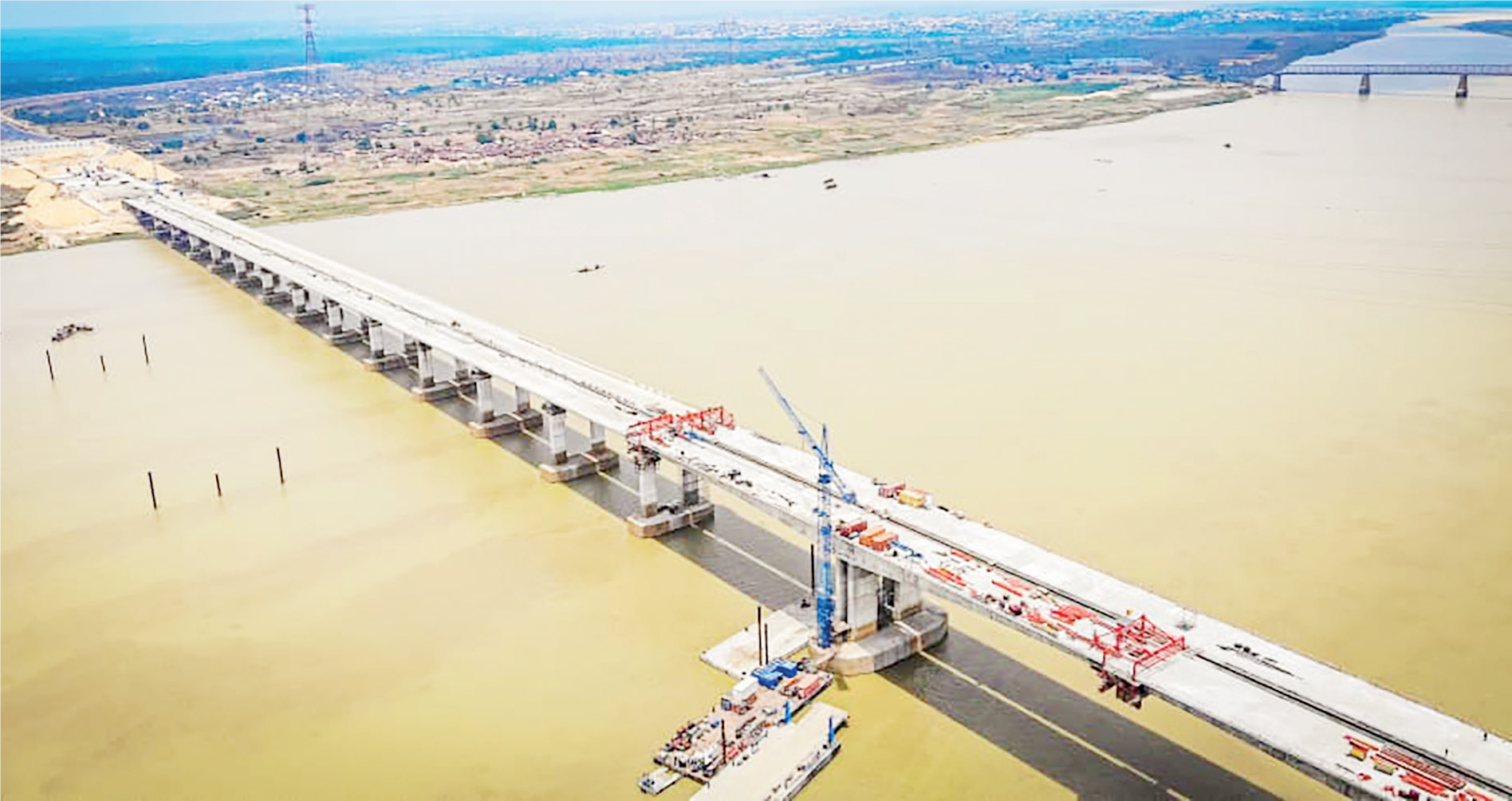
March 13, (THEWILL) – On March 8, a high-profile delegation of the Federal Government, comprising the Chief of Staff to President Muhammadu Buhari, Ibrahim Gambari; the Minister of Works and Housing, Babatunde Fashola and his Labour and Employment counterpart, Chris Ngige, which was on a mission to inspect the progress being made in the construction of the Second Niger Bridge, was received by representatives of the governments of Anambra and Delta States. The takeaway from the visit was overly positive, as over 85 per cent of the construction had been done and an April round off of the entire project was promised. Also promised was an expected October commissioning, well ahead of the holiday-time gridlock that had become a standard fare for the majority of travellers, who waste hours caught up in traffic jams inbound and outbound Onitsha.
Yet, as impactful as these details are about the realisation of a Second Niger Bridge, the reaction to the development was understandably tempered by mostly those who have waited these past decades with bated breaths to see the possibility of an alternative to the only link road across the River Nigeria without success until now. To fully grasp the cautious optimism with which the news relayed by the high-profile delegation was received, it is necessary to look beyond the teething problems that earmarked the recent kickoff of the project under the previous administration of Goodluck Jonathan and also beyond the initial promises of Fashola, who had promised a February commissioning, and go all the way back to the 1978/1979 political campaign of Shehu Shagari, the then presidential candidate of the National Party of Nigeria (NPN). It boggles the mind to no end that already in the late 1970s, the original Niger Bridge was considered insufficient and in need of a complementary link between the South-East and southern Nigeria, on the one hand, and the rest of the country, on the other. Yet, only now is there a very real possibility of this alternative.
Back in the 1970s, the bearings of a political campaign tool were beginning to be obvious: to earn the confidence of the people to the East and South of Nigeria, a politician ought to wave the “Second Niger Bridge Construction” carrot and, like clockwork, the votes from the region will flow like the very waters of the River Niger. It worked for Shagari but, as is obvious by now, no Niger Bridge materialised, with the NPN government in charge of the affairs of the country from 1979 to 1983. Instead, most of the in-country movement southwards went through the solitary Niger Bridge, increasing the tension on the infrastructure beyond projected levels. That was the state of affairs in the lifetime of the military juntas of Generals Muhammadu Buhari, Ibrahim Babangida, Sani Abacha, Abdulsalam Abubakar and through the democratically elected Olusegun Obasanjo, Umaru Yar’Adua and Goodluck Jonathan administrations.

During Babangida’s regime, the danger of the deterioration of the Niger Bridge was highlighted by the then Minister for Works and Housing, Abubakar Umar. In his reaction, Babangida challenged local engineers to come up with concepts for a Second Niger Bridge. The Nigerian Society of Engineers responded by incorporating a consulting firm called NSE PREMS Limited, which delivered a master plan for the execution of said bridge, but circumstances conspired to prevent it from going further, especially towards the end of the Babangida administration.
Yet, the warning about the Niger Bridge was factual. It was bearing the brunt of being the sole cross-Niger link to the South-East and South-South. As a route between Onitsha in Anambra State and Asaba in Delta State, the bridge was completed in December 1965 by the French construction giant, Dumez, following designs of Dutch engineering consultants. It had a total length of 4,606 feet (1,404m) and the entire construction took about a year as it began in 1964 and was ready for use in 1965, at a cost between £5 and £6 million, which comes to about N51 billion when adjusted for inflation. Sir Abubakar Tafawa Balewa, Nigeria’s Prime Minister at the time, commissioned the project on January 4, 1966, in what turned out to be his final public event outside Lagos as Prime Minister. On January 15, he was assassinated in a bloody coup and his body was discovered by the roadside near Lagos six days after.
As for the bridge, which had a steel centre-truss, three vehicular lanes with pedestrian walkways on both sides, it suffered severe damages after retreating Biafran soldiers exploded dynamite on the structure during the Nigerian Civil War of 1967–1970, in order to prevent the Nigerian military’s assault on Onitsha. It was a manoeuvre that left the Nigerian Army on the Asaba side of the river stranded and unable to advance against the retreating horde. That damage rendered the bridge unusable until it was re-opened on Thursday, March 26, 1970, courtesy of a contribution of £116,000 from West Germany towards its reconstruction. For the intervening years, it was the only source of in-country movement southwards, with its attendant gridlock during periods of high traffic and related problems of access to and from Asaba and Onitsha. These placed an enormous strain on the structure, even as it impeded the movement of goods and services along that section of what is known as the Trans-African Highway that traverses Lagos all the way to Mombasa in Kenya.
As desirably significant as an alternative bridge was the Ernest Shonekan-led Interim National Government, which lasted a brief 84 days, Abacha’s junta, in power for five dark years and the Abdulsalami Abubakar handover regime that lasted one month shy of a year paid scant attention at best and lip service, at worst, to the initiation of the construction. Promises for the building resurfaced during Obasanjo’s rule, but eight years and two terms passed by with the only difference being that approximately five days before he left office, Obasanjo flagged off the N58.6 billion project and handed it over to his successor, Umaru Yar’Adua. Unfortunately, Yar’Adua was ill and was unable to engage in the project or complete his term, dying in office three years into his four-year term. The Obasanjo government’s plan for a six lane, 1.8 km tolled bridge, which was to be completed in three-and-half years, stalled. The bridge was to be funded through a public-private partnership (PPP), with the contractor, Gitto Group, providing 60 per cent of the fund, the Federal Government providing 20 per cent and the governments of Anambra and Delta States each contributing 10 per cent.
Then, Jonathan entered into the timeline with fresh promises to make the Second Niger Bridge a reality, especially given his status as a southerner. He pledged his word at a town hall meeting held on August 30, 2012, to see to its construction and commissioning. It turned out to be more of the same for those waiting to witness the reality of an extra route across the Niger. The Jonathan government continued the tradition of politicians that came before it as talk about the Second Niger Bridge left the front burners as issues of the security and welfare of the average Nigerian quickly seized the country’s attention. The stalling on the project lasted until March 10, 2014, a full year before the 2015 general election, when the re-election campaign machinery swung into action for another round of eye-service. On that day in March, the groundbreaking ceremony for the bridge finally took place. By that time, attention had already shifted to the campaign season proper and it was only in the lifetime of the current administration did the real work towards this October commissioning truly begin.
That the 1.6-kilometre bridge that also entails the building of a 10.3-kilometre highway, an Owerri interchange, and a toll station, will be delivered to assuage the cautious optimism of its beneficiaries is a critical piece of national infrastructure with significant socio-economic benefits for the surrounding states and the entire country. It is widely recognised as one of the most important infrastructure projects in Nigeria connecting the country’s most economically active regions. While there is no official data on the volume of traffic on the original Niger Bridge, there are occasions when crossing the bridge takes more than three agonising hours, not to mention peak times like the holidays when some people have been known to spend the night on the bridge. That is an anomaly this alternative bridge should stop. It is expected to also improve the commercial viability of the immediate area and revitalise economic life therein. It will reduce traffic flow, improve road safety and generate more opportunities for local residents. The economic impact of such a significant infrastructure on the contiguous regions will be game-changing for the trajectory of growth and development that it will engender.
The funding for the project was initially based on a Public Private Partnership (PPP) model with Gitto Group, the Federal Government and the states, but after the deal fell through the onus fell on the government, which solely financed the project to the tune of almost N400 billion, according to Gambari. However, I am of the view that projects of this magnitude, with overarching benefits for a large population, should not be left to the government alone. A very obvious exemplification of a similar project that is modeled on the PPP formula is the proposed 4th Mainland Bridge in Lagos. The bridge, a 2×4 lane carriageway cross-sectional road with permission for BRT Lane, is a 37.4km long bridge project by the Lagos State Government, which will connect Lagos Island by way of Langbasa in Lekki by way of Baiyeku in Ikorodu across the Lagos Lagoon to Itamaga in Ikorodu.
For this, the government issued a Request for Qualification (RFQ) for bidders to apply in February. The number of concessionaires competing to build, manage and maintain the Lagos bridge has been reduced from 39 to three, according to the governor, and building will begin before June 30. The selection process for the project manager will be completed before March 31, but the completion of the paper work and other technicalities will push the kick-off date for the project to the second quarter of 2022, which is between April 1 and June 31. This apparent lag was actually a well intentioned selection process to ensure that only the best concessionaire to handle the project for the state made it through the rigorous process. This is the recommended standard to avoid situations, such as what happened with the Second Niger Bridge that forced the full responsibility for such a key project on the shoulders of the government before the project even began. The Lagos example will share the responsibility and make for a more balanced ownership of the developmental process, while ensuring that the efficiency of the private sector reflects in the timely completion and high budget fidelity ratio of such significant projects.
I must therefore commend President Buhari, Fashola and the contractor, Julius Berger for the realisation of the Second Niger Bridge and also extend my support to Lagos State Governor Babajide Sanwo-Olu’s plan for the 4th Mainland Bridge.