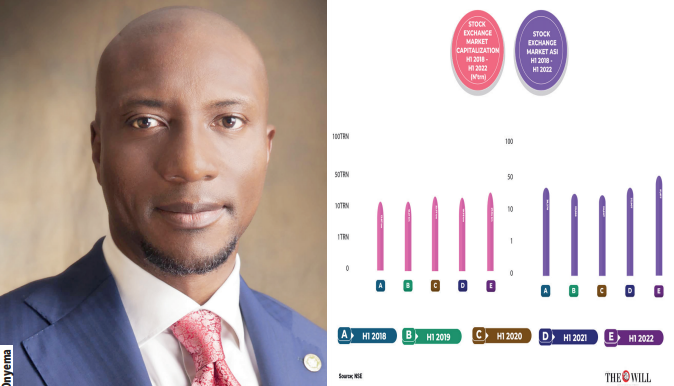
July 03, (THEWILL) – Nigeria’s equity investors witnessed a bumper harvest of N27.94 trillion in market capitalisation in the first half of the year (2022), creating N4.75 trillion or 21 percent returns for the profit hunters compared with N23.19 trillion the market opened with on January 4, 2022. This was the offshoot of an unprecedented bullish trend that pushed the market to a height never recorded since the 2008/2009 global crisis with the All-Share Index (ASI) rising to 51,817.59 from 43,026.23 at the beginning of the year’s trading.
The equity market indicators also revealed a sustained bullish trend year-to-year as investors gained N8.18 trillion or 41.4 percent returns compared with N19.77 trillion market capitalisation and ASI of 37,907.28 in H1 2021. Investigation revealed that the nation’s bourse had not recorded a premium height in market growth even before the 2008/2009 global financial crisis during which ASI fell from a height of 66,000 basis points in March 2008 to less than 22,000 points by January 2009. Over N8 trillion or 70 percent of the total market capitalization of the Exchange was wiped out during the period.
Thriving in Anomalies?

The high performance of the equity market has remained baffling to many especially since the historic 2020. Many observers are still perplexed over the unusually bullish trend that earned Nigeria the best performing stock exchange in the world in 2020 – a year that businesses experienced the worst operating environment. By conventional wisdom, the stock market is a barometer of the economy.
As an important component of a country’s economic and financial set-up, stock markets reflect and mirror the conditions of an economy at a given time. They are termed “barometer” because changes in the stock market index are indicative of the concurrent changes in the economy.
Some market watchers and stakeholders wonder if the market operators descended from an environment that shares no neighbourhood with Nigeria as all the economic indices work against the country. Inflation has hit an all-time high of 17.71 percent with the local currency exchanging for over N600 per Dollar in the parallel market amid severe forex shortage.
The unruly trajectory of insecurity has remained the buzzword with rallying cry and refrain which suggest that the country is heading towards an unimaginable precipice. Multiple and high exchange rate regimes have left investors spooked, putting a damper on the inflow of foreign capital into the economy. There is low production capacity exacerbated by an unprecedented high cost of food and diesel – two basic factors that drive GDP growth and production.
Trapped in such a frightening socio-economic scenario, therefore, for Nigeria to emerge the best performing stock exchange in the world deserves some interrogation. At least, it will assist in enlightening the minds of the ‘uninitiated’ who are battling with the paradox and, also, watching the complex interplay of the stock market fundamentals from the sidelines. As of May, 2022, Nigeria’s stocks emerge Africa’s best performers with 24 percent returns that beat market expectations.
Factors Behind Market Surge
Several reasons account for Nigeria standing like an oasis in the desert during the COVID-19 ravaged year among global stock markets which has remained in the equity market.
First was the sudden bullish trend created by the exodus of investors from the low interest environment of the fixed income market. The Nigerian government had ‘decreed’ low-yield returns for the T-Bills and Bonds instruments. This, in its wisdom, was to discourage the influx of investors to the safe haven of the fixed income market incubating idle assets.
The low-yield interest rate environment ignited an increase in stocks’ valuation leading to a good number of stocks recording price gains compared to their pre-rally status. This included stocks outside the bellwether group such as insurance which used to flood the dormant equities and ‘kobo’ stock league. Not less than 30 stocks were identified among those that rewarded investors with impressive returns year-to-date; occasioned by the “induced” rally in the stock market. In other words, many dead stocks resurrected and injected more strength into the raging bull at a time many expected the bear to dominate the stage.
Another factor that led to the stock market quantum leap in 2020 was the palpable ‘frustration’ of foreign investors who could not access foreign exchange (forex) to repatriate their profits or import raw materials. They “had no better choice than to reinvest in the stock market”, said Uche Uwaleke, Professor of Capital Market at Nasarawa State University. Evidently, the biting forex scarcity discouraged investments even in the real sector.
Other factors, according to Uwaleke, include the favourable prices of oil in the international market which has boosted the share price of many quoted companies.
“I attribute the positive sentiments that prevailed in the last six months to a Favourable International crude oil price which boosted share prices of companies in the oil and Gas sector like Seplat. The Russian Ukrainian crisis chiefly accounts for the surge in crude oil prices.
“Positive GDP growth reflecting in particular in the Telecom sector where stocks like Airtel Africa and MTNN have largely benefited. There is also a trend of relatively strong external reserves which has sustained the interest of some foreign investors in our markets. Furthermore, CBN’s accommodative monetary policy reflected an MPR which was held constant at 11.5% from September 2020 until May 2022 when it was increased to 13.5%. Associated with this is relatively low fixed income returns to the advantage of the equities market,” Uwaleke told THEWILL in a note.
The Doyen of the Stockbrokers and Director at UIDC Securities Limited, Mr Sam Ndata, attributed the surge in the equity market to the current political season which has seen a high level of election-related spending. Ndata told THEWILL by telephone that many politicians are rushing to the capital market to “hide” their election-related loot as a sure way of safeguarding their assets. “It happens every political season. Some of the politicians receive the election windfall and squander it, but the wise ones will hide them in the capital market.”
Impending Moment of Reality
Experts believe that the current bullish trend in the Nigerian equity market is not indicative of a strong, productive economy. They believe that the continued shortage of dollars and high exchange rate force investors to the equity market, hence the surge does not reflect in the overall economy. They predict a quick reversal to reality when the economic uncertainties give way.
“I attribute the positive sentiments that prevailed in the last six months to a Favourable International crude oil price which boosted share prices of companies in the oil and Gas sector like Seplat. The Russian Ukrainian crisis chiefly accounts for the surge in crude oil prices.
“Positive GDP growth reflecting in particular in the Telecom sector where stocks like Airtel Africa and MTNN have largely benefited. There is also a trend of relatively strong external reserves which has sustained the interest of some foreign investors in our markets. Furthermore, CBN’s accommodative monetary policy reflected an MPR which was held constant at 11.5% from September 2020 until May 2022 when it was increased to 13.5%. Associated with this is relatively low fixed income returns to the advantage of the equities market,” Uwaleke told THEWILL in a note.
The Doyen of the Stockbrokers and Director at UIDC Securities Limited, Mr Sam Ndata, attributed the surge in equity market to the current political season which has seen a high level of election-related spending. Ndata told THEWILL by telephone that many politicians are rushing to the capital market to “hide” their election-related loots as a sure way of safeguarding their assets. “It happens every political season. Some of the politicians receive the election windfall and squander it, but the wise ones will hide them in the capital market.”
“Be that as it may, the second half of 2022 may witness bear sentiments on account of increased fixed income returns following the recent hike in MPR by the MPC of CBN. Rising inflation rate which is detrimental to investment in the capital market is another factor that could reverse the bullish trend.
“We also need to consider the weakening naira and external reserves depletion due, in part, to activities of politicians as well as the uncertainties associated with increasing political activities,
“Rising insecurity, energy and transport costs which negatively affect companies bottom lines ultimately and the widening government deficits from increasing fuel subsidy leading to further government borrowing which drives up interest rates in the process, remain challenges are there too.
“Furthermore, interest rates normalisation in developed countries especially in the USA and UK resulting in capital outflows from developing countries including Nigeria are issues that we need to bear in mind,” Uwalekle said.

Sam Diala is a Bloomberg Certified Financial Journalist with over a decade of experience in reporting Business and Economy. He is Business Editor at THEWILL Newspaper, and believes that work, not wishes, creates wealth.