
Driven by unmatched resolute domestic players who took position as fortune-hunting foreign investors fled, Nigeria’s local bourse hit the historic peak of its performance in the first half of the year (H1 2023).
At the close of the trading session on Friday, June 30, 2023, the last trading day of H1 2023, the market’s benchmark performance indicators – Nigerian Exchange Limited (NGX) All-Share Index (ASI) and its market capitalization – increased significantly to 60,968.2 basis points and N33.2 trillion, respectively.
This represents an overall year-to-date gain of 18.96 percent, compared with 51,251.06 basis points and N27.92 trillion capitalisation that the market opened with on the first trading day of January 3, 2023. It also confirmed investors’ gain of N5.3 trillion during the period.

Despite the rising inflation, interest rate hike, and naira redesign-induced cash crunch , equity investors, majorly domestic players, increased their buying pressures and listing in the local bourse in an unusually resolute manner.
“You cannot understand the market; it is the more you see the less you understand because those who put their money there are not just ordinary persons. The market is complex, deep and wide. What is driving Nigeria’s equities market at this time is something one needs to really understand,” said Dr Paul Uzum, a stockbroker.
Besides buying pressure, investigation showed that no less than N8 trillion was added to the equities market through new listings by eight indigenous firms after the foreign investors had begun to desert the local bourse, following the advent of COVID-19 in 2020.
The companies include Access Corporation (N562 billion), BAPlc (N62,5 million), Bua Cement (N3.31 trillion) and Bua Foods (N3.44 trillion).
Others are Geregu (N750 billion), GTCO (N1,030 trillion), Ronchess Global (N223.6 billion) and Sterling Financial Holdings (N74.3 billion).
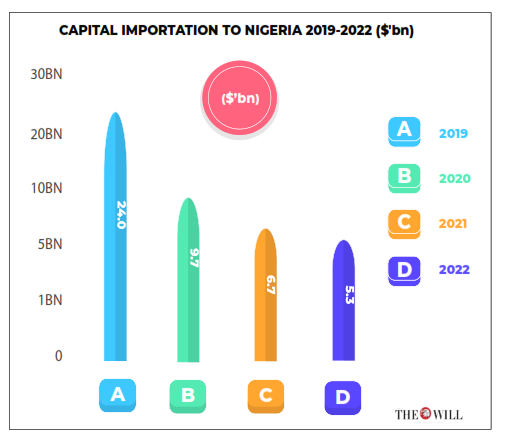
Investigation showed that investment inflow (capital importation) to the economy declined by 78 percent between 2019 and 2022, as follows: $24 billion, $10 billion, $5.7 billion and $5.4 billion in 2019, 2020, 2021 and 2022 respectively, according to data by the Nigerian Exchange Group (NGX).
The 2023 trading year was preceded by a massive capital withdrawal by foreign investors who, apparently, were apprehensive over the outcome of the 2023 general election.
The NGX revealed in its foreign portfolio report in December 2022 that foreign investors withdrew a total sum of N171 billion from the capital market between January and October that year. The investors also invested N171.3 billion during the period, which implies that these portfolio investors left just N6.83 billion in Nigeria equities.
In 2022, the foreign portfolio investors (FPI) staked N156.3 billion and took away N173.32 billion. The monthly breakdown showed that in January 2022, foreigners invested N18.10 billion in stocks but took out N23.21 billion from the market.
They brought in N20.86 billion and took out N24.57 billion in February. In March, foreigners invested N16.37 billion in Nigerian stocks but took out N25.80 billion.
In April, capital inflows to the market amounted to N15.02 billion while N12.06 billion was taken out of the market by foreign portfolio investors. Similarly, the foreigners invested N25.53 billion in Nigerian stocks in May and took out N19.7 billion.
The rocky transactions continued in June when the foreigners invested N24.63 billion in stocks and withdrew N17.56 billion from the market. The summary of stock transactions as of November 30 showed that foreign inflows into the stock market were worth N13.68 billion while the foreign outflow was N16 billion
The foreign inflow into the Nigerian capital market was N15.78 billion while N12.43 billion was recorded as an outflow by foreign investors in August. In September, foreigners invested N10.08 billion in the stock market but moved N9.59 billion out of the market while in October they invested N18.16 billion in stocks but went away with N10.39 billion.
The Doyen of Nigerian Stockbrokers, Sam Ndata, said the bullish trend in the Nigerian equities market cannot be unconnected with political activities that heightened in 2022, culminating in the general elections in the first quarter of 2023.
According to Ndata, the flock to the equities market was expected because it has been the trend during election seasons when there is a lot of cash in circulation. He said the Central Bank of Nigeria (CBN) tight monetary policy could not dampen the move to the equities market because of the circumstances surrounding the source of the funds.
“It is usual at every election season; we saw a similar trend in the elections that enthroned former President Muhammadu Buhari in 2015 and 2019 when politicians had a lot of cash at their disposal.
“The politicians are no longer interested in buying houses or dumping their money in their bank accounts. In order to run away from the prying eyes of the anti-graft agencies, they consider it wise to put their money in stocks where it is safe and covered,” Ndata said in a telephone chat.
He noted that this period is off-season in terms of dividend payment expectations. So there can be no better way to explain the unusually bullish trend of the local bourse than to see the attitude of politicians during election seasons.
Analysts believe that the local bourse will continue to soar in the second half of the year which coincides with the fourth quarter when buying pressure is intensified to position for the earning season. Investors target the listed companies with good dividend-paying history.
In the just ended week, the local equities closed the session stronger, bringing the All-Share index up by 1.43 percent to settle at 60,968.27 points. Notably, having gained in all three trading sessions of the week, the ASI closed 2.92 percent higher week-by-week, extending gains for the sixth consecutive week.
Analysis of last Friday’s market activities showed trade turnover settled higher relative to the previous session, with the value of transactions up by 27.30 percent. A total of 998.08 million shares valued at N15.96 billion were exchanged in 10,580 deals.

Sam Diala is a Bloomberg Certified Financial Journalist with over a decade of experience in reporting Business and Economy. He is Business Editor at THEWILL Newspaper, and believes that work, not wishes, creates wealth.
