
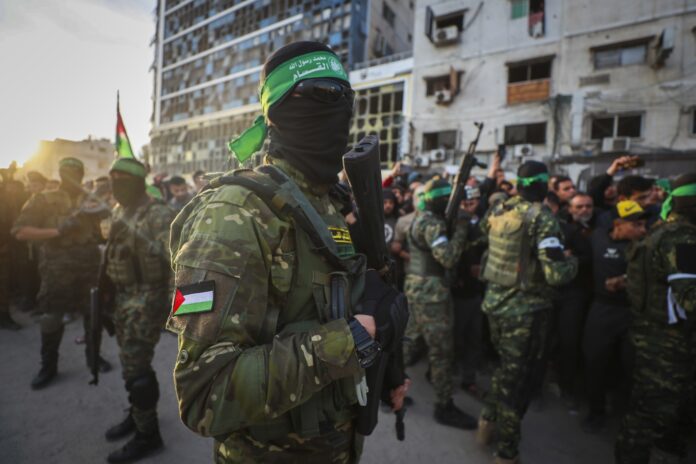
July 6 (THEWILL) — The Palestinian militant group, Hamas, on Monday announced the dissolution of the governing body that has administered the Gaza Strip for nearly two decades, ending its 19-year rule of the enclave and paving the way for a technocratic civilian administration.
The move marks Hamas’ most significant political concession since it seized control of Gaza from the rival Palestinian movement, Fatah, in 2007, following its victory in the 2006 Palestinian legislative elections.
The decision is expected to facilitate the transfer of civilian governance to the National Committee for the Administration of Gaza (NCAG), a technocratic body established under the ceasefire framework brokered by United States President Donald Trump in October 2025.

Announcing the development, Head of Hamas’ Government Media Office, Ismail al-Thawabta, said the head of the government’s emergency committee, Mohammed al-Farra, had formally resigned and dissolved the committee to enable the transition.
“The head of the government’s emergency committee, Mohammed al-Farra, has officially submitted his resignation. He has also decided to dissolve the committee to facilitate the administrative and governmental transition to the National Committee for the Administration of Gaza,” al-Thawabta said.
The emergency committee had overseen Gaza’s civil administration during the conflict with Israel and following the ceasefire that came into effect in October 2025.
Hamas spokesman Hazem Qassem described the dissolution as a strategic step aimed at removing obstacles to a political settlement and demonstrating the group’s readiness to relinquish day-to-day governance.
“Hamas has taken a new step in that it will no longer be in charge of the Gaza Strip, in order to remove any pretexts for the occupation, which continues its aggression and war of extermination.
“We hope for the swift entry of the National Committee for the Administration of Gaza, and Hamas affirms its readiness to hand over governmental responsibilities to the committee to ensure its success,” Qassem said.
According to Hamas officials, the decision was communicated to other Palestinian factions during recent talks in Cairo, where Egyptian and other regional mediators have continued efforts to preserve the ceasefire and advance negotiations on Gaza’s political future.
A Hamas official said the factions welcomed the decision, describing it as a serious step towards enabling the National Committee to assume responsibility for governing the territory.
The NCAG, headed by Palestinian technocrat Ali Shaath, was established to oversee Gaza’s civilian administration and reconstruction in the post-war period.
However, the committee has remained outside the enclave for months, reportedly due to Israeli objections to its deployment.
The announcement comes as negotiations over the second phase of the Gaza ceasefire remain at an impasse.
The first phase of the truce saw the release of the remaining Israeli hostages held by Hamas in exchange for Palestinian prisoners detained by Israel.
The planned second phase envisages the gradual withdrawal of Israeli forces from Gaza, discussions on Hamas’ disarmament, and the establishment of a long-term governance arrangement for the territory.
However, the process has stalled for months. Israeli forces have expanded their presence across Gaza and now reportedly control nearly 70 per cent of the territory.
While Israel insists Hamas must be disarmed and excluded from any future governing structure, the group maintains it will only consider relinquishing its weapons after a recognised Palestinian administration has been established.
Israel has also rejected an immediate return of the Palestinian Authority, based in Ramallah, to govern Gaza, leaving the question of post-war governance one of the most contentious issues in ongoing ceasefire negotiations.

Felix Ifijeh is a journalist with years of professional reporting experience. Known for his keen news sense, compelling storytelling and commitment to accurate, impactful reporting, he has built a reputation for turning leads into clear, engaging, and well-structured reports that resonate with readers. His work reflects deep newsroom experience and a commitment to accurate, impactful journalism.
