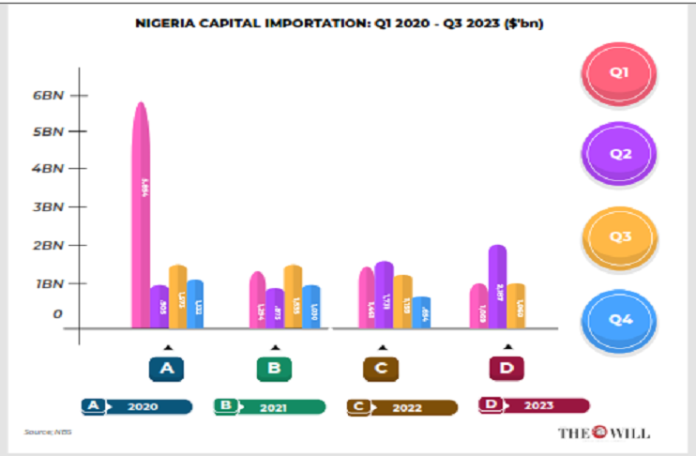
January 07, (THEWILL) – Despite housing the largest natural gas reserves and significant crude oil deposits in Nigeria, Imo state, in South-east region, attracted zero foreign investment in four years, between 2020 and 2023, according to data by the National Bureau of Statistics (NBS).
The NBS in its quarterly Capital Importation reports showed that, after recording the sum of $3 million in 2019, Imo had no dime to its name by way of investment inflow to the state during the reference period.
The reports further revealed that Imo was the only oil-producing state in the South-east region that attracted no foreign investment for the four years under review, unlike its two counterparts – Anambra and Abia states which achieved a total of $51.48 million and $210.12 million, respectively.

The reports did not offer details of the investments to the states by sectors and products. However, Abia recorded the highest bulk of $150.09 million investment inflow in the third quarter of 2023, after the inauguration of Mr Alex Otti as the elected 4th governor of the state in May 2023.
Imo’s unimpressive situation is more worrying on the ground that the state is known for its largest natural gas reserves in the country and in West Africa, which is the source of commercial supplies to Lagos and other upcountry locations. Imo gas is the major source for the Lagos Gas Company that feeds many companies, households and large establishments up to the Agbara industrial zone in Ogun State.
Also, The widely celebrated NNPC’s 615 km AKK Gas pipeline project from Abuja to Katsina through Kano and beyond, via the gathering facilities all through Kogi state,.will be fed largely with gas sourced from Ohaji-Egbema Local Government Area of Imo State, known for its abundant gas deposit,
“Imo’s huge oil and gas deposits constitute an unprecedented economic asset that no other South-east state can boast of. So, for Imo to be lacking in foreign investment in oil, gas and other natural resources is a huge disappointment,” said Engr. Gregg Amadi, an oil and gas operator.
Amadi’s position re-echoes in the statement by the former Minister of State for Petroleum, Chief Timipre Sylva. According to Sylva, Nigeria has nearly 300 trillion cubic feet of natural gas reserves, ranking 9th in the world, with Imo holding the largest reserve amongst all Nigerian states.
“Imo state with 200 trillion cubic feet of gas deposits should be set for economic boom,” Sylva said during a visit to the Imo Governor, Hope Uzodinma, in April 2021. Although, major oil and gas companies have presence in Imo, the NBS reports indicate that the state does not serve as the operators’ investment destination. The companies include Shell Nigeria Gas Limited, Ashland Oil Nigeria Limited and Seplat Energy Plc..
Amadi said the oil and gas firms use Imo as their outpost while their operational bases are in Port Harcourt or Lagos. “That is why Imo records zero foreign investment,” he opined. But the fact that states like Akwa Ibom, Rivers, Ogun, Oyo, Adamawa and many other non-oil producing states record investment inflow contradicts Amadi’s claim.
Among the major gas facilities in Imo is the ANOH Gas Processing Plant development at OML 53 (and adjacent OML 21) operated by Seplat Energy, which the firm said would drive the next phase of its growth in expanding the gas business. The project which comprises a Phase One 300MMscfd midstream gas processing plant has been concluded and is awaiting commissioning.
The gas plant located in OML 53, Niger Delta, is expected to deliver dry gas, condensate, and Liquefied petroleum gas (LPG), and otherwise known as cooking gas, to customers locally and internationally.
Chioma Afe, Director, External Affairs and Social Performance, in a statement on NGX, said the ANOH gas plant installation works reached mechanical completion on December 29, 2023, in line with its revised timetable.
ANOH is one of Nigeria’s most strategic gas projects. Experts say it will help the country to accelerate its transition away from small-scale diesel generators to cleaner, less expensive fuels such as natural gas for power generation. With such a significant project, stakeholders are concerned that Imo would be shunned by strategic investors, especially in the oil and gas sector.
The dearth of investment inflow impacts on the employment status of the state. For most of 2020, available data by the NBS showed that Imo was plagued with high unemployment rate among the 36 states of the federation and the Federal Capital Territory (FTC).
“Under State disaggregation, Imo State reported the highest rate of unemployment with 48.7 per cent, followed by Akwa-Ibom State and Rivers State with 45.2 per cent and 43.7 per cent, respectively. The State with the lowest rate was Anambra in the South-East with 13.1 per cent”, the NBS stated in its Q2 2020 Labour Statistics Data of Employment and Unemployment report.
Like the curiosity that underlines the dearth of foreign investment in a state of abundant oil and gas deposits, the high unemployment rate in Imo does not align with the numerous presence of hotels that flood Owerri, the capital.
Experts confirm that Owerri has the highest density of hotels among Nigerian cities with the exception of Lagos and the FCT; these hotels are highly patronized and fully booked, especially during weekends.
A Professor of Economics at the Imo State University, Owerri, who would not want his name disclosed, told THEWILL in a telephone chat in December 2023, that the flood of hotels do not impact on the economy of Imo because, according to him, “they are run remotely’ from other parts of the country, especially Port Harcourt.
“The people interacting with the hotels are strangers, mainly from the Niger Delta cities of Port Harcourt and Warri, and also Lagos and Abuja. They do not live in Owerri, so their patronage is relatively ephemeral. The facility owners do not invest their profits in Imo, they use it to expand their businesses in other parts of the country because of the toxic operating environment.
He added that hotels in Owerri attract large clientele owing to the amoral culture for which the place is widely known. “Owerri has the highest concentration of educational institutions among Nigerian cities, making it a huge provider of sensual escapades which also attracts other sensual practitioners from other parts of the country.
“Here you have the Federal University of Technology, Owerri (FUTO), Imo State University (IMSU), Alvan Ikoku University of Education (AIUE), Federal Polytechnic, Nekede, Imo Polytechnic, Umuagwo, Schools of Nursing and various secondary schools supplying beautiful women to a mass of fun-seekers.”
Engr Amadi argued that even if the hotel operators and their customers are mainly strangers, the state would benefit from the booming hospitality business through direct and indirect employment and tax revenue to the government. In his view, Imo suffers from dearth of investment inflow because of its notoriety as the epicentre of insecurity in the South-east.
Insecurity has escalated in Imo since 2020, scaring genuine investors, including Imo indigenes who are eager to relocate home from other parts of the country. “No sensible investor will make Imo a preferred destination because of the high level of insecurity in the place. Imo is terribly insecure,” Amadi said.
During his election campaigns last year, Governor Uzodinma who will be inaugurated this month (January) for a second term, publicly promised to send 4,000 Imo youths abroad (Europe and Canada) to earn a living under an arrangement he claimed he had concluded with “some foreign companies”.
“That shows you the quality of leadership in a state that thirsts for foreign investment. Does that speak of Imo as a place that serious foreign investors would patronise?” Amadi queried.
While the Deputy Speaker of the Imo House of Assembly, Amarachi Iwuanyanwu lauded Governor Uzodinma over his promise to facilitate the employment of 4,000 Imo youths abroad, the candidate of the Young Progressives Party (YPP) in the November 11 governorship election in Imo State, Dr. Kemdi Opara described the promise as a deceitful gimmick.

Sam Diala is a Bloomberg Certified Financial Journalist with over a decade of experience in reporting Business and Economy. He is Business Editor at THEWILL Newspaper, and believes that work, not wishes, creates wealth.