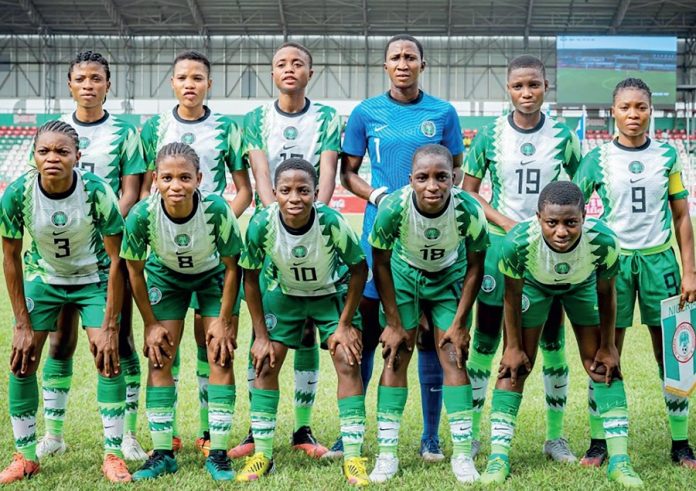
August 31, (THEWILL) – The Flamingos, Nigeria’s Under-17 national female football team, were held to a goalless draw by Ethiopia in the second leg of the World Cup qualifiers played on Saturday, June 4, inside the MKO Abiola Stadium in Abuja, and qualified for the World Cup with a 1-0 lead on aggregate over both legs. It was a sensational qualifying run for the young girls. They had played six qualifying games and remained unbeaten during that time, scoring 15 goals without ever conceding. They therefore qualified as one of three teams to represent Africa at the October 11-30 FIFA U-17 Women’s World Cup in India.
However, recent events in India have threatened the hosting of the event this year and with FIFA’s involvement there is a lasting hope that all the pending issues will be resolved before due commencement date so that the brilliant efforts the girls have put into qualifying will reap fruits on the global stage of youth football.
Since its debut in 2008, the U-17 national teams of FIFA member associations have competed in the FIFA U-17 Women’s World Cup, which, as noted above, will take place in India again this year. At least, that was the expectation before last month. With the goal of making it to the World Cup, to improve on the performance in the Jordan-hosted 2016 edition, where the Flamingos were eliminated in the first round after placing last in Group C, which also included North Korea, Brazil and England and earning just one point from its three games, the current crop of young girls, under the supervision of coach Bankole Olowookere, were determined and resilient from the start of the qualifying series to the very end for a perfect record.

After missing the 2018 edition in Uruguay, there was a dedication in the team to truly represent the football chops the country has been known for on the continent in age-range competitions.
This commitment was evidently displayed in two of their qualifiers. Nigeria won 5-0 against DR Congo to move on to the World Cup third qualifying round. The outcome gave the West Africans an 8-0 aggregate win after they won the opening leg 3-0 in Kinshasa on March 6. At the Samuel Ogbemudia Stadium, the Flamingoes wasted no time in scoring, with Opeyemi Ajakaye scoring as early as the fifth minute. Ajakaye quickly increased the hosts’ lead in the 14th minute by taking advantage of a defensive error by the Congolese. With the third goal scored by Oluwatunmininu Adesina in the 23rd minute, it was obviously a poor day out on the pitch for DR Congo. Doosur Atume scored the fourth goal for the Flamingoes in the 62nd minute, and Taiwo Afolabi added the last goal with two minutes remaining to seal the decisive victory.
For a much stiffer test, the Flamingos were pitched against the Egyptian national side in the final tie of the third round. But the Egyptian girls received no leniency from the flamingoes. Ajakaye’s goal in the 28th minute gave the Flamingos the lead after a shaky start.
The Flamingoes increased their advantage in the 38th minute, and they went into halftime with a two-goal lead. In the 54th minute, Miracle Usani of the Flamingoes blasted a low shot in for the third. Omowunmi Bello scored her second goal of the series and the fourth goal for the Flamingos by shooting past the charging Egypt goalkeeper in the 62nd minute. Ajakaye even added a fifth, but the goal was disallowed for offside. In the return leg, held on the night of Saturday, April 30, at the Petrosports Stadium, Cairo, two early goals from serial goal-scorer Ajakaye and Bello sealed victory Bankole Olowookere’s girls seeing them through to the final round of the series where they met and best Ethiopia to secure their ticket to India.
However, over at India, trouble was brewing and putting the World Cup hosts in jeopardy. The All India Football Federation (AIFF), which is in charge of football governance in the country, was suspended by the world football governing body, FIFA, on Monday, August 16 due to “third party” interference. The FIFA statement read: “The Bureau of the FIFA Council has unanimously decided to suspend the All India Football Federation (AIFF) with immediate effect due to undue influence from third parties, which constitutes a serious violation of the FIFA Statutes.
The suspension will be lifted once an order to set up a committee of administrators to assume the powers of the AIFF Executive Committee has been repealed and the AIFF administration regains full control of the AIFF’s daily affairs. The suspension means that the FIFA U-17 Women’s World Cup 2022, scheduled to take place in India on 11-30 October 2022, cannot currently be held in India as planned. FIFA is assessing the next steps with regard to the tournament and will refer the matter to the Bureau of the Council if and when necessary. FIFA is in constant constructive contact with the Ministry of Youth Affairs and Sports in India and is hopeful that a positive outcome to the case may still be achieved.”
It was FIFA’s reaction to decision of India’s highest court to disbanded the All India Football Federation (AIFF) in May, which it followed with the appointment of a three-member committee to govern the sport. What the grouse is refers to FIFA’s culture of non-interference by government in football administration. FIFA therefore views India’s court-appointed administrators’ committee having a voice in how Indian football is handled as outside meddling and claims that having an equal number of prominent athletes and state association delegates in the electoral college is “not a prudent idea.”
In an effort to ameliorate the effects of the ban, FIFA and the Asian Football Confederation (AFC) have met Indian football stakeholders and laid down a roadmap for the AIFF to change its rules by the end of July and hold elections by 15 September.
Like the majority of international sports governing bodies, FIFA forbids outside influence on the national governing bodies. The possibility of a ban has grown increasingly real ever since the Indian Supreme Court removed the Praful Patel-led football body and established the three-member CoA to implement the National Sports Code-compliant modifications. The new National Sports Code prevented Patel, a seasoned adminstrator who had served as AIFF president for the previous 13 years, from running for reelection.
Now, FIFA’s opposition to having a body chosen by the Supreme Court oversee the nation’s sports is putting Indian football at risk. India’s Gokulam Kerala qualified for the AFC Women’s Club Championship for a second successive season after winning the Indian Women’s League in May. However, the Kerala-based side had to return home on the Monday that the ban was announced, from Uzbekistan because it was removed from the AFC Women’s Club Championships following the ban. The 23-member team, led by India captain Ashalata Devi, were left stranded in Tashkent for six days since arriving at the Uzbekistan capital on August 16, the day the news of the ban imposed on the AIFF by the world governing body FIFA reached India.
As part of moves to have the ban removed, the Indian government made an urgent request in the Supreme Court for an early hearing to resolve the issue on August 16. The next day, the Supreme Court set the hearing on the matter for Monday (August 22) on Solicitor General Tushar Mehta’s request and requested the Union of India to take proactive measures to ensure holding of the Women’s U-17 World Cup and lifting the suspension on AIFF are duly achieved. Yet, there are indicators that FIFA will require before lifting it such as the Repeal of the CoA mandate in full, the restoration of full administration to the AIFF, the revision of the AIFF constitution in accordance with the requirements of FIFA and the AFC and to be approved by the AIFF general assembly without interference from any third party, the setting up of an independent electoral committee to be elected by the AIFF general assembly to run the elections of a new executive committee and due the AIFF to carry out the upcoming electoral process as per the statutory requirement while holding its elections based on the pre-existing membership structure of AIFF (i.e. state associations only).
Hopefully, the parties involved can get this sorted out on time so that the U-17 World Cup, which was moved from 2020 due to the coronavirus pandemic can be held as scheduled and the Flamingos can continue on in the impressive pattern of Nigerian women athletes this year.