– Indicts Sterling Exploration, Military, Government Officials
– Says Many Operators Circumvent Metering at Flow Stations
– Controversy Over RMAFC’s Decision to Delay Release of Findings
April 12, (THEWILL) — A recent investigation has uncovered the extensive siphoning of Nigeria’s oil and gas resources through well-coordinated economic crimes mostly involving independent oil and gas operators in collaboration with cartels, rogue government officials and military personnel.
These corrupt activities are exposed in an official 187-page document, which was compiled in January 2026 by a government-appointed inter-agency committee to investigate reports of the illegal activities and oil well disputes among the states, THEWILL checks can confirm.

Titled ‘Report of The Inter-Agency Technical Committee (IATC) On the Verification of Crude Oil And Gas Wells Coordinates Of Disputed Oil And Gas Fields/Wells And Newly Drilled Oil And Gas Wells From 2017 To December 2025,’ the document details the multiple criminal activities in the sector, which largely contributes to the country’s inability to achieve crude oil production targets or meet its Organisation of Petroleum Exporting Countries, OPEC, production quota and overcome chronic revenue deficits due to insufficient oil production.
THE AGENCY
As part of an extensive and aggressive investigation of oil theft being pursued by the Federal Government through a combination of military operations and controversial private pipelines surveillance contracts to curb massive revenue losses, the Inter-Agency Technical Committee (IATC), was inaugurated on June 18, 2025 by the Revenue Mobilisation Allocation and Fiscal Commission (RMAFC) with personnel drawn from the RMAFC, National Boundary Commission (NBC), the NUPRC, Office of the Surveyor-General of the Federation – OSGoF, and the Surveyor-General of all the affected states as observers in the conduct of the Committees activities.
The Committee’s terms of reference, which included critical examination and verification of the crude oil and gas well coordinates submitted to the Revenue Mobilisation Allocation and Fiscal Commission by the Nigerian Upstream Petroleum Regulatory Commission (NUPRC) through on-site visits to oil company locations on land, in creeks and offshore, made mind-boggling findings on the serious acts of economic sabotage going on in the oil and gas sector.
THE FINDINGS
Among the violations are well-orchestrated inconsistencies in the number of producing crude oil and gas wells reported by the companies to the Nigerian Upstream Petroleum Regulatory Commission (NUPRC), in comparison with the actual figures obtained in the field. Also, it revealed unaccounted production of crude oil and gas wells clandestinely managed by numerous companies, which is not reflected in the data provided to the authorities, resulting in loss of huge revenue to the government.
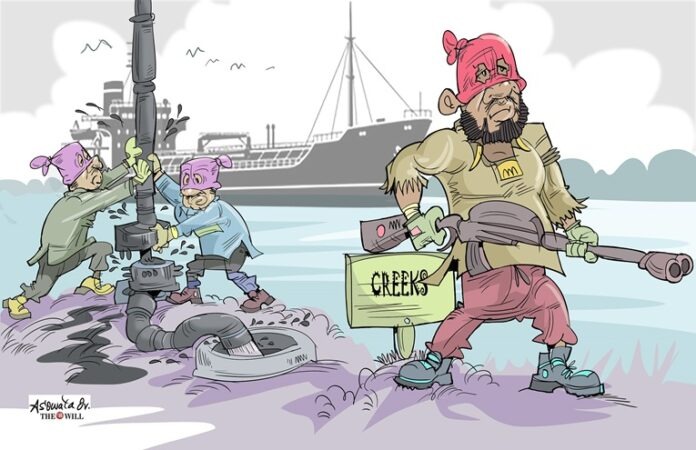
The report noted instances of covert loading of crude oil cargoes in the creeks, using vessels that are untracked and monitored. It noted instances where crude is pumped into waste pits and thereafter siphoned using trucks.
It added that in many instances, trucks are utilised to transport crude oil production from the companies’ flow stations to export terminals without sufficient tracking and oversight by relevant agencies through which huge quantities of crude are stolen daily.
Citing specific cases, the report highlighted the oil fields where the discrepancies were identified, noting that “there is variance in the numbers of crude oil and gas wells submitted by the companies to NUPRC, compared to what was obtained on the fields (Anieze, Ameshi, Enyi and Oguali oil fields etc).”
The report noted that many flow stations of the marginal field operators are not metered adding that there are serious infrastructure decays in the offshore assets. “Large numbers of the crude oil and gas wells visited were to be revamped, shutdown due to oil thefts or capped. This is worrisome, for instance, OMLs 70 and 100 are producing at 35 per cent capacity,” it said.
It noted that the companies use tons of cubic gas produced for well reinjection, energy generation for their facilities, power their CNG vehicles without any records of utilisation and payments, while the rest are wasted in flaring, citing several companies.
The findings indicted some companies for relying on measurement mechanisms of third-party Floating Storage and Offloading facility (FSO) to take measurement of discharged crude oil cargo to the transporting vessels without having meters at the main pumping stand of the flow station. These procedures, it said, constitute bottlenecks to government officials eager to have accurate records of production. “This procedure encourages manipulations,” it said.
The report stated, “That there is unaccounted production of the crude oil and gas wells discovered during the verification exercise.
“That metering systems are not installed at many of the flow stations of the marginal field operators.
“That there are serious infrastructure decays in the offshore assets.
“Large numbers of the crude oil and gas wells visited were to be revamped, shutdown, oil thefts, or capped. This is worrisome, for instance, OMLs 70 and 100 are producing at 35 per cent capacity.”
It noted that some operators use tons of cubic gas produced for well reinjection, energy generation for their facilities, power their CNG vehicles without any records of utilisation and payments while the rest are wasted in flaring.
“That some companies relied on measurement mechanisms of third-party Floating Storage and Offloading facility (FSO) to take measurement of discharge crude oil cargo to the transporting vessels without having meters at the main pumping stand of the flow station. These procedures create a bottle neck to government officials to have accurate records of the production,” the report said, adding that, “This procedure encourages manipulations.”
THE CASE OF STERLING EXPLORATION
Notably, the report indicted Sterling Exploration and Energy Production Company (SEEPCO) Limited, operator of OML 143 which has two flow stations located in the Kwale area of Delta State, for alleged crude theft and fraud.
It said the monitoring vacuum has emboldened companies to operate with impunity, enriching a small network of collaborators like SEEPCO, which the IATC identified as a major deviant.
“The operators, including SEEPCO and others, openly claimed to the IATC that they maintained influence at the Presidency and that the IATC findings would have no impact on their operations…
“The IATC met overt hostility from the operator’s administrative staff, who were of Indian origin. These individuals occupied key positions within the company’s senior management structure, while their Nigerian counterparts appeared marginalized, with little or no influence over administrative or production control decisions.
“The company’s operations characterized by excessive secrecy, questionable business practices, and an atmosphere of intimidation. Staff members exhibited visible fear of job loss whenever approached by the IATC and were unable or unwilling to respond to inquiries, the level of operational opacity and misconduct observed was alarming. The company deliberately concealed the locations of crude oil and gas wells from the IATC and, on separate occasions, abandoned the team in remote forested areas and withdrew its oil stations staff and company security personnel. The IATC acknowledges the effort of the Nigerian Army for providing adequate security coverage and preventing interference from individuals mobilized by SEEPCO to obstruct the exercise.
“The IATC directly observed extensive corrupt practices across all facilities managed by SEEPCO. These activities amount to economic sabotage, extending beyond Delta State to all assets operated by the company nationwide. The Committee stands ready to substantiate these findings and provide testimony where required. The operation of SEEPCO in Nigeria’s oil and gas sector is laced with pervasive and systemic fraud,” it noted.
ISSUES OF ‘PARTICULAR CONCERN’
The Inter-Agency Technical Committee, IATC, also found alarming security breach and compromise of maritime oversight regarding the activities of well-organised oil merchant syndicates employing sophisticated equipment and vessels to load crude oil directly from the wellheads in the offshore crude oil facilities.
“The IATC observed that such activities could not occur without the complicity of certain individuals or stakeholders, including operators, merchants and security personnel, etc. The entry of vessels into Nigerian territorial waters without the knowledge of the Nigerian Navy represents a serious breach of security and a clear compromise of maritime oversight,” the reports stated. It cited an example to support its findings.
“A notable example of this happened on the OSO platform (Asabo Charley) well jacket. The criminals were arrested with their equipment and vessel, but the IATC were reliably informed that the perpetrators were released based on intervention of authorities from above and the hooligans came back to the same location 2 weeks after their arrest. The Jacket had since been shut down completely due to this incident and it is a “very viable jacket with good production figures” the report revealed on page 23, adding that inadequate or non-use of crude oil and gas metering remains a major source of concern, as the Committee noted.
Curious about this development, the Committee then asked a critical question that amounts to deliberate sabotage. Who is opposing the metering of crude oil production in Nigeria or why is Nigeria’s case different from that of Saudi Arabia and Qatar and other notable countries in the sector?
Its frustration on this matter is obvious: Is the resistance coming from government officials, God-father merchants, international oil companies (IOCs), marginal/indigenous crude oil and gas field operators or non-state criminal actors?
“The continued failure to install crude oil separator systems at oil stations and metering at the crude oil and gas flow stations over the years raises serious concerns about possible complicity among key stakeholders within the sector.”
Although the Committee hailed the transparency in asset declaration in the offshore operations, particularly with respect to well identification, it raised the alarm over the obscurity in production reporting and the movement of crude oil, fearing the safety hazards posed by corroded, poorly maintained platforms and wells jackets classified as non-producing.
It said, “The level of dormant oil and gas wells in the jackets is about 60 per cent and this saddens the heart. If measures are not taken this could lead to a major production collapse in the offshore sector. There is need for the government to engage with the company to discuss the way forward in revamping these dormant oil wells. The offshore operation needs adequate attention and serious rescue.”
MARITIME TERRITORIAL ADJUDICATION
A major milestone in the Committee’s report is the adjudication on the oil well disputes among states – including Akwa Ibom, Cross River, Rivers, Imo and Anambra, which involved the adoption of the Supreme Court judgment that re-defined the country’s maritime territorial arrangement, particularly among the oil producing states.
“The Committee’s engagement was undertaken in compliance with the Supreme Court’s judgment in Suit No. SC.250/2009, which authorised the Revenue Mobilisation Allocation and Fiscal Commission, the National Boundary Commission and the Office of the Surveyor-General of the Federation to ensure that offshore oil wells located between Cross River State and Akwa Ibom State are duly attributed to the state to which they rightfully belong,” the Committee noted.
Among the recommendations based on its latest mapping are those concerning oil well disputes among Akwa Ibom/Cross River, Anambra/Delta, Imo/Rivers, Edo/Delta, Rivers/Delta, Rivers/Akwa Ibom, Rivers/Bayelsa.
RMAFC’s RELUCTANCE REGARDING THE REPORT
Despite the Committee’s damning discoveries, the RMAFC is reportedly reluctant about the report.
Sources familiar with the matter told THEWILL that the Chairman of the RMAFC, Dr. Mohammed Bello Shehu, is blocking the adopting and official release of the report because of its findings and recommendation particularly, with the oil well redistribution to states following the current verification exercise.
“These are the heartless economic saboteurs of this country who would do everything to ensure the system continues to work in the way it will benefit their selfish interests,” a Port Harcourt-based oil service operator who pleaded anonymity told this newspaper. The operator added that most of the companies involved in the fraud are connected to highly placed individuals.
Yet, the Inter-Agency Committee report was signed by 11 of the 14 members of the committee drawn from the participating agencies. In an addendum titled ‘Rejoinder to NUPRC Representatives for Recusing themselves from endorsing the report of the exercise’, the team noted that the two representatives from NUPRC participated adequately in all the processes except in the editing of the report, for which they did not make themselves available despite a proper and due invitation.
“They later requested to read and endorse accordingly, on Monday, February 9, 2026. Upon reading, they informed the Coordinator that the contents of the report were beyond the scope of their operations in the office (NUPRC), and as such they could not append their signatures,” the team noted.
RMAFC REACTS
When contacted, the Head of Media at RMAFC, Mrs Maria Yusuf, responded with a rebuttal of the Inter-Agency report through a statement signed by the Commission’s Chairman, Shehu.
According to her, in a note forwarded to THEWILL, the Commission has carried out its assignment under a clearly defined and transparent procedure and only recently received a draft report from the Inter-Agency Committee on Friday, February 13, 2026.
“Consistent with established protocol, the draft document has been transmitted to relevant technical and statutory stakeholders, namely the Nigerian Upstream Petroleum Regulatory Commission (NUPRC), the National Boundary Commission (NBC), and the Office of the Surveyor-General of the Federation (OSGOF), for detailed review, observations and technical input,” she said, adding that, “following receipt of the observations and recommendations from these agencies, the matter will be subject to further scrutiny by the Commission’s internal tripartite Committees, comprising the Committee on Crude Oil, Gas and Investment and the Legal Matters Committee. These committees will undertake comprehensive technical and legal reviews before presenting their findings to the Plenary Session of the Revenue Mobilisation Allocation and Fiscal Commission for deliberation and final recommendations.”
After these institutional processes, she further said, the Commission’s final report will be formally transmitted to the President and the Attorney-General of the Federation for necessary consideration and further action in accordance with applicable laws and constitutional provisions.
Pleading the Commission’s commitment to transparency and due process, Yusuf urged the public to await official communication from the Commission upon completion of the statutory review process.
“The Commission remains committed to transparency, due process, and the objective discharge of its constitutional mandates in the national interest,” she said.
But the IATC issued a stark warning in its report, “In the absence of a reliable and transparent metering framework, the oil companies will continue to have a free day in exploiting Nigeria, crude oil and gas under-reporting/theft does not harm the elite who exploit systemic weaknesses for personal enrichment; rather, it disproportionately affects ordinary Nigerians.”
Sam Diala is a Bloomberg Certified Financial Journalist with over a decade of experience in reporting Business and Economy. He is Business Editor at THEWILL Newspaper, and believes that work, not wishes, creates wealth.