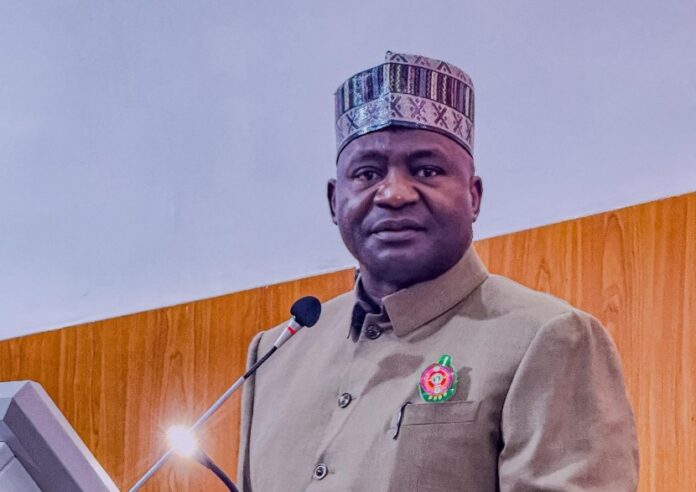
April 15, (THEWILL) — The Minister of Defence, Christopher Musa, has dismissed allegations that civilians were deliberately targeted in the recent military airstrike on Jilli Market in Borno State, insisting that the location functioned as a strategic logistics hub for terrorist operations in the North-East.
Musa made the clarification during an appearance on ARISE News Prime Time on ARISE News, as public debate intensified over reports suggesting that more than 100 people may have been killed in the operation.
While the incident has continued to generate controversy, with growing concerns over civilian casualty risks, intelligence accuracy, and the operational challenges of conducting airstrikes in areas where insurgents are believed to operate within or around civilian settlements, Gen. Musa maintained that Jilli Market had long been identified by security agencies as a restricted and high-risk enclave, allegedly used by insurgent groups as a supply and coordination point.

According to him, intelligence reports indicated that the location served as a logistics base where terrorist elements routinely sourced fertiliser for the production of improvised explosive devices (IEDs), as well as food items and fuel needed to sustain operations in the field.
He argued that the military operation was aimed at disrupting these supply chains, which he described as central to the operational survival of terrorist groups operating in the region.
Responding to concerns that civilians may have been among those affected, the Defence Minister rejected the narrative that the area was a conventional civilian market at the time of the strike.
“Nobody in that area was innocent”, he said, insisting that individuals operating within the enclave were aware of its security designation and the nature of transactions taking place there.
He further maintained that economic activity in the area had become heavily influenced by insurgent demand, with traders reportedly supplying goods at inflated prices due to the risks associated with accessing the enclave.
According to him, commodities such as fuel were routinely transported into the area, emptied, and resold to terrorist elements, creating what he described as a profit-driven supply ecosystem linked to insecurity.
Musa also suggested that the recent spike in terrorist activity in the North-East may be influenced by political dynamics, arguing that insecurity often escalates during election cycles.
He alleged that some actors exploit instability to project governmental weakness or gain political advantage, stating that such patterns have historically accompanied heightened violence periods.
“Any time it’s a political year, it goes up”, he said, adding that the intention of such escalations is often to undermine public confidence in state institutions.
Despite the controversy, the Defence Minister reiterated that Nigeria’s armed forces are making steady progress in degrading terrorist capabilities across operational theatres. He described the counter-insurgency campaign as a sustained and complex conflict requiring continued vigilance, intelligence cooperation, and public support.
“We’ve had a number of casualties. It is a war that is ongoing”, he said, urging Nigerians to support security forces as they confront what he described as a determined adversary with external support networks.

Felix Ifijeh is a journalist with years of professional reporting experience. Known for his keen news sense, compelling storytelling and commitment to accurate, impactful reporting, he has built a reputation for turning leads into clear, engaging, and well-structured reports that resonate with readers. His work reflects deep newsroom experience and a commitment to accurate, impactful journalism.