
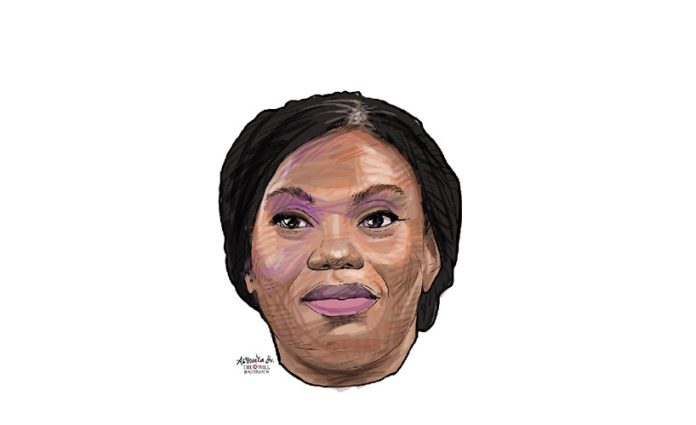
December 16, (THEWILL) – For many politically discerning Nigerians who celebrated the emergence of British- Nigerian Kemi Badenoch as the first black woman leader of the 190 years-old UK Conservative Party leader on November 2, 2024, the ongoing verbal exchanges between her and an elected leader back home is as interesting as it is amusing.
The argument deals with her seeming dismissal of the country where she was raised by middle class parents, attended primary and secondary school until she was aged 16 before relocating to the land of her birth and nationality where she completed her A-Level, subsequent to obtaining degrees in law and computer systems engineering.
She sparked controversy recently, shortly after her party leadership victory, when she stated that she didn’t want her adopted country, Britain, to “look like the one she ran away from,” describing her childhood as “growing up in fear and insecurity in a country plagued by corruption” and having “seen what happens when politicians are in it for themselves… using public money as their private piggy banks”.

Last Monday, Nigerian Vice President Kashim Shettima accused Badenoch of denigrating Nigeria and suggested she could “remove the Kemi from her name” if she was not proud of her Nigerian heritage.
Shettima, who spoke at the 10th Annual National Migration Dialogue held at the Banquet Hall of the Presidential Villa, in Abuja, had acknowledged Badenoch as “the leader of the British Labour or Conservative Party. We are proud of her in spite of her efforts at denigrating her nation of origin.” According to the VP, “She is entitled to her own opinions; she has even every right to remove the Kemi from her name, but that does not underscore the fact that the greatest black nation on earth is the nation called Nigeria.”
Shettima highlighted Nigeria’s prominence on the comity of nations, “One out of every three, four black men is a Nigerian and by 2050, Nigeria will support the United States and will be the third most populous nation on earth.”
Rubbing it in, Shettima described her forerunner in office, Rishi Sunak – the UK’s first prime minister of Indian heritage – as “a brilliant young man” who “never denigrated his nation of ancestry”.
Asked about Shettima’s comments, Badenoch’s spokesman said, “She stands by what she says” and “is not the PR for Nigeria. She is the leader of the opposition and she is very proud of her leadership of the opposition in this country,” he told reporters. “She tells the truth. She tells it like it is. She is not going to couch her words.”
Still clearly bristling, the 44-year-old British-Nigerian Member of Parliament for North West Essex who had earlier in a response to her criticism by Nigeria’s Vice President, replied that she was “not a public relations officer for Nigeria,” adding that she identifies herself as Yoruba and has nothing in common with Northern Nigeria, a “haven for Islamism and Boko Haram”.
In a recent interview with British media, The Spectator, Badenoch again, sparked fresh identity controversy.
She said, “I find it interesting that everybody defines me as being Nigerian. I identify less with the country than with the specific ethnicity [Yoruba]. I have nothing in common with the people from the north of the country, the Boko Haram where Islamism is.
“Being Yoruba is my true identity and I refuse to be lumped with northern people of Nigeria, who were our ethnic enemies, all in the name of being called a Nigerian. Somebody once told me when I was very young that my surname was a name for people who were warriors. They protected the crown and that’s what I see myself as doing. I am here to protect, and I will die protecting this country because I know what’s out there.”
During this back and forth exchange, high-profile Nigerians joined the fray to express their views for and against.
One of such personalities is the Bishop of Sokoto Diocese of the Catholic Church, Hassan Kukah. In a lengthy epistle, the cerebral priest said, “To ascend to the top of the British Conservative Party at the age of 44 is by any measure, an historic achievement. To do so as a woman and a black woman at that, the daughter of immigrants, and a wife and a mother, is worthy of celebration. Kemi’s ascendance is special. It points at the possibilities and challenges that lie ahead for those who dare. It is often the case that some doors are closed, but not locked. When that right moment comes, you need boldness, courage, character and self-belief and of course, the grace of God.”
He described the assumption that her perceived controversial comments were designed to throw her country, Nigeria ‘under the bus’ at the slightest opportunity as false and an exaggeration.
“This is no doubt an exaggeration by her opponents. But let’s face it. To be thrown under a stationary bus should not be a matter of concern at all. Should we not be worried about the corruption that has become a swamp out of which we have been unable to swim? Should we not be worried that in our own country, we are still raising roadblocks against gifted men and women because of their faith or ethnicity? I am surprised that even some of her critics who have cases with the Economic and Financial Crimes Commission have found it convenient to condemn her for calling out Nigeria’s cancer of corruption. Nigeria’s dirty laundry will not be cleaned by outsiders or by self-deceit.
From where she stands today, as a former Secretary of State for International Trade, Kemi likely knows more about the state of our sleaze than even we are prepared to admit. There are, of course, other critics who seem to be driven by envy.” He, however, advised her not to “stray too far from her natural constituency”, because she cannot either “ignore that she is black and the daughter of immigrants. Not only because it would smack of self-hatred, but it would rob her of the authenticity and largeness of spirit required of all transformative leaders.”
But for Tahir Ibrahim Tahir, Talban Bauchi, who said he watched a British Television programme where almost all the panellists were “embarrassed by Badenoch’s comments and condemned them as capable of causing a diplomatic row. He lamented that while she is said to be intelligent, she needs to deploy some degree of emotional intelligence as a person and especially as a political leader.
“When we speak of corruption in third world countries, Africans can only primitively borrow a leaf from the corruption of western civilisation as they continue to strip foreign nations of their God given wealth. If Nigerians have stolen from the country’s wealth, haven’t the UK and other countries provided safe havens for the ill-gotten wealth?”
During her campaign in the 2010 UK general election for Dulwich and West Norwood, Badenoch made her views on Nigeria clearer than what they are currently. She had appealed for support to her Nigeria constituency on the promise to “improve our national image and do something great here,” because, “Like you, I am sick and tired of reading that Nigerians are fraudsters, terrorists bombing airplanes or slaughtering each other in places like Jos. Our generation has suffered enough from the mistakes of the past, and it is up to us not to repeat them.”

Felix Ifijeh is a journalist with years of professional reporting experience. Known for his keen news sense, compelling storytelling and commitment to accurate, impactful reporting, he has built a reputation for turning leads into clear, engaging, and well-structured reports that resonate with readers. His work reflects deep newsroom experience and a commitment to accurate, impactful journalism.
