
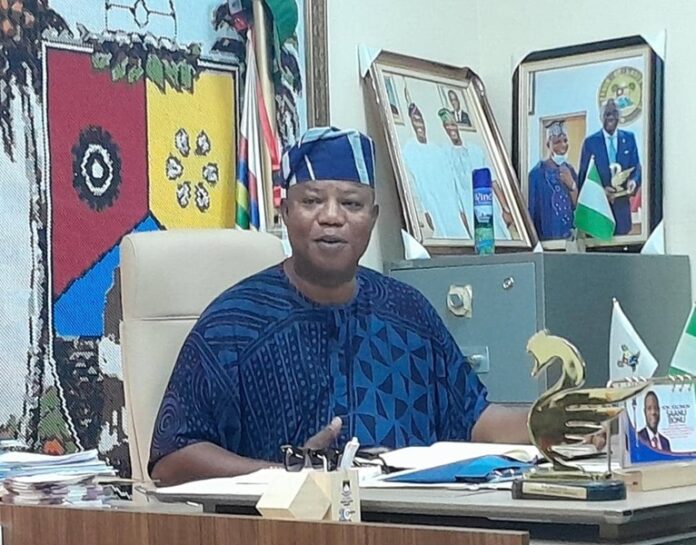
November 25, (THEWILL) — A quiet but consequential warning has emerged from the Lagos State House of Assembly, where the Chairman of the House Committee on Tourism, Arts and Culture, and lawmaker representing Badagry Constituency 1, Honourable Solomon Bonu, says Lagos may be losing the economic gains embedded in its tourism blueprint due to prolonged inaction. He issued the caution during a meeting with members of the Association of Nigerian Journalists and Writers of Tourism (ANJET) in his office.
The lawmaker’s remarks were not delivered as a political commentary but as a reminder that Lagos may be dragging its feet on a policy document designed to reshape one of its most promising economic sectors. He worries that the Lagos State Tourism Master Plan, launched with fanfare on July 21, 2021, reviewed by industry experts, and signed into law, has remained largely untouched, leaving the state without a functional guide to navigate the complexities of modern tourism.
Bonu disclosed that the situation has become so concerning that he personally convened a session of past permanent secretaries and directors of the Ministry of Tourism to revisit the plan and identify why it stalled. According to him, the gathering served as a reality check. “You cannot run tourism without a master plan”, he said, adding that the state risks running in circles if it continues to substitute comprehensive policy with fragmented activities.

For Bonu, the non-implementation is not just an administrative lapse; it is a looming economic loss. Lagos attracts thousands of leisure seekers every weekend. Yet, it argues that the state is earning far less than it should because there is no structured system guiding revenue capture, tourist movement, infrastructure expansion or long-term product development. The lawmaker referenced the weekend crowds at the park across from the Assembly complex, noting that despite the sheer volume of visitors, the state derives little direct value from such gatherings.
He insists that the master plan already addressed these issues, detailing how transportation, agro-tourism, medical tourism, and cultural assets can be synchronised into a revenue-generating ecosystem. His fear is that with each passing year, Lagos risks starting from scratch instead of building on what experts have already designed.
Bonu believes the real solution lies in a deliberate embrace of private sector participation. His argument is simple: without investors who understand tourism operations, Lagos’ ambitions will remain conceptual. He explained that international-standard tourism thrives on strong private investment and pointed out that Lagos must provide the right regulatory and business climate to draw such partners.
The lawmaker returned several times to the issue of accountability, noting that even if tourism receives increased funding, it will amount to nothing unless audits, transparent reporting, and strict monitoring become the norm. For him, the conversation about tourism is incomplete without financial discipline, both to reassure investors and to ensure that public resources produce measurable results.
But beyond the institutional gaps, he introduced a forward-thinking proposition: diaspora tourism as a strategic pillar. He said he is pushing ideas that include a dedicated housing scheme for diaspora visitors and a heritage return voyage experience tracing historical coastal routes. Though speaking strictly in his personal capacity, he suggested that such initiatives could create a powerful emotional and economic bridge between Lagos and global Africans seeking cultural reconnection.
The ANJET visit offered an opportunity for the lawmaker to restate his conviction that tourism must be treated as a serious economic engine, not an entertainment sidebar. He insisted that Lagos already possessed the natural demand for tourism; what it lacks is the structure to convert it into sustainable value.
His closing message was that the state stands at a crossroads. With a master plan already in hand, Lagos must decide whether to implement it or allow its relevance to fade, risking the same cycle of abandoned frameworks that have slowed progress in other sectors.
Honourable Bonu’s tone suggested economic urgency, not political urgency. His warning is that the longer Lagos delays, the more difficult it will become to reclaim lost ground in a rapidly evolving tourism landscape where cities around the world are competing for the same global audience.

Janefrances Ebere Chibuzor is a Tourism Writer at THEWILL
