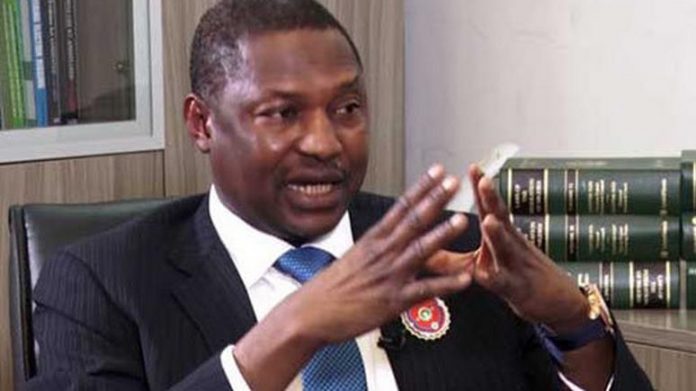
December 17, (THEWILL) – The Attorney-General of the Federation and Minister of Justice, Abubakar Malami (SAN), says the inclusion of mandatory direct primaries in the Electoral Act amendment bill negates the Constitution of existing political parties.
Punch reports that Malami stated this in a letter to President Muhammadu Buhari, highlighting the problems with the inclusion of mandatory direct primaries in the Electoral Act amendment bill.
A source at the Ministry of Justice, familiar with the development, said Malami informed the president that making direct primaries mandatory for all political parties will cause confusion.

“The AGF has sent his advice on the Electoral Act amendment bill to the President. He has highlighted the problems of the bill. The AGF, however, did not quote any section of the law that makes it illegal which is unlike the previous letters he writes to the president,” the source said; adding that Malami was worried that forcing all parties to adopt the direct mode of primary would mean that all existing parties would have to change their constitutions.
The source said1, “The office of the AGF sent its position two weeks ago. They raised a number of issues. For instance, if you are asking political parties to run direct primaries, from a strictly legal point of view that would mean that only new political parties will be bound by the law.
“Existing political parties will not, because they have registered their parties, they have filed their constitution long time ago on the basis of what is contained there. And most of it is a mixture, if you check the parties, direct and indirect primaries are stated.
“So, are you going to change their constitutions for them? So, this is the legal opinion. But this is just one. There are several other legal positions which favours and disfavours the bill because, as the Minister of Justice, his duty is to tell the president the pros and the cons. It is now up to the president to decide on which way to go.”
Senior Special Adviser to the president on Media and Publicity, Garba Shehu, confirmed that the president had received a communication from Malami on the bill, but said he was not privy to the content of the letter.
“Yes. I can confirm that the president has received a communication from the honourable minister on the matter but honestly, I am not privy to the content of the communication. I have not been briefed,” Shehu said.
The Spokesman for the AGF, Dr Umar Gwandu, when contacted on the development, said, “The Honourable Attorney-General of the Federation and Minister of Justice is attending the 2021 United Nations Conference of State Parties on Anti-Corruption currently holding in Egypt.”
“I am not in a position to confirm whether any opinion has been proffered by the Honourable Attorney General of the Federation and Minister of Justice over the Electoral Act amendment bill. I cannot ascertain the veracity of your claims at this moment.”
THEWILL had reported that the presidency said, Buhari was still consulting and seeking advise on the Electoral Act amendment bill.
The National Assembly had on November 19, 2021, transmitted the Bill to President Buhari, who now has until December 19, 2021, to sign it or communicate to the lawmakers his feelings and comments about the bill.
If after 30 days as required by law, the president refuses to sign the bill and the National Assembly is not in support of the president’s amendments, the senate and the House of Representatives can recall the bill and pass it. If the bill is passed in the form it was sent to the president by two-thirds majority votes in both chambers, it will automatically become a law even without the signature of the president.