
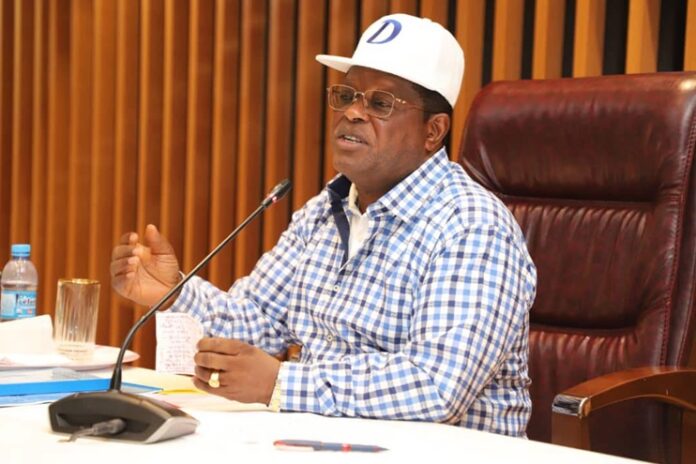
March 14, (THEWILL) — The Minister of Works, David Umahi, has commended indigenous contractors handling construction works on federal highway projects initiated by the federal government, saying that their performance is a clear demonstration of Nigeria’s growing indigenous engineering capacity.
The minister, who stated this at the weekend, during an inspection of ongoing works on a section of the Calabar corridor of the President’s legacy road programme, said Nigerian construction firms have demonstrated strong commitment to national development, often continuing work even before receiving mobilisation payments.
According to the minister, the corridor forms part of the first stretch of the 465-kilometre highway project that will eventually link southern Nigeria to the Federal Capital Territory, creating a strategic transport and economic corridor.

He noted that several indigenous contractors engaged by the Federal Ministry of Works have continued construction activities despite not yet receiving mobilisation funds.
“Many of these local contractors have shown remarkable patriotism. Some of them have not been mobilised with funds yet, but they are already working. At least eight indigenous contractors under the Federal Ministry of Works are currently executing projects without mobilisation”, Umahi stated.
He compared their approach with that of some foreign companies, which, according to him, often delay work while assessing political and economic conditions before committing resources.
“These indigenous firms see themselves as partners in nation-building. Companies like Hitech Construction Company and others have shown that Nigerian contractors can deliver projects with the same level of professionalism and quality as foreign firms”, he added.
The minister explained that the project begins from Calabar and stretches from Ndibe Beach through Afikpo, Amasiri and Onueke, before connecting through the South-South and South-East corridors and eventually linking to Ukwachi (Ndiebor Ishieke) and the old Enugu–Abakaliki road. The road continues through Mbeke Ishieke and terminates at the boundary between Ebonyi and Benue states.
He said that the section one of the project covers approximately 125.5 kilometres with a contract value of about ₦454 billion.
Umahi disclosed that the Federal Government has already paid 30 percent of the contract sum, in line with the Engineering, Procurement, Construction and Finance (EPC+F) funding model adopted for the project.
Under the arrangement, the Federal Government provides 30 percent of the funding, while contractors source the remaining 70 percent through financing.
The road is being constructed with concrete pavement technology, which the minister said is expected to last up to 100 years with minimal maintenance.
“Concrete pavement has come to stay in Nigeria because of its durability. With the quality of materials being used, these roads will last for decades”, he said.
Umahi disclosed that the project includes major bridge infrastructure, including a 25-span bridge structure measuring about 700 metres and another bridge of approximately 1.5 kilometres.
The bridge components are being installed using an advanced launching system in which cranes move along the piers to position beams without ground-based operations.
He said the superstructure works are already at advanced stages and expressed optimism that the project could be completed earlier than the official 36-month timeline if the current pace is sustained.
“If the contractors continue at this speed and the timeline is extended by about nine months, the project can be completed earlier than scheduled”, he said.
The minister added that about 11 kilometres of dual carriageway have already been completed along parts of the corridor.
He also directed contractors to establish an additional concrete production plant at Onueke to accelerate work from multiple fronts.
Umahi noted that the project forms part of four major legacy infrastructure corridors being implemented by the Tinubu administration across the country.
He explained that the road will eventually connect with the Lagos–Calabar Coastal Highway, creating an integrated transport network across several regions.
Other related projects include the Second Niger Bridge Bypass, a 17.5-kilometre dual carriageway estimated at ₦170 billion, as well as sections of the Enugu–Onitsha Expressway currently under reconstruction.
According to him, part of the Enugu–Onitsha road project covering 107 kilometres is being executed by MTN Nigeria under the Federal Government’s tax credit scheme, while another 92-kilometre section is being handled by Sinohydro Construction Company Limited using concrete pavement technology.
He revealed that about 50 percent of the concrete section has already been completed.
Umahi also acknowledged the role played by state authorities in facilitating the projects, particularly in resolving issues related to compensation for affected properties.
He commended the Ebonyi State Government for paying compensation to property owners along some project corridors, which he said made it easier for contractors to commence work.
“In cases where contractors have not yet been mobilised, they cannot handle compensation payments. That is where the support of state governments becomes critical”, he said.
The minister further disclosed that additional compensation payments are being processed for property owners affected by planned road expansion and dualisation works in some communities.

Sunday Ogbu is a professional journalist with eight - twelve years experience that had worked with various print and online media. Sunday specializes in news reporting with the aim of educating his readers on current social, political and economic occurences within his area of coverage. Sunday is a strong force to work with in the media industry and uses his positive attitude and tireless energy to encourage others to work hard and succeed. Sunday is inspired daily by his wife and their four children. In his free time, Sunday likes sight-seeing, reading and discussing issues of societal interest.
