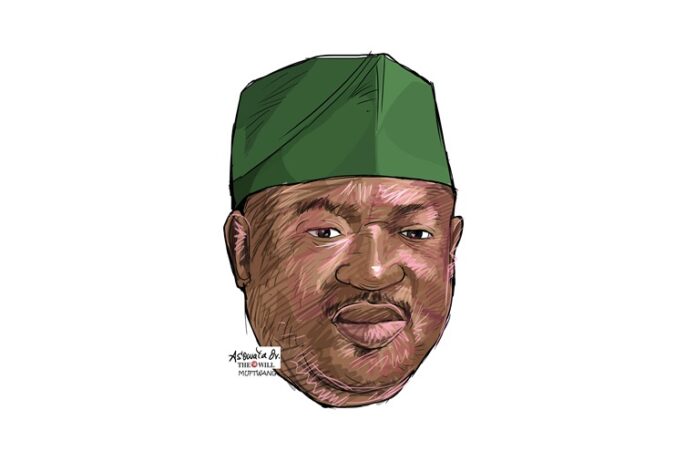
February 17, (THEWILL) – Having won The Sun Newspaper ‘Man of the Year’ award for 2024, Governor Caleb Manasseh Mutfwang is seeking illumination and sunshine on his people and Plateau State as a whole through appropriate policy formulation, committal policy execution, patriotic fervour and good conscience from state public sector personnel as a crucial variable in delivering good governance.
For most of last week, Mutfwang went to school with his deputy governor, Mrs Josephine Piyo, members of the State Executive Council, heads of agencies and parastatals, and other critical members of the state government machinery. Unflattering and sober, the theme of the week-long retreat was also terse and focal: “That Plateau may shine”.
Coming on the heels of a minor cabinet reshuffle, the retreat was an occasion for introspection and internalisation of the politico-economic and philosophical thrust of the Mutfwang Administration; a moment for quality control, a possible return to factory setting and assessment for enhanced service and improved delivery, by asking and providing answers to the self-interrogative of ‘how far, so far?’

Explaining the necessity and timing for the retreat, the State government’s official position was succinct and unambiguous: “the 2025 annual Plateau State Executive Retreat is strategically designed to present an opportunity for reassessment and realignment of collective efforts toward the vision and mission of His Excellency’s agenda”. Thus, the objectives of the review engagement were articulated in the imperatives of reflecting on the administration’s mileage thus far; review critical success factors; aggregate initiatives toward enduring partnerships and collaborations; strengthen governance; and, to work toward attaining sustainable development.
Governor Mutfwang’s remarks to kick-start the sessions of the exercise were a digest of the popular “the time is now” mantra of the administration. As he explained, it is time for Plateau people to ponder on why poverty subsists in the same land that is so bountifully blessed; it is time for the people of Plateau to reappraise their potential as a people, and how to add value to the environment; it is time to engage and introduce initiatives that will enhance the level of life of the generality of the people; it is time to think a new Plateau of digital commerce, industrial expansion and explosion; excellent or world-class educational institutions, hospitals, infrastructures, and overall society that reflects and captures the dignity of man.
All these, according to Mutfwang, with the devotion and shared spirit of all-hands-on-deck, are possible; and the “time is now” if all put in their best in their respective assignments and give ultimate “loyalty to God”. Like the bombastic Bambulu in James Ene Henshaw’s Play, This Is Our Chance, Governor Mutfwang is literally telling his people: “the world outside moves fast… and we must move with it”.
To achieve the broad-based objective, according to Mutfwang, “the retreat (was) characterized by technical sessions, visionary and reflection dialogues, and team bonding activities”, with the hope that the end of the retreat will produce “an action plan to implement good governance practices, with a strengthened commitment to accountability and transparency”.
For a retreat which sessions were structured to see participants make progress from reflection on the first day, to “analyze” on day two, to “align” and “consolidate” on days three and four, and proceed to the final and ultimate day five of “performance”, much is expected from the Mutfwang government in terms of quality of governance, policy formulation and direction, and integrity in service delivery. This is more so that only recently, the governor constituted a State Economic Council comprising technocrats with varied and extensive experience and carriage in private and public sectors investment economics.
Unlike in the immediate past administration in the State when the same Economic advisory group ended up regrettably as a mere policy pronouncement, Mutfwang’s Economic Council has to be charged to work, live, and realize its mandate, and should seek interface and synergy with the particulars and objectives produced by the retreat of last week.
At the presentation of the Medium Term Expenditure Framework and Fiscal Strategy Paper for 2025-27, with the Appropriation Bill for 2025 coded “budget of consolidation and sustainability” before the State House of Assembly on November 25, 2024, fiscal strategies and options for the attainment of development goals were given as economic diversification, strengthening of public institutions, human capital development, reduction of infrastructure deficits, and urban renewal and housing development.
In justifying the 2025 Budget, the Governor said further that “the 2025 Budget aims to reaffirm our commitment to the peace and prosperity of Plateau State, having laid a solid foundation….our desire and passion is to consolidate the past gains recorded, and rekindle our vision towards transforming and revitalizing the State projects and programmes across
all sectors of the economy.” With its theme and curriculum, the just concluded retreat means a lot, and should impact no less meaningfully on activities leading to the success of the fiscal strategy for 2025-27.
On the first day of the retreat, that was also coded as the ‘reflect’ session, the character of men and why nations sometime fail – and even fall – was in focus when the “values orientation: the key to economic rebirth, infrastructural development, peaceful coexistence and good governance” came up for review. It is interesting that one of the expected outcomes of this retreat is “effective leadership qualities, ethical principles in governance, and strategies for addressing corruption”.
It is not out of context to posit that the success of the 2025-27 development Plan, beginning with the 2025 budget of consolidation and sustainability implementation is the originating essence of the recently concluded annual executive retreat. Thus, the retreat’s broader objectives of diversification of revenue sources; comprehend the budgeting process and implementing financial management best practices, accountability, and prioritization of resource allocation are well conceived and contextualised.
Although in both the retreat curriculum and sessions outlines the very important subject of budget monitoring and evaluation did not receive bold mention, it is nonetheless interesting that the objectives sought included familiarising participants with the Plateau State Budget Monitoring and Evaluation policy. It is only effective monitoring and proper evaluation that can bring about reliable policy or programme audit.
Other objectives, such as revenue expansion or generation options, understanding budget process, grappling with financial management best practices, adoption of performance metrics as indexical to performance evaluation, use of technology to improve governance and response to citizens’ challenges, with emphasis on data privacy and alertness for cyber security show a desire by the Mutfwang administration to upgrade the state economy from its present status to a more contemporary, absorbent, prolific, and competitive one driven more by production and exports than by consumption, ostentation, and imports. Nothing could have been more in this direction than the human capital development that was the overall objective of the brain storming exercise.
The retreat was also a forum to provide and share leadership and leadership skills, leadership mentoring, human capital development, and even an exercise in giving meaning to governance, policy, programming, and above all, demonstrating politics of content and direction. As commendable and sophisticated as the retreat fits into contemporary global standards of popular governance, everything will come to naught if the beneficiaries don’t adopt the right work ethic, especially fiscal discipline and blocking of leakages and wastages, in the daily discharge of their responsibilities.
More so, special systemic guards should be provided in the fiscal processes of 2026 and 2027 to insulate and protect the objectives of the three-year development plan from the vagaries and distortions likely to be emitted during political and electioneering activities which will peak during the period, and the attention of the executive will be more the election year than dutifully guiding the fiscal process to an effective end and conclusion.