
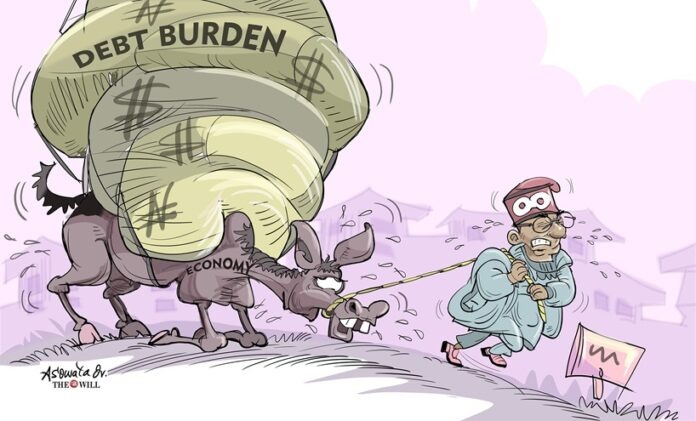
April 26, (THEWILL) — President Bola Ahmed Tinubu’s recent request for the Senate’s approval of a $516.3 million-dollar syndicated loan to finance key segments of the Sokoto-Badagry Superhighway, has sent ripples of concern among well-meaning citizens. When approved (as no doubt exists that it will not), it will add to the nation’s piling debt profile.
Nigeria is sinking deeper in the miry clay of debt and has acquired the unenviable reputation for relentless borrowing. While the debt-piling has unsettled the minds of most citizens, because of its obvious consequences, the government’s attitude, surprisingly, is different. It has elected to tow the path of impunity in a matter that has become the biggest leak in the country’s economic bucket.
The infamous trend
Clearly, individuals who voice apprehension regarding the direction of public borrowing do so not from a place of cynicism, but rather from a genuine concern for the nation’s long-term stability. Even Mr Wale Edun, until Thursday, April 22, 2026, Minister of Finance and Coordinating Minister of the Economy, raised the alarm over the government’s continued borrowing, in early February. He warned that the country must reduce its dependence on “borrowing and build a stronger domestic revenue base to stabilise its finances.”

Speaking at a retreat of the Nigerian Revenue Service, NRS, in Abuja, Edun argued that the global financial climate had become increasingly hostile to developing economies. He cited 2024 data showing that “developing countries paid $163 billion in debt servicing, compared with just $42 billion in overseas development assistance and $97 billion in foreign direct investment.”
A dispassionate review of the data is instructive. When President Goodluck Jonathan transferred power to President Muhammadu Buhari in 2015, Nigeria’s total public debt stood at approximately N12.06 trillion (about $63.5 billion at the time), consisting of both domestic and external liabilities. Though significant, this figure was modest relative to subsequent developments.
By May 2023, at the conclusion of President Buhari’s tenure, public debt had risen to N87.38 trillion – an increase of more than sevenfold in eight years. Borrowing had become a principal instrument for financing budget deficits and infrastructure commitments.
Under President Bola Ahmed Tinubu, inaugurated on 29 May 2023, the upward trajectory has continued. Within 23 months, the debt stock climbed to N142.3 trillion by September 2024 and surpassed N149 trillion by mid-2025.
Shocking reality
Nigeria’s total public debt stock stood at N159.28 trillion (110.97 billion dollars) in December 2025, according to data from the Debt Management Office (DMO). A breakdown of the debt figures shows that total domestic debt is N84.85 trillion (59.11 billion dollars), while total external debt is N74.43 trillion (51.86 billion dollars). This makes domestic borrowing the largest component, accounting for 53.27 percent of the debt stock while external borrowing makes up 46.73 percent of the total public debt.
The DMO emphasised that the country’s total debt comprised external and domestic borrowing of the Federal Government, as well as those of the 36 states and the Federal Capital Territory (FCT). The breakdown shows that the Federal Government accounts for majority of the debt, N80.49 trillion of the domestic debt and N66.27 trillion of the external debt.
The 36 states and the FCT collectively owe N4.36 trillion domestically and N8.16 trillion externally. According to the April IMF data, Nigeria’s debt-to-GDP ratio is projected to be 32.3 in 2026, decreasing from 35.5 per cent in 2025. Though below the 60 per cent global threshold, experts say high debt-servicing costs relative to revenue remained a significant concern. They also worry that while the monetary policy side of the economy shows relative stability and making progress, the fiscal side remains problematic.
External components
External debt is divided into three primary categories based on the nature of the lender: Multilateral loans stand at 23.19 billion dollars, constituting 45 per cent of external debt. These are international financial institutions providing concessional loans.
The largest single external creditor is the World Bank, with 18.3 billion dollars. Nigeria is currently the third-largest debtor to the World Bank’s International Development Association (IDA) after Bangladesh and Pakistan. The African Development Bank (AfDB) has approximately 3.5 billion dollars in outstanding credit facilities. There is also a 6.20 billion dollars bilateral loans (loan from individual foreign governments), which constitutes 12 per cent of external debt.
The Exim Bank of China is the leading bilateral creditor, accounting for 4.91 billion dollars (over 80 per cent of bilateral debt).
Domestic component
Domestic debt consists of securities issued by the Federal Government and held by local banks, pension funds, and institutional investors. FGN bonds is the dominant instrument, representing about 80 per cent of local debt, which now includes securitised Ways and Means advances from the Central Bank. There are also Nigerian Treasury Bills, FGN Sukuk, and Promissory Notes.
Role of NASS
Legislative approvals have facilitated the expansion. In November 2024, the National Assembly authorised N1.77 trillion ($2.2 billion) in external borrowing to support the 2024 budget. In October 2025, it approved an additional $2.35 billion, partly for refinancing Eurobonds and partly to finance the 2025 deficit. In May 2025, the Federal Government sought authorisation for a multi-currency package comprising $23.5 billion, €2.2 billion, ¥15 billion, and N757.9 billion — an aggregate of roughly N45 trillion. It was gleefully approved.
Official justification for sustained borrowing centres on bridging fiscal deficits, financing infrastructure, stabilising the economy amid oil price volatility, managing exchange rate pressures, and refinancing maturing debt. While these objectives are legitimate in principle, experts argue that a substantial proportion of borrowing goes to fund recurrent expenditure rather than productivity-enhancing investment. This distinction is critical to long-term sustainability.
With fresh loan requests before the National Assembly, projections suggest the total could exceed N182 trillion in the near term.
The paradox
The central question, therefore, is not merely whether Nigeria’s debt is “safe” on paper, but whether it is sustainable in practice.
According to experts, debt servicing consumes a large proportion of government revenue – up to 80 percent, constraining fiscal space for health, education, and social protection. Also, external liabilities expose the country to exchange rate risk, particularly amid naira volatility. The rapid pace of borrowing, following the substantial expansion under the previous administration, also raises concerns about intergenerational equity.
However, financial experts maintain that borrowing, when judiciously deployed, can catalyse growth and structural transformation. But when it becomes habitual and disconnected from revenue reform or expenditure discipline, it can erode fiscal resilience.
Nigeria’s debt trajectory ought to be a reflection of positive policy choices — choices that will shape economic opportunity, institutional credibility, and the welfare of future generations. However, the reverse is the case.
Professor Akpan Ekpo, former Vice Chancellor of University of Uyo, Akwa Ibom State has consistently warned that Nigeria’s rising debt profile is not justified by current infrastructure projects and that the country is not using loans efficiently to generate revenue. According to him, continued debt-driven financing, particularly in an era of high interest rates, is unsustainable and so, reliance on borrowing must decrease.
Ekpo, currently Chairman of the Foundation for Economic Research and Training in Lagos, maintains that “accumulating debt without sufficient investment in productive sectors is dangerous,” warning that “the country cannot borrow its way to prosperity.”
More contradictions
Notwithstanding the high propensity for borrowing, little measurable results can be identified as the benefits the increased borrowing – not even on the living standard of the people. This was the point in the World Bank April 2026 report that raised significant concerns regarding Nigeria’s fiscal framework.
According to the global lender, Nigeria has a “hidden spending system” that has diverted over ₦34.53 trillion in revenue from the Federation Account over the past three years (2023–2025). While gross revenue has increased, these massive, non-transparent “pre-distribution deductions” have significantly reduced funds available for development, undermining efforts to manage public debt.
In the April 2026 Nigeria Development Update, the World Bank revealed that 41 percent of gross revenue (roughly ₦34.53 trillion) did not reach the Federation Account Allocation Committee (FAAC) for distribution to federal, state, and local governments between 2023 and 2025. Despite rising nominal revenues due to forex reforms and petrol subsidy removal, the government’s fiscal capacity has not improved proportionately.
Although revenue has increased, debt servicing costs have risen to an alarming extent, with reports suggesting that in early 2025, debt service surpassed total government revenue. The massive deductions have constrained funds, leading to a decrease in capital investment on infrastructure, which is considered essential for long-term economic growth.
The World Bank warns that if the country fails to ensure transparency in these revenue flows and curb excessive deductions, its fiscal sustainability will remain under threat, regardless of increased nominal earnings.
If Nigeria continues to accumulate foreign and domestic debt without undertaking the reforms required to stabilise its public finances, the consequence is grave.
Growing obligations, weak revenue, and costly debt servicing risk locking the country into a cycle where loans are used simply to stay afloat. The consequence is a shrinking fiscal space in which essential spending on infrastructure, education, health, and social services is crowded out by repayment pressure. Without corrective action, rising debt may become both unsustainable and economically constraining, limiting Nigeria’s ability to invest in the future.
Nigeria needs to shift toward a more disciplined and growthoriented financial strategy through the cutting of wasteful spending and ensuring that any borrowing is tied to projects capable of generating measurable economic returns.
Strengthening institutions, enhancing transparency, and diversifying the economy, particularly through manufacturing, agriculture processing, and technology, will reduce dependence on volatile oil revenues. At the same time, attracting investment rather than relying on loans can create jobs and expand the tax base. With these steps, the country can manage its debt responsibly, restore fiscal stability, and gradually reduce the need for continuous borrowing.
The Federal Government has, however, robustly defended its borrowing plan for the 2026 fiscal year, stating that “its aim is to boost inclusive growth and not just borrowing for borrowing’s sake or consumption.”
Special Adviser to the President on Finance and Economy, Mrs Sanyade Okoli, at Proshare’s 6th Economist Conference, recently held virtually under the theme ‘Can Nigeria Fund Itself Without Killing Private Investment?’, said the government’s “objective goes beyond raising debt to financing inclusive and sustainable growth.” She argued that Nigeria’s “current fiscal position must be assessed in the context of the economic distortions inherited at the start of the administration.”

Sam Diala is a Bloomberg Certified Financial Journalist with over a decade of experience in reporting Business and Economy. He is Business Editor at THEWILL Newspaper, and believes that work, not wishes, creates wealth.
