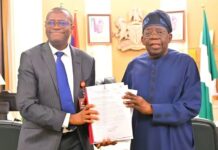
June 22, (THEWILL) – For an administration that still has two years to complete its four-year tenure, learning to manage and assuage the feelings of its people is an endless political exercise. Shortly after President Bola Tinubu conferred national honours on perceived heroes and heroines of June 12 on Democracy Day, the stage was set for unexpected protests.
A week after the initial conferment, the President, who was on a working visit to Kaduna State, announced the conferment of the Commander of the Federal Republic on a former military Governor of the state, Col Abubakar Umar (retd.). “Let me use this opportunity to correct an omission,” Mr Tinubu said. “One of the people I missed in my June 12 broadcast is Colonel Dangiwa. Let me honour him with CFR.”
Col Umar lost his commission for criticising the annulment of the June 12, 1993 presidential election, voting for justice and democracy. He governed Kaduna from August 1985 to June 1988 during the Ibrahim Babangida military regime.

He retired from the army in 1993 after the June 12 debacle. He was jailed by the Sani Abacha regime for demanding good governance and a return to democratic rule.
Like many activists, families and associates who failed to see the names of their parents and prominent figures on the President’s honour list and continued to raise objections, associates of retired Col Umar had published a critical piece, calling for redress and they were happy the President obliged them.
Others are calling for an amendment, too. Prominent among them are the families of the leaders of the pro-June 12 National Democratic Coalition, NADECO, the late Michael Ajasin, activists who fought alongside President Tinubu for the revalidation of the June 12 election.
The family of late Ajasin, who was also a fourth republic governor of Ondo State on the platform of Alliance for Democracy, expressed regret over the omission of their father’s name in the honours roll.
Reacting to this, the eldest son of the late NADECO leader said, “I would be lying if I didn’t say that I and other members of my family were rather surprised that the name of our father was not among those honoured by President Tinubu as he doled out National honours to June 12 heroes.”
Arguing that the humble and low profile character of his family may have led to the oversight, he protested, “It is unconscionable that the leader of the group (NADECO) best known for fighting the military and bringing about the much-touted democracy never got a single mention in the scheme of June 12 celebration/anniversary! I do not know whether this conspicuous omission was deliberate or not, but be it known that Chief Michael Adekunle Ajasin CFR in his lifetime doubled as the Leader of Afenifere and NADECO, the two organisations that were the arrowheads and in the forefront of the fight against military dictatorship.”
According to him, even where no awards or rewards are dispensed to these heroes of democracy, they certainly deserve to be recognised and mentioned in a country that has a dearth of heroes.
Other protesters include activists and a child of one of the ‘Ogoni four’ -Albert Badey, Edward Kobani, Samuel Orage, and Theophilus Orage- who were murdered on May 21, 1994, in Gokana during the conflict between the Movement for the Survival of the Ogoni People, MOSOP, and the Nigerian Government, leading to the arrest and subsequent execution on November 10, 1995, of environmentalist and author, Kenule Saro-Wiwa and other MOSOP activists, namely Barinem Kiobel, John Kpunien, Baribor Bera, Saturday Dobee, Felix Nwate, Nordu Eawo, Paul Levura, and Daniel Gbokoo.
Thirty years after the ‘MOSOP nine’ were executed for instigating the death of the ‘Ogoni four’ President Tinubu conferred “posthumous national honours on Ken Saro Wiwa (CON), the leader of the Ogoni Nine Saturday Dobee (OON), Nordu Eawo (OON), Daniel Gbooko (OON), Paul Levera (OON), Felix Nuate (OON), Baribor Bera (OON), Barinem Kiobel (OON), and John Kpuine (OON).”
The afore-mentioned were tried by a military tribunal for protesting against Shell’s activities in the oil-rich Niger Delta and hanged.
Reacting to the posthumous award for the ‘Ogoni nine’, Sauge Barde, son to Albert Barde, a retired Rivers State permanent secretary who later became a traditional ruler in Ogoniland, said the President by giving honour to the ‘Ogoni nine,’ reopened deep wounds that gave him sleepless nights akin to mourning all over again the brutal murder of his father and three other Ogoni chiefs.
He said,“ Since Thursday night, I started mourning my father again. It is a complete disregard for the memory of our fathers, who actually served this country diligently without blemish over the years and were killed, murdered in cold-blood in broad daylight by the same men that are being honoured today (Thursday) – and they made no mention of the four. It’s a very sad development.
“A pardon is okay, as I said. It’s the President’s prerogative to grant pardon. But to now honour murderers, I think we are now introducing a new low in our Nigerian society… You can now be a career murderer and be given an honour in Nigeria. That’s what it means. That’s the new low.”
Barde said he would have rejected the idea of his father being honoured “side by side with murderers,” as he was not in “a hurry to betray my father for any form of compensation.”
Alluding to the presidential pardon as a product of misinformation and driven by the government’s desire to pave the way for the return to Ogoniland for oil exploration, Barde said the honour, “ is going to pass through generations and Ogoni will remain divided. I’m so sad. What the President did is wrong. I used to see him as one who listens to both sides and does the right thing. But unfortunately, I think he is misguided and I don’t know why he fell for that.”
Interestingly, an Ogoni activist, Celestine Akpobari, coordinator of the Ogoni Solidarity Forum, rejected a posthumous conferred on the ‘Ogoni nine’.
“You cannot pardon someone that has not committed an offense; we are demanding total exoneration,” he said adding, “To say ‘pardon’, I think it is insulting. If there is any group who needs pardon, it is the Nigerian Government that has committed so much crime against the Ogoni people.”
In another protest, a group under the aegis of Quintessential Professionals called on President Tinubu to update the list and include the names of those it considered an unpardonable omission. They include former United States Ambassador to Nigeria, Walter Carrington, for his collaboration with pro-democracy activists for the revalidation of the June 12 presidential election results.
According to Stanley Dunia who spoke on behalf of the group, Tinubu’s allies in the Afenifere and NADECO movements, who were in the trenches during the struggle, were also left out of the honours lists. He wondered what could have informed such an omission. These names include NADECO Secretary, Chief Ayo Opadokun, Pa Olanihun Ajayi, Chief Cornelius Adebayo, Chief Olabiyi Durojaiye, Senator Adedayo Adeyeye, and Senator Jonathan Zwingina.
Others are Kofo Akerele-Bucknor, Dr. Kayode Fayemi, Senator Babafemi Ojudu, Reverend Adebiyi, Dr. Chidi Odinkalu, Chief Olisa Agbakoba, Innocent Chukwuma, Mike Ozekhome, Yinka Odumakin and Joe Okei-Odumakin.
Some of these activists have risen to speak up for themselves. Akerele-Bucknor who became Tinubu’s deputy for a year during his first term as governor of Lagos State, said the President still habours grievances against her for their turbulent relationship during the governorship, while Senator Ojudu, former political adviser to Vice President Yemi Osinbajo said it is all about politics.
“It would be unrealistic, especially in the African political context, to expect magnanimity from a sitting President toward individuals who have been openly critical of his policies or withheld support for his political ambitions. I did not vote for this President in 2023 and have remained vocal about the direction of his administration. I understand, therefore, the political nature of recognition and take no offense in being omitted from the list,” said Ojudu who was given a CON award by former President Muhammadu Buhari, arguing that he did not join the pro-democracy struggle in expectation of a national award.
Responding, Presidential Spokesperson Bayo Onanuga said, “The president has done what is normal. They can make an argument for exoneration and the president will look into it,”
Felix Ifijeh is a journalist with years of professional reporting experience. Known for his keen news sense, compelling storytelling and commitment to accurate, impactful reporting, he has built a reputation for turning leads into clear, engaging, and well-structured reports that resonate with readers. His work reflects deep newsroom experience and a commitment to accurate, impactful journalism.