November 06, (THEWILL) – The Nigerian Exchange (NGX) hit the peak of its growth on Friday, May 27, 2022 when it recorded a market capitalisation of N29.15 trillion and an All-Share Index (ASI) of 54,085.30. It was a historic performance being the highest since the birth of the establishment in 1961. It was also the peak of a bullish trend that began in 2020 when Nigeria emerged the best performing stock exchange in the world amid COVID-19 pandemic that spread human suffering and destabilised global economy in the worst dimension in 100 years
A curious angle to this development is that the Nigerian equity market achieved the feat amid a downturn that saw the economy hemorrhaging from severe headwinds. One of the reasons for the strong performance is that the NGX is backed by stocks of strong firms which reflect the backbone of the economy. And one of the stocks is Nestle Nigeria Plc.
Historically, Nestle Nigeria Plc remains the most expensive stock on the Nigerian Exchange (NGX), selling for N1,215 per share on close of trading on Friday, November 4, 2022. The stellar performance was not a flash in the pan. Except for the “interruption” by Airtel Africa enlisted barely three years ago in July 2019, Nestle Nigeria remains a backbone of The Exchange over the years — holding the highest price and a robust market capitalisation.

Current Trend
Nestle Nigeria is currently the most valuable stock on the NGX with a market capitalisation of N963 billion which is almost 3.99 percent of the Nigerian Exchange equity market of N24.1 trillion. Nestle Nigeria began the year with a share price of N1,556.50 but has since lost 21.9 percent off that price valuation, ranking it 131st on the NGX in terms of year-to-date performance.
Data by the NGX showed that Nestle Nigeria is among the top traded in the last three months (August 8 – November 4, 2022) when it traded a total volume of 8.05 million shares in 2,251 deals, valued at N10.5 billion. This translates to an average of 127,703 traded shares per session. A volume high of 2.26 million was achieved on August 26, and a low of 1,280 on October 26, for the same period. Analysts adjudge it as belonging to the league of stellar performing firms whose stocks have sustained the equity market.
“This is one of the topmost performing stocks among the 157 listed equities since the year. It is traditional with the company because of its strong fundamentals linked to its strong corporate governance. You can see that the price variations are within the same asymmetric corridor (of N1,000) without a sharp deviation, unlike what we saw in Airtel,” said Sam Ndata, Doyen of the Stockbrokers and Director at UIDC Securities Limited,
An investigation by THEWILL revealed that Nestle Nigeria’s strong fundamentals have been sustained over the years. Unlike Airtel Africa which fluctuated below the N1,000 mark at a point, Nestle Nigeria’s share price remained above N1,000 before and in the last three FYs when it competed with Airtel Africa.
Deeper Impact
Nestle Nigeria share price opened with N1,469.90 on January 2, 2020 – the first trading day of the year to close N1,505 per share on December 31, 2020. The stock opened N1,505 per share on the first trading day in 2021 to close with N1,556.50 on December 31, 2021.
For 2022, the share price has also remained above the N1,000 mark in the first three quarters with N1,395, N1,400 and N1,480 to support the NGX market capitalisation of N25.31 trillion, N27.93 trillion and N26.45 trillion as of Q1, Q2 and Q3 respectively.
The implication of this is that Nestle Nigeria is a consistent contributor to the bullish trend of the NGX because of its strong fundamentals and good corporate governance. Investigation showed that Nestle Nigeria gained 11.11 percent but lost 10.44 percent since the increase in benchmark rate by the monetary policy authority, the Central Bank of Nigeria (CBN) in May 2022.
With Central Bank’s aggressive rates hike to battle rapid inflation and crippling foreign exchange liquidity crisis, investors have accelerated migrations away from crashing equities into fixed income markets. Nigeria’s apex bank had hiked the monetary policy rate (MPR) to 15.5 percent and the cash reserve ratio to 32.5 percent in their September 2022 meeting. Since then, equities trading at the Nigerian Exchange has been marked by a steady decline and resilience, yet not below the N24 trillion mark.
Notwithstanding the current headwinds, Nestle Nigeria made its shareholders happy in Q3 2022 with a revenue of N11l.02 billion, up from N90.15 billion, and increase in profit after tax from N33.58 billion in the corresponding period of 2021 to N40.15 billion.
“Companies listed in the Consumer Goods segment of the NGX are contending with bottlenecks in global input supply and currency-related costs. Their operating expenses have increased significantly; though they have continued to increase the price of their goods, weak consumer demand and rising inflation remain the albatross. The impressive performance of Nestle Nigeria amid this headwind, therefore, singles it out for mention,” said Dr. Paul Uzum, a Stockbroker and Head of Securities Trading at Planet Capital,
Dr Uzum told THEWILL in a note that investors’ migration to the safety haven of fix income market accounts for the bearish trend that is witnessed in the equity market of late from the peak of N29.15 trillion on May 27, 2022 to N24.1 trillion as of November 4, 2022 a drop of 17.4 percent. He, however, observed that the impact did not “dislodge” Nestle Nigeria from its prime position.
Giving further insight, National Co-ordinator, Independent Shareholders Association of Nigeria (ISAN), Dr Anthony Omojola said Nestle Nigeria remains a strong-bone of the NGX through its performance and contribution to the growth of the economy. Weak stocks do not yield strong support on their own, and Nestle is not among the stocks weakened by the prevalence of portfolio investment over direct foreign investment.
“Nestle Nigeria has enjoyed a prime place for many years. This is because of its products quality, availability, good management, well spread corporate social and community development programmes and taking advantage of related parties’ strength. Their products are moved to and sold by the subsidiaries of their group and they also enjoy the opportunity of having access to related parties’ products.
“They hire professionals and also train their staff who are given international exposure. The Board is concise and unique. These attributes impact on their overall performance to the benefit of the shareholders, the equity market and the economy in general,” Omojola told THEWILL in a note.
Touching Factors
At corporate level, three factors appear responsible for the company’s vaulting share price over the years. These include product demand, stellar performance results and the company’s expansion plans which showcase prosperity. Analysts say the company behind the stock is an iconic one; everyone wants a piece of it. So the north-bound share price is driven by demand, prospects of continued wealth-creation and impressive dividend history. The company had indicated that it was going to expand aggressively in the South-East and South-South regions of the country. Its ultra-modern Flowergate facility in Sagamu, Ogun State for Maggi production, suggests more revenue and more profits for the company, with higher returns for the shareholders.
An analysis of its recent financial reports showed there was a huge jump in revenues and the bottom line – signaling prospects for the firm known for popular brands like Nescafe and Milo. With only one quarter to go till the end of the financial year, the company is well on its way to hit N500 billion revenues that will reflect in a robust bottom line. Its homegrown solution to raw material procurement (backward integration) plays a major role.
Backward Integration
Nestle Nigeria is a key player in the nation’s backward integration policy. Backward integration is a practice where companies are encouraged to cultivate their own raw materials by purchasing their suppliers or establishing farms to grow produce for their factories.
The policy aided the quick recovery of listed Fast-Moving Consumer Goods (FMCG) firms after the double tragedy of COVID-19-induced recession and the 15-months land border closure in 2020. The crash in crude oil prices which started in the fourth quarter of 2014 compelled the government to push the policy to save foreign exchange, create jobs, boost productivity and grow the GDP.
Operators in the SME space (belonging to various sectors), especially agriculture and transportation, have benefited from the policy as the FMCG firms take giant strides to key into the initiative which has also boosted tax revenue for the government.
For instance, Nestlé Nigeria put a plan in place to engage 5,000 smallholder farmers for the supply of raw materials for its agro-business operations. The initiative, ‘Developing Inclusive Grain Value Chains Project’, is in partnership with IDH— a Sustainable Trade Initiative and TechoServe outfit.
According to Nestle, the initiative is a seven-month project that will facilitate the supply of maize, soybeans, millet, and sorghum. It added that the scheme will increase the income of farmers and create a steady supply of locally grown crops as the COVID-19 pandemic disrupted global importation of these materials.
Nestle revealed that the objectives of the project include working with six small and medium-sized enterprises (SMEs) that aggregate crops and supply them to Nestlé factories; aggregators and sub-aggregators will receive training on proper grain handling, storage, and testing, as well as entrepreneurial and financial skills; while logistics partners will receive training on proper handling and storage of grain during transit.
Year-end Outlook
For the rest of the year, the company expects resilient revenue/earnings growth driven by NESTLE’s brand equity and production process innovation. Analysts believe that the company’s successful introduction of the use of local raw materials such as soya bean, maize, cocoa, palm olein and sorghum, in its production processes, if sustained, would help reduce the high cost of imported raw materials.
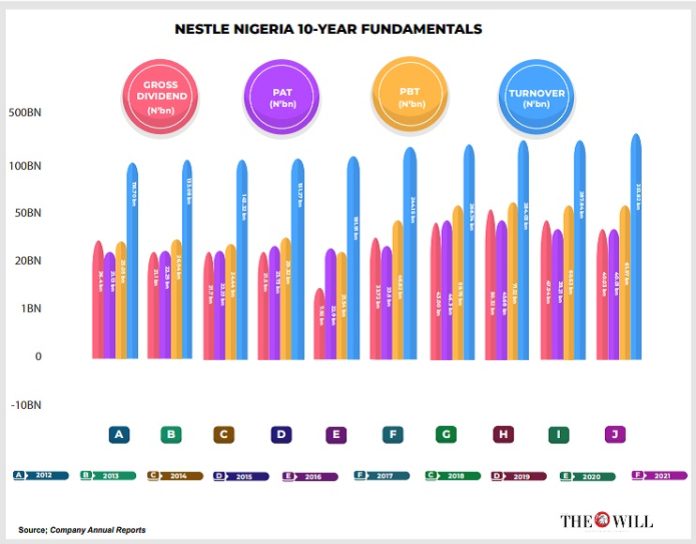
Consequently, it will improve earnings, to the benefit of the overall economy which was boosted with Nestle Nigeria’s aggregate income tax of N127.64 billion in the past ten years (2012-2021), as shown in its annual reports.

Sam Diala is a Bloomberg Certified Financial Journalist with over a decade of experience in reporting Business and Economy. He is Business Editor at THEWILL Newspaper, and believes that work, not wishes, creates wealth.