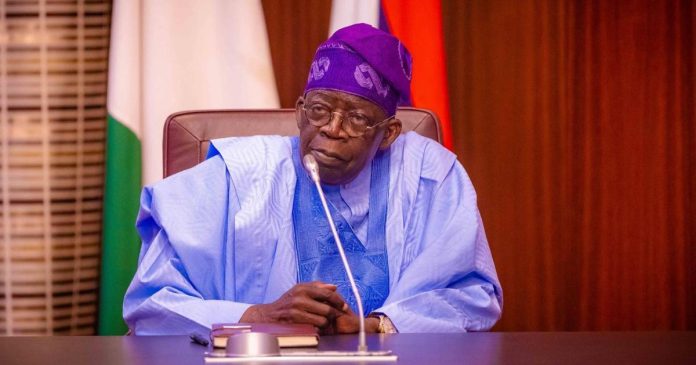
June 26, (THEWILL) – President Bola Tinubu has said that the four new tax laws are designed to bring tangible relief to ordinary Nigerians, restore fairness in the tax system, and stimulate inclusive economic growth for the future.
THEWILL reports that the President, at a short ceremony held on Thursday at the State House, signed into law the four groundbreaking tax reform bills that will transform Nigeria’s fiscal and revenue framework.
The four bills–the Nigeria Tax Bill, the Nigeria Tax Administration Bill, the Nigeria Revenue Service (Establishment) Bill, and the Joint Revenue Board (Establishment) Bill–represent what the President called a bold new era of economic governance.

They are expected to harmonise tax administration across federal and state levels, reduce duplication and corruption, and make the tax process more predictable for individuals and businesses alike.
Assenting the bills into law, President Tinubu described the legislation as a decisive break from the past, adding that the reforms are tailored to ease the burden on working families, small businesses, and low-income earners while eliminating inefficiencies that have long plagued Nigeria’s fiscal structure.
“These reforms go beyond streamlining tax codes. They deliver the first major, pro-people tax cuts in a generation, targeted relief for low-income earners, small businesses, and families working hard to make ends meet”, he assured.
President Tinubu stated that the new legislations are intended to unify Nigeria’s previously disjointed tax regime, cut bureaucratic red tape, and make revenue collection more transparent and efficient.
“For too long, our tax system has been a patchwork—complex, inequitable, and burdensome. It has weighed down the vulnerable and shielded inefficiency. That era ends today”, he said.
The President noted that the reforms would not only simplify the tax system but also serve as a tool for national renewal, delivering economic justice and rebuilding trust between the government and the governed.
“We are laying the foundation for a tax regime that is fair, transparent, and fit for a modern, ambitious Nigeria. A tax regime that rewards enterprise, protects the vulnerable, and mobilises revenue without punishing productivity”, he said.
Emphasising that the legislation is not merely about technical adjustments but a broader reimagining of Nigeria’s fiscal culture, the President declared, “We are not just signing tax bills but rewriting the social contract. We are not there yet, but we are firmly on the road.”
He added that the new framework would not only ease life for citizens but also enhance investor confidence and position Nigeria as a competitive destination for business and innovation.
“We are also building a framework for the Nigeria of tomorrow—leaner, fairer, and laser-focused on unlocking opportunities for all”, he noted.
President Tinubu commended the Presidential Fiscal Policy and Tax Reform Committee for its “tireless work”, praised the National Assembly for a “rigorous review process”, and thanked state governments for their “critical contributions”.
He also appreciated “the Nigerian people for keeping faith with this vision of reform”.
Meanwhile, the Chairman of the Federal Inland Revenue Service (FIRS) said that the implementation of the new tax laws will commence on January 1, 2026, giving stakeholders a six-month transition period to prepare.
“The effective date for implementation has been set for January 1, 2026, as announced by the relevant ministry. This gives us a full six-month window for robust sensitisation, thorough planning, and alignment with the government’s fiscal calendar. A reform of this magnitude cannot be rushed”, he said.
He disclosed that the Federal Inland Revenue Service would now transition into the Nigeria Revenue Service (NRS), with an expanded mandate covering both tax and non-tax revenue, promising greater efficiency and transparency.
In his remarks, Chairman of the Presidential Fiscal Policy and Tax Reforms Committee, Taiwo Oyedele, commended President Tinubu’s bold leadership in signing into law four tax reform bills.
He announced that essential goods and services, including food, healthcare, education, transportation, and accommodation, are now exempt from VAT.
Oyedele stressed that the reforms are pro-growth and pro-poor, aimed at improving equity, reducing burdens on vulnerable Nigerians, and stimulating economic development.
“Over one-third of workers in both public and private sectors will now be completely exempt from Personal Income Tax. More than 90% of micro, small, and nano enterprises are also exempt from Corporate Income Tax, VAT, and PAYE obligations”, he noted.
“These essential categories account for over 80% of average household spending in Nigeria. By removing VAT, we’re putting money back in the hands of ordinary people.
“The new laws are designed to end discretionary waivers and ensure that tax incentives are accessible to all qualifying businesses, not just the well-connected”, he said.

Felix Ifijeh is a journalist with years of professional reporting experience. Known for his keen news sense, compelling storytelling and commitment to accurate, impactful reporting, he has built a reputation for turning leads into clear, engaging, and well-structured reports that resonate with readers. His work reflects deep newsroom experience and a commitment to accurate, impactful journalism.