
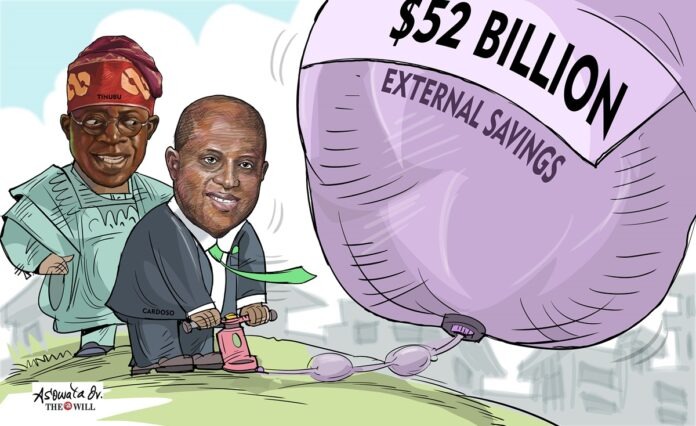
July 19, (THEWILL) — For the first time in several years, the Central Bank of Nigeria (CBN) possesses a significantly larger arsenal to defend the naira without resorting to administrative controls that previously distorted the foreign exchange market. The stronger reserve position has also improved Nigeria’s ability to meet external obligations, finance imports and reassure international investors about the country’s macroeconomic stability.
This means that Nigeria has strategically built one of its strongest external financial positions in recent years. With external reserves and other foreign assets now standing at roughly $52 billion, the country has erected a formidable financial buffer. This level is capable of shielding the economy from external shocks, supporting exchange-rate stability and strengthening investor confidence.
The trigger
An upbeat and confident Governor, Central Bank of Nigeria (CBN), Dr Olayemi Cardoso, last week disclosed that Nigeria built the giant financial shield that grew its external savings to $52 billion, through strategic policy initiatives. He emphasised that the heavy cash cushion gives the government much more power to defend the naira and keep prices from jumping around.

According to Cardoso, even better news is that the country’s actual clean savings have crossed $40 billion — a spendable cash that remains after clearing out all foreign debts and obligations.
To put this in perspective, the nation only had $3 billion in clean savings when the current team took over the vault (in September 2023). That old low number caused a lot of fear in the business community. He explained how fixing the old broken system brought back deep trust from global investors.
“When we started, net reserves were in the region of about $3 billion plus. Today, our net reserves are in the $40 billion range. It has been a long and difficult journey, but there has been a regime change at the Central Bank and that is what has produced these outcomes.”
The apex bank boss maintained that this strong pile of dollars is paving the way for a major upgrade inside the banking sector: “Right now, the Central Bank is making local lenders increase their total capital survival funds”, he said.
According to Cardoso, this rule ensures that Nigerian banks grow large enough to support private businesses with big loans instead of just buying safe government papers. He added,“Some people worry that commercial banks are only focusing on short-term government investments right now”.
However, Cardoso is very confident that this behaviour will change as the financial environment settles down. He expects that these new rules will eventually bring down high inflation and lower loan interest rates for everyone.
Consequently, international investors are already bringing fresh money into the country because they like the current stability. Cardoso strongly warned local business leaders not to stay behind or assume that things are still broken.
He pointed out that waiting too long to start new projects would be a massive mistake. If local business owners do not move quickly, foreign investors will grab all the top opportunities before the home team even wakes up.
Policy radars
Much of Nigeria’s improved external position reflects a marked shift in monetary management under Olayemi Cardoso as CBN governor.
Unlike previous years when reserves came under intense pressure from multiple exchange-rate windows and extensive interventions, the apex bank has focused on restoring market confidence.
Among the major policy achievements are greater transparency in the foreign exchange market, clearance of outstanding FX obligations owed to investors, higher interest rates that have attracted foreign portfolio investment and improved remittance inflows. Others are better coordination of reserve management, reduced speculative attacks on the naira and stronger confidence among foreign investors.
These measures have helped stabilise the foreign exchange market after months of severe volatility.
A stronger reserve position also gives the CBN greater flexibility to intervene during periods of excessive currency speculation without exhausting national savings.
Equally important, investors now see Nigeria as a country gradually rebuilding policy credibility—a factor that matters as much as the reserves themselves.
Financial analysts say the psychological impact of a healthy reserve position cannot be overstated as confidence itself attracts capital, and capital further strengthens reserves in a virtuous cycle.
Ayo Teriba, Chief Executive Officer, Economic Associates, argues that stronger reserves demonstrate resilience despite global shocks and provide a solid buffer against external volatility.
The Chief Executive Officer, Centre for the Promotion of Private Enterprise (CPEE), Muda Yusuf, also agrees that higher reserves increase investor confidence, strengthen Nigeria’s capacity to defend the naira, and support macroeconomic stability. He however cautions against over-reliance on oil and neglecting the private sector, especially the micro, small and medium enterprises (MSMEs)
Route to avoid
Economic and investment experts warn that the current reserve strength must not become another opportunity for fiscal indiscipline. They argue that Nigeria has repeatedly built healthy external reserves during oil booms only to deplete them rapidly through unsustainable fiscal spending, exchange-rate subsidies and excessive interventions.
Bismarck Rewane, Chief Executive Officer, Financial Derivatives Company (FDC) urges the CBN to sustain its current strategy by maintaining a genuinely market-driven exchange-rate regime, continuing inflation-focused monetary policy, limiting discretionary interventions and building reserves during periods of strong oil receipts. His other suggestions include encouraging diaspora inflows, deepening export diversification and reserving policy consistency irrespective of political pressures.
Perhaps the greatest achievement so far has been restoring policy credibility. Markets dislike uncertainty more than difficult reforms. Frequent policy reversals could quickly erode the confidence painstakingly rebuilt over the past two years.
Fiscal policy as weakest link
While monetary authorities appear increasingly disciplined, Nigeria’s fiscal management continues to expose significant structural weaknesses. For instance, as the CBN tightens liquidity to tame inflation, expansionary government spending often injects fresh inflationary pressures into the economy.
The result is that monetary policy frequently works against fiscal policy instead of complementing it, thus, negating the benefits of strategic monetary reforms. One place this has remained chronic is the national budget.
For instance, the 2026 budget projects total expenditure of N68.32 trillion against revenue of N36.87 trillion, leaving a N31.45 trillion gap. This is 46.1 percent of the budget and well above the Fiscal Responsibility Act of 3 percent GDP threshold. The government plans to finance N29.2 trillion through domestic borrowing, with the rest from project-linked loans, asset sales and grants.
Despite improved revenue projections, windfall revenue due to increased crude price, expenditure growth continues to outpace gains — contributing to the widening deficit and increased borrowing requirement. Also, the gains from improved revenue generation are lost to growing debt servicing, as a result of continuous borrowing.
‘Where is the money?’
In the view of analysts, one of the greatest frustrations for many Nigerians is the limited visibility of what public borrowing has achieved. For instance, while government expenditure approached N36 trillion in 2024, only about N7.9 trillion was allocated to capital projects.
This means less than one-quarter of total spending went into infrastructure and long-term investment, while the overwhelming majority funded recurrent expenditure – salaries, overhead, pension, debt-servicing and day-to-day running of government.
These are legitimate obligations, but they do not constitute the visible assets the citizens want to see. Borrowing to finance recurrent expenditure, in an atmosphere of waste and profligacy, pushes the monetary policy gains into ruins.
Following rising government borrowing, debt servicing remains one of the most significant pressure points in the 2026 budget framework. Debt service is projected at N15.81 trillion, making it one of the largest expenditure components.
Ways out
Economic experts emphasise that while the monetary policy is stabilising the economy, the fiscal policy must toe the same path of discipline. Nigeria’s borrowing strategy should increasingly prioritise projects that expand economic productivity – power generation, broadband connectivity, industrial parks, agriculture, manufacturing and human capital.
Government must accelerate tax administration reforms without overburdening compliant businesses. Leakages in public finance require aggressive elimination through digital revenue collection. Subsidy savings should be redirected into productive infrastructure rather than recurrent expenditure. Public procurement must become more transparent. Most importantly, governments at federal and sub-national levels must reduce the cost of governance.
Without fiscal discipline, even the strongest monetary policy eventually reaches its limits.
Addressing the missing link: Inclusive growth
The real test of ongoing reforms is not reserve accumulation, financial experts say. It is whether Nigerians experience better living standards. Economic reforms become politically sustainable only when citizens see tangible improvements in employment, food prices, electricity supply, healthcare and household incomes.
The challenge before policymakers is, therefore, to convert macroeconomic stability into inclusive prosperity. This requires shifting national attention from stabilisation to production.
Dr Mike Adebowale, an economist, said Nigeria’s current reforms have demonstrated that disciplined monetary policy can restore confidence and strengthen external buffers. But reserves alone cannot build prosperity.
The next phase of reform, he submits, must come from fiscal authorities. Both arms of economic management must work toward the same objective: expanding production rather than merely stabilising markets.
According to him, a stronger CBN cannot permanently compensate for weak fiscal governance. Likewise, disciplined fiscal policy without credible monetary management would struggle to attract investment. The country’s long-term prosperity therefore depends on seamless coordination between both institutions.
The Bottom Line
Nigeria’s strengthened external financial position deserves recognition. The CBN has made measurable progress in restoring confidence, rebuilding reserves and stabilising the foreign exchange market. Those gains should be protected through policy consistency, transparent reserve management and continued commitment to market-based reforms.
Analysts however say, the reserve build-up should not create complacency. Fiscal authorities, they maintain must now match the CBN’s discipline by raising revenue more efficiently, reducing wasteful spending, investing in productive infrastructure and improving the business environment.
Notice: Function wpdb::prepare was called incorrectly. Unsupported value type (object). Please see Debugging in WordPress for more information. (This message was added in version 4.8.2.) in /home/thewilln/public_html/staging.thewillnews.com/wp-includes/functions.php on line 6170
Notice: Function wpdb::prepare was called incorrectly. Unsupported value type (object). Please see Debugging in WordPress for more information. (This message was added in version 4.8.2.) in /home/thewilln/public_html/staging.thewillnews.com/wp-includes/functions.php on line 6170
Warning: Undefined variable $show_related in /home/thewilln/public_html/staging.thewillnews.com/wp-content/plugins/molongui-authorship/views/author-box/parts/html-tabs.php on line 30

Sam Diala is a Bloomberg Certified Financial Journalist with over a decade of experience in reporting Business and Economy. He is Business Editor at THEWILL Newspaper, and believes that work, not wishes, creates wealth.

