
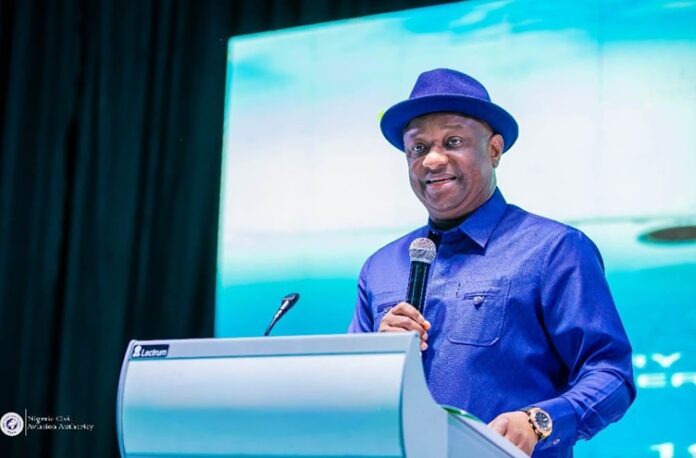
April 01, (THEWILL) — Nigeria is strategically positioning itself to unlock the vast economic potential of its aviation sector through bold policy reforms designed to attract global investment, strengthen institutional credibility, and drive long-term growth.
The Minister of Aviation and Aerospace Development, Festus Keyamo, SAN, disclosed this on Wednesday at the maiden Nigerian Aircraft Acquisition and Investigation Summit 2026 in Lagos, themed “Unlocking Capital Confidence and Capacity in Nigeria’s Aviation”.
Backed by President Bola Tinubu, the minister said the Federal Government has deliberately de-risked aviation investment through a mix of legal, financial and institutional reforms to boost investor confidence and unlock access to capital.

He explained that a major pillar of this strategy is Nigeria’s strengthened compliance with the Cape Town Convention and Aircraft Protocol, which protects the rights of aircraft financiers and lessors, thereby reducing the risks traditionally associated with the sector.
“Nigeria stands today at the threshold of a new aviation era — an era in which capital is more confident, institutions are more credible, and capacity is being deliberately built”, Keyamo declared.
He added that Nigeria is now ready to welcome global financiers, aircraft lessors, Original Equipment Manufacturers (OEMs), and development partners, noting that improved revenue repatriation and support for local Maintenance, Repair and Overhaul (MRO) development have strengthened the sector’s attractiveness.
Keyamo stressed that beyond attracting investment, the government’s focus is on translating capital inflows into tangible capacity — including fleet expansion, improved connectivity, stronger domestic airlines, and a skilled workforce.
“Let us unlock the full potential of Nigeria’s aviation industry. Let us build an ecosystem that is investable, competitive, sustainable and globally relevant”, he said.
Citing projections by Boeing, the minister noted that Africa will require over 1,200 new aircraft and more than 70,000 aviation professionals in the next two decades. He emphasised that Nigeria’s strategy integrates aircraft acquisition with local MRO capabilities, training pipelines, efficient airport systems, cargo development, and digital operations.
“Aircraft acquisition cannot be discussed in isolation… That is how we intend to capture full aviation value rather than merely importing lift capacity”, he added.
Highlighting aviation’s broader economic impact, Keyamo noted that while air cargo accounts for less than one per cent of global trade volume, it represents about 35 percent of trade value.
“It means our aviation strategy must extend beyond passenger traffic… to deliberate development of cargo hubs, cold-chain systems, smart border processes, and airport ecosystems that support trade, manufacturing, agribusiness and pharmaceuticals”, he explained.
Keyamo said key cities such as Lagos, Abuja, Kano and Port Harcourt are being repositioned as economic gateways capable of driving export competitiveness and industrial growth.
The Director-General of the Nigeria Civil Aviation Authority, Capt. Chris Najomo, said Nigeria has taken decisive steps to improve the regulatory environment by domesticating the Cape Town Convention in the Civil Aviation Act 2022. He added that the implementation of the Irrevocable De-registration and Export Request Authorisation (IDERA) has significantly enhanced aircraft leasing and financing in Nigeria.
“NCAA is enforcing IDERA with fidelity; so aircraft financiers and lessors alike have nothing to worry about when it concerns the resolve of the regulator”, Najomo said.
He, however, cautioned airlines against uncoordinated fleet expansion, urging them to align aircraft acquisition with operational needs and maintenance capacity.
“Expanding fleet size without corresponding maintenance capability limits the overall benefits of investment and leads to significant capital outflow”, he warned.
Also speaking, the Managing Director of the Nigerian Airspace Management Authority, Dr Ahmed Farouk, described Nigeria as one of Africa’s most promising untapped aviation markets.
He said the government is strengthening oversight, improving transparency, and enforcing compliance to ensure that investments are protected.
“You need assurance that the system can support your investment. That assurance is what we are building”, Farouk said.
The summit drew participation from airline operators, financiers, regulators, and representatives of the Central Bank of Nigeria and the Infrastructure Concession Regulatory Commission, underscoring a coordinated national push to transform the aviation sector.

Felix Ifijeh is a journalist with years of professional reporting experience. Known for his keen news sense, compelling storytelling and commitment to accurate, impactful reporting, he has built a reputation for turning leads into clear, engaging, and well-structured reports that resonate with readers. His work reflects deep newsroom experience and a commitment to accurate, impactful journalism.
