
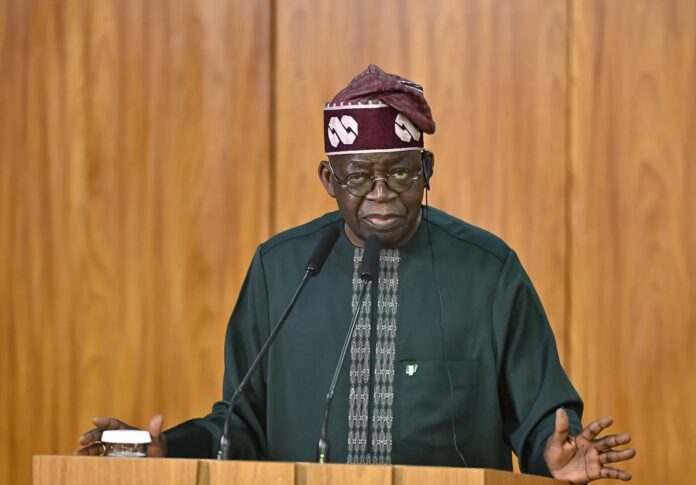
May 30 (THEWILL) — President Bola Tinubu has insisted that Nigeria would have slipped into bankruptcy if his administration had failed to remove fuel subsidy, maintaining that the policy decision prevented fiscal collapse and set the economy on a path to recovery.
THEWILL reports that Tinubu made the declaration on Friday while hosting state governors who paid him a Sallah visit and joined in commemorating the third anniversary of his administration.
Present at the gathering were the governors of Lagos, Nasarawa, Jigawa, Sokoto, Kebbi, Taraba, Niger, Ekiti, Delta, Ondo, Edo, Adamawa, Benue, Enugu, Ogun, and Kogi states, alongside the deputy governors of Borno and Kano states.

Defending one of the most consequential policies of his administration, Tinubu acknowledged the hardship that followed the subsidy removal but argued that the move was unavoidable given the country’s worsening fiscal condition at the time he assumed office.
According to him, Nigeria had for years spent vast resources sustaining a subsidy regime that largely benefited a few individuals while draining public finances and limiting investments in critical sectors.
“It was challenging at the time, but we survived. We faced litigation and accusations. We survived them. Instead of bankruptcy, Nigeria has survived. The economy has recovered. It is growing. Agriculture is booming,” the President said.
Tinubu credited governors and Nigerians for supporting the administration through what he described as painful but necessary reforms, saying their patience and perseverance had helped stabilise the country. He pointed to ongoing infrastructure projects, expanding agricultural investments, and renewed economic activities as evidence that the reforms were beginning to yield results.
The President specifically highlighted the development potential of the Sokoto-Badagry corridor, noting that investments in dams, irrigation systems, and electricity infrastructure would significantly boost agricultural productivity and economic growth.
“Many of you have survived and promoted the perseverance of many of our people, asking them to trust this government, and you have built that trust around one person: my leadership. I thank you very much,” he said.
Tinubu further argued that reforms in foreign exchange management, fiscal discipline, social investment programmes, and infrastructure development were restoring investor confidence and strengthening macroeconomic fundamentals.
Expressing satisfaction with the financial position of many states, the President said governors were no longer relying heavily on federal government interventions to pay salaries and meet basic obligations.
“I’m glad governors are no longer borrowing from the federal government and asking for interventions and not knowing how to survive, how to pay salaries, no more. You kept the spirit, you kept the hope. You persuaded our people to be patient and endure these three years of painful reform, during which we put the economy on a reset. Today, the benefits are showing,” he said.
According to Tinubu, major road projects abandoned by previous administrations are being rehabilitated while the housing sector is gradually rebounding.
“The economy has recovered. Macroeconomic indices are doing very well. Construction is ongoing on roads and infrastructure; the ones abandoned have been rehabilitated. The housing industry is coming on very well. Agriculture will prosper again. We will achieve food sovereignty if we utilise the land that is in your possession and in your various states effectively,” he added.
The President assured Nigerians that his administration would continue to pursue policies aimed at reducing economic hardship, creating jobs, strengthening food security, and delivering inclusive growth.
Vice President Kashim Shettima commended Tinubu’s resolve in implementing reforms many previous administrations avoided, describing the subsidy removal as a courageous intervention against decades of entrenched inefficiencies in the oil sector.
“You did not come to power in the season of ease. You came at a time when the house required more than a caretaker. It required a builder with the courage to examine the foundation you inherited. In that defining hour, you chose not to postpone the surgery. You chose not to massage the wound. You chose to confront the contradictions that have held this country hostage for 50 years,” Shettima said.
Speaking on behalf of the Nigeria Governors’ Forum, Kwara State Governor AbdulRahman AbdulRazaq said the subsidy removal and broader fiscal reforms had significantly increased revenues available to states, enabling them to improve service delivery and execute development projects.
“I think the nation was shocked by the audacity of Mr President to implement that serious policy, but today, it benefited immensely from that policy,” AbdulRazaq said, adding that many states had reduced their dependence on borrowing, and some were now focusing on debt reduction rather than issuing new bonds.
The governor also urged the President to consider supporting a future review of the national minimum wage to N100,000.
Similarly, Chairman of the Progressive Governors Forum and Imo State Governor Hope Uzodinma praised Tinubu for steering the country away from economic collapse through bold reforms.
“You have virtually recovered Nigeria from the brink of collapse to a state of stability and survival,” Uzodinma said, adding that governors had assessed the President’s performance and awarded him a “100 per cent” score.
Earlier, Lagos State Governor Babajide Sanwo-Olu welcomed his colleagues to Lagos for the Sallah celebration and thanked them for their support for the President and his reform agenda.
Felix Ifijeh is a journalist with years of professional reporting experience. Known for his keen news sense, compelling storytelling and commitment to accurate, impactful reporting, he has built a reputation for turning leads into clear, engaging, and well-structured reports that resonate with readers. His work reflects deep newsroom experience and a commitment to accurate, impactful journalism.
