April 07, (THEWILL) – Nigeria’s oil and non-oil exports to the United States of America face severe challenges following President Donald Trump’s recent imposition of 14 per cent tariff on exports from Nigeria to the USA, claiming that his country pays 27 per cent tariff on her exports to Nigeria.
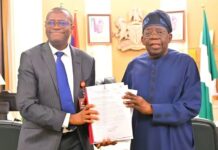
Admitting that the imposed 14 per cent reciprocal tariff has the prospect to negatively impact Nigeria’s oil and non-oil exports, Minister of Industry, Trade and Investment, Dr. Jumoke Oduwole on Sunday, said the imposed tariff could potentially disrupt trade relations and undermine the competitiveness of Nigerian products in the US market, especially in sectors reliant on market access and price competitiveness.
“A significant portion of Nigeria’s exports over 90 per cent comprises crude petroleum, mineral fuels, oils and gas products. The second-largest export category accounting for approximately 2–3 per cent, includes fertilizers and urea, followed by lead, representing around one per cent of total exports valued at approximately $82 million,” Oduwole said, adding,

“Nigeria also exports smaller quantities of agricultural products such as live plants, flour, and nuts, which account for less than two per cent of our total exports to the US.
“While oil has long dominated Nigeria’s exports to the US, non-oil products, many previously exempt under AGOA, now face potential disruption.
“A new 10 per cent tariff on key categories may impact the competitiveness of Nigerian goods in the US. For businesses in the non-oil sector, these measures present destabilising challenges to price competitiveness and market access, especially in emerging and value-added sectors vital to our diversification agenda.”
Oduwole lamented the implication of the tariff on smaller businesses that rely on the African Growth and Opportunity Act, AGOA, exemptions. She said the SMEs “would feel the brunt of the new tariff, with rising costs and uncertain buyer commitments likely to make market access even more difficult.”
She was however optimistic about the future, saying, “This development strengthens Nigeria’s resolve to boost its non-oil exports by strengthening quality assurance, control, and traceability in Nigerian exports to meet global standards and improve market acceptance into more economies across the globe.”
She reiterated the Federal Government’s commitment to mitigating the impact while accelerating economic diversification.
According to the minister, Nigeria’s exports to the United States have averaged $5–6 billion annually in the last two years.
THEWILL recalls that in a sweeping move aimed at reshaping global trade dynamics, US President Donald Trump last week Wednesday announced a 10 per cent tariff on imports from all countries, with additional levies targeting about 60 nations deemed the “worst offenders” in trade imbalance.
Citing economic security concerns, the White House described the decision as a national emergency response to what it called unfair treatment of the United States in global trade. The move, which takes effect on April 5, 2025, is anchored on the International Emergency Economic Powers Act of 1977 (IEEPA), allowing the president to take action against economic threats.
The White House justified the tariffs as a corrective measure against countries engaged in currency manipulation, excessive value-added taxes (VAT) and restrictive trade policies that disadvantage American businesses.
According to the proclamation, foreign trade practices have weakened US manufacturing, disrupted critical supply chains, and made the country’s defense-industrial base vulnerable.
The 10 per cent blanket tariff applies to all imports, while nations with the largest trade surpluses against the U.S. will face even higher reciprocal tariffs starting April 9, 2025.
The White House emphasised that the tariffs would remain in place until the administration determines that US trade partners have taken “significant steps” to address trade imbalances.
The order also grants Trump the authority to increase levies if trading partners retaliate or reduce them if they comply with U.S. demands.
Certain goods, including pharmaceuticals, semiconductors, steel, and critical minerals that are not available in the US will be exempted from the tariffs. However, non-compliant imports from Canada and Mexico outside the US-Mexico-Canada Agreement (USMCA) will face tariffs of up to 25 per cent.
Trump’s tariff decision has drawn swift reactions from major trading partners, with concerns that the move could escalate into a full-blown trade war.
With tensions rising, analysts warn that Trump’s tariff escalation could trigger retaliatory measures from affected nations, further straining global trade relations.
In her reaction, the Director-General of the World Trade Organisation, Dr. Ngozi Okonjo-Iweala, has called for more consultations and negotiations among world leaders to avoid a trade war that would send countries on a damaging inflationary spiral.
Oduwole, however, disclosed that the Federal Government was putting measures in place to address the development. These actions, according to her, include expanding alternative exports to the USA, “enhancing quality control and traceability for Nigerian goods and strengthening trade diplomacy” to secure favourable terms.
On a larger scale, Nigeria will consult with USA trade representatives and the WTO to address the implications of the new tariff.
Meanwhile, prices of Brent crude tumbled after China announced retaliatory 34 per cent tariffs on US goods, in line with Trump’s new 34 per cent tariffs against the Asian giant.
Also, a tariff-induced drop in demand for crude oil comes as the Organization of the Petroleum Exporting Countries, OPEC, announced it is increasing output to 411,000 barrels per day in May, up from the previously planned 135,000 barrels per day, the organisation said.
Brent crude, the benchmark for global oil prices, dropped $4.57 to $60 a barrel. Moreover, the US stock market has lost about $6 trillion over Trump’s new tariffs.

Felix Ifijeh is a journalist with years of professional reporting experience. Known for his keen news sense, compelling storytelling and commitment to accurate, impactful reporting, he has built a reputation for turning leads into clear, engaging, and well-structured reports that resonate with readers. His work reflects deep newsroom experience and a commitment to accurate, impactful journalism.