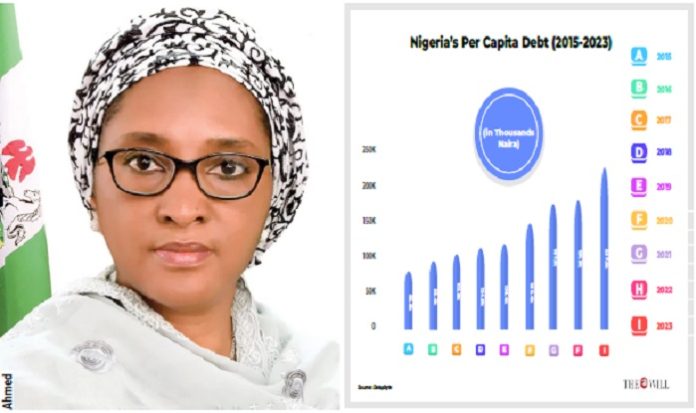
Nigeria’s current total public debt of N70 trillion Naira, if shared among the country’s estimated population of 220.2 million, places a debt burden of N317,850 on each citizen, according to data compiled by THEWILL. The 774 local government areas of the country will also be liable to N90.5 billion each as their share of the total public debt.
The N70 trillion public debt is made up of N46.25 trillion of the federal and state governments, and N23,70 trillion borrowed by the federal government from the Central Bank of Nigeria (CBN) through ways and means. The current population of Nigeria is 220,229,992 as of Friday, April 7, 2023, based on Worldometer elaboration of the latest United Nations data.
The Debt Management Office (DMO) disclosed last month (March 2023) that Nigeria’s debt profile as of December 31, 2022 is N46.25 trillion or $103.1 billion. It further said there was an increase of over N7 trillion from what the country owed in 2021.

“Total Public Debt Stock consisting of the Domestic and External Debt Stocks of the Federal Government of Nigeria (FGN) and the sub- national governments (the 36 State Governments and the Federal Capital Territory) was N46.25 trillion or $103.1bn. The comparative figure for December 31, 2021, is N39.5tr or $95.77bn.
“In terms of composition, Total Domestic Debt Stock was N27.55tr ($61.42bn) while total external debt stock was N18.7tr ($41.6bn),” the DMO said in a statement on March 31, 2023.
It further stated that the reasons for the increase in the total public debt stock were new borrowings by the Federal Government and sub-national governments, primarily, to fund budget deficits and execute projects.
In what seemed a calculated means to calm frayed minds, the debt management agency said the debt-to-GDP ratio of 23.20 percent is within the 40 percent limit self-imposed by Nigeria, the 55 percent limit recommended by the World Bank/International Monetary Fund, and the 70 percent limit recommended by the Economic Community of West African States.
However, experts have argued that what should constitute a priority to the federal government should be debt-to-revenue ratio due to the consequences of spending more than we earn. One of them is Paul Alaje, Senior Economist and Partner at SPM Professionals who cautioned against relying on the “misleading concept” of debt-to-GDP which does not show the reality of the situation.
The Minister of Finance, Budget and National Planning, Mrs Zainab Ahmed, had disclosed at the public presentation of the 2023 budget in Abuja that the Federal Government planned to securitise the N23.7 trillion ways and means issued by the CBN.
“The President has approved the securitisation of the ways and means balances with the amount being N23.7 trillion and a 40 years moratorium on principal repayment, three years and pricing interest rate 9 per cent.
“The CBN ways and means has built up over eight years from 2014-2022 to the current amount and we are hopeful that the National Assembly will pass it as requested by Mr President,” Ms Ahmed added.
Alaje who condemned the accumulation of over N23 trillion through Ways and Means under Buhari posited that securitising the facility into a 40-year Treasury Bill would not help the economy without fixing the fundamental problem of productivity.
Analysts express worry over the worsening economic situation in the country and the macroeconomic challenges it triggers as the citizens’ living standard deteriorates by the day. A Labour Economist, Mitchel Daniel said the current economic climate in Nigeria creates a frightening picture of the future for the people.
“Virtually all development indices are against Nigeria; there is nothing that evokes hope or strengthens the heart of the ordinary citizen when compared to the mountain pains that the high debts bring,” Daniel told this newspaper in a telephone chat, citing the raging inflation (21.91 percent in February 2023) and high unemployment (33 percent) rates, as well as weak Naira and large population of out-of-school children in Nigeria.
An Abuja-based media research and data analytical firm, Dataphyte, had earlier in the year projected that Nigeria’s Debt per capita may hit over two Hundred thousand naira in 2023. An earlier report by Dataphyte had shown that the country planned to generate the sum of N8.64 trillion with an estimated expenditure of N19.76 trillion in its 2023 budget estimate which was a fall from the N9.97 trillion estimated as revenue for 2022.
“This would mean that the budget deficit of the country is expected to hit N11.12 trillion in 2023 which will push up the country’s debt profile, currently put at N41.60 trillion, to N52.72 trillion,” the data building organisation said.
Between 2015 and 2022, Nigeria’s per capita debt has continued to rise, amounting to 175.71 percent increase within the period, Dataphyte said, raiding the cost of debt servicing to unimaginable level.
Ms. Ahmed had stunned the nation when she announced at the public consultation on the draft 2023-2025 Medium Term Fiscal Framework/Fiscal Strategy Paper (MTFF/FSP) in Abuja that the cost of debt servicing surpassed Federal Government’s retained revenue by N310 billion in the first four months of 2022.
The scenario has forced the government at all levels to increase their tax revenue drive even when the citizens are not benefitting from what the government should be providing such as infrastructure, healthcare, power, education and security. “This contradiction is largely responsible for the worsening state of poverty in the country,” Daniel argued.
In its Multidimensional Poverty Index (MPI) report published in November 2022, the Federal Government through the National Bureau of Statistics (NBS) revealed that 63 percent of persons living within Nigeria (133 million people) are multi-dimensionally poor.
It stated that 65 percent of the poor (86 million people) live in the North, while 35 percent (nearly 47 million) live in the South. Poverty levels across States vary significantly, with the incidence of multidimensional poverty ranging from a low of 27 percent in Ondo to a high of 91 percent in Sokoto.
“Multidimensional poverty is higher in rural areas, where 72 percent of people are poor, compared to 42 percent of people in urban areas,” the report stated.
The poverty level reflects on the dwindling standard of living across the states and worsening the misery index — a yardstick of economic distress..
Nigeria’s misery index rose by 11.9 percentage points to 73.05 percent in March 2023. The misery index is a measure of economic distress felt by everyday people, due to the risk of (or actual) joblessness combined with an increasing cost of living. The misery index is calculated by adding the seasonally adjusted unemployment rate to the inflation rate.
Nigeria also has more than 10 million out-of-school children — the highest rate in the world, occasioned by deteriorating economic situation and poor standard of living.
Commentators on economic and political affairs have advised the incoming government to focus on revitalising the critical areas of the economy especially agriculture and manufacturing as well as curbing insecurity.

Sam Diala is a Bloomberg Certified Financial Journalist with over a decade of experience in reporting Business and Economy. He is Business Editor at THEWILL Newspaper, and believes that work, not wishes, creates wealth.