

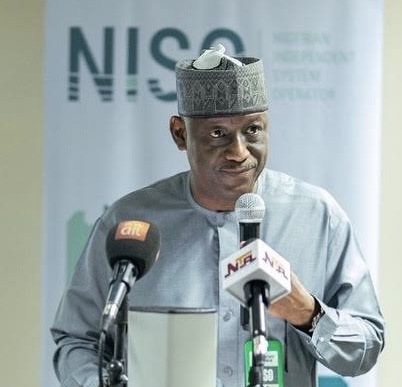
July 6, (THEWILL) — The Nigerian Independent System Operator (NISO) has declared operational efficiency as its top priority, warning that persistent underutilisation of the national electricity grid has cost Nigeria more than ₦2.376 trillion in capacity payments over the past 11 years.
Managing Director and Chief Executive Officer of NISO, Mr Abdu Bello, disclosed this at the 11th Nigeria Energy Forum 2026 (NEF-2026) Conference in Lagos.
Bello, who was represented by the organisation’s General Manager, Research, Mr Deji Ojo, said the establishment of NISO was repositioning Nigeria’s electricity sector from infrastructure expansion to operational excellence, market efficiency, reliability and industrial competitiveness.

The conference, themed “Upscaling Value Addition for Sustainable Industrialisation”, brought together policymakers, investors, energy experts and industry stakeholders to discuss strategies for accelerating Nigeria’s industrial growth through sustainable energy solutions.
Bello said Nigeria had an available electricity generation capacity of 7,311 megawatts (MW) as of May 2026, but only an average of 4,222MW was being dispatched to consumers, leaving about 3,162MW of available generation capacity stranded and unutilised.
“As of May 2026, Nigeria had an available generation capacity of 7,311MW, but the average dispatched generation that was produced and translated into economic value was just 4,222MW. You will discover that about 3,162MW is stranded capacity and not being converted to economic use”, he said.
According to Bello, one of NISO’s major objectives is to ensure that existing electricity generation capacity is efficiently converted into economic value by improving grid operations and eliminating system bottlenecks.
“The major goal of NISO is to translate the existing megawatts into economic use”, he added.
Also speaking, the Group Managing Director of Odu’a Investment Company Limited, Mr Abdulrahman Yinusa, described reliable electricity as the foundation of industrial development.
Represented by the company’s Executive Director, Investment and Business Development, Mr Yemi Ajao, Yinusa said Nigeria possessed abundant raw materials but must focus on processing them into finished products rather than exporting them in their crude form.
“Nigeria sits on the raw materials the world wants most. The question is whether we turn them into finished products or keep giving them away cheaply”, he said.
The Chief Executive Officer of All On, Caroline Eboumbou, represented by Senior Grant Associate Jadesola Rawa, said Nigeria’s energy future would be shaped not only by government policies and investments but also by the ingenuity of its people.
She noted that All On’s partnership with the Tertiary Institutions Student Energy Challenge (TIEC) had continued to nurture innovation, with several previous winners receiving additional support to strengthen their businesses and commercialise their clean energy solutions.
The Executive Secretary of the Nigerian Content Development and Monitoring Board (NCDMB), Mr Omatsola Ogbe, represented by the Board’s General Manager, Monitoring, Mr Suleiman Ozimede, urged Nigerians to embrace made-in-Nigeria products while maximising indigenous human and material resources to achieve sustainable development.
Similarly, the Executive Vice Chairman of the National Agency for Science and Engineering Infrastructure (NASENI), Khalil Halilu, said the agency was building an integrated ecosystem where innovation would be conceived, manufactured and commercialised locally.
Representing the Rural Electrification Agency (REA), Senior Adviser on Strategy, Abba Hayatudeen, said Nigeria’s future would be determined by the number of businesses empowered, industries revived and prosperity unlocked through sustainable energy.
Mrs Ibironke Olubamise, National Coordinator of the Global Environment Facility (GEF) Small Grants Programme in Nigeria, said the programme was helping communities tackle environmental challenges while improving livelihoods through targeted financing.
Speaking on the evolution of the forum, NEF Co-Chair, Mr Adekunle Makinde, said the initiative had become a bridge between young innovators and investors, ensuring promising university research projects no longer ended up abandoned after graduation. He said the forum had successfully attracted grant funding and investment support to help young innovators scale up clean energy solutions.
Also speaking, Chief Executive Officer for Africa at KoBold Metals, Mfikeyi Makayi, said artificial intelligence was revolutionising mineral exploration through advanced sensors, predictive models and data-driven decision-making.
The Director-General of the Raw Materials Research and Development Council (RMRDC), Prof. Nnanyelugo Ike-Muonso, reaffirmed the council’s commitment to promoting the optimal utilisation of Nigeria’s raw materials to drive sustainable industrial growth.
Mr Febisola Oyeniyi, General Manager, Enterprise Sales at MTN, stressed the growing convergence between digital technology and sustainability.
According to him, “Digital is powering the future of energy. Sustainability is powering the future of digital. Together, both will power Nigeria’s future.”
The Director-General of the National Board for Technology Incubation (NBTI), Kazeem Raji, said the board was established to bridge the gap between innovation and industrialisation by supporting technology-based enterprises.
Meanwhile, NEF Innovation Director, Bamise Olanrewaju, disclosed that the All On TIEC 4.0 competition attracted 107 pitch decks from 36 tertiary institutions across 20 states.
He said Coolbox, led by Samuel-Rotua Richard of the University of Lagos, won both the First Prize and Public Vote Award, while AutaNet, led by Fadekemi Haruna, and DP2P Energy Trading, led by Muhammad Abdulraheem, both from the Federal University of Technology, Minna, emerged second and third, respectively.
In his opening remarks, the Chairman of the Nigeria Energy Forum, Oluwole Daniel Adeuyi, said the 2026 conference theme reflected Nigeria’s opportunity to transform its abundant resources into competitive industries capable of creating jobs, boosting exports and delivering sustainable prosperity.
“The future belongs to nations that add value, manufacture competitively, innovate boldly and build resilient industries”, Adeuyi said.

Felix Ifijeh is a journalist with years of professional reporting experience. Known for his keen news sense, compelling storytelling and commitment to accurate, impactful reporting, he has built a reputation for turning leads into clear, engaging, and well-structured reports that resonate with readers. His work reflects deep newsroom experience and a commitment to accurate, impactful journalism.



