
July 05, (THEWILL) — Federal Government has dismissed allegations that it operated a “shadow treasury” through more than ₦8 trillion in off-budget spending, insisting that every kobo of public expenditure under the administration of President Bola Tinubu is backed by the Constitution and relevant laws enacted by the National Assembly.
The government was responding to claims by former Vice President and African Democratic Congress (ADC) presidential candidate, Atiku Abubakar, who alleged on Saturday that the Tinubu administration had expended about ₦8.8 trillion outside the country’s approved budget, citing the International Monetary Fund’s (IMF) 2026 Article IV Consultation Report.
THEWILL recalls that Atiku had alleged on Saturday that about ₦8.8 trillion in public expenditure had been executed outside Nigeria’s approved budget and described the development as evidence of fiscal impunity.

The former Vice President had called for emergency investigations by the National Assembly, the Office of the Auditor-General of the Federation and anti-corruption agencies, while also urging the Federal Government to account for all expenditures allegedly incurred outside the budgetary framework.
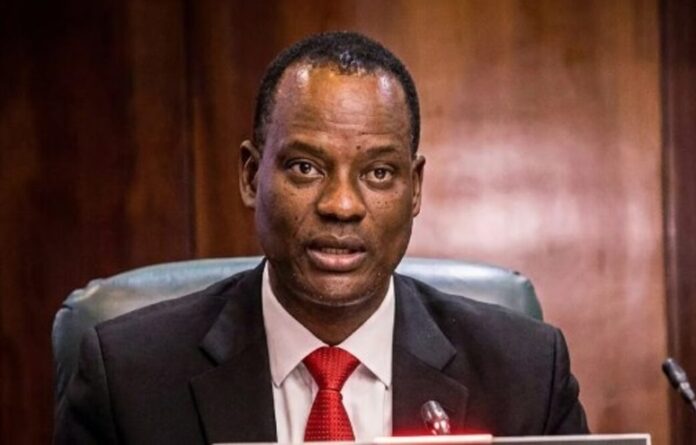
In a statement issued on Sunday, the Minister of Finance and Coordinating Minister of the Economy, Taiwo Oyedele, said Atiku’s interpretation of the IMF report was inaccurate and capable of misleading the public on the true state of Nigeria’s public finances.
According to the ministry, recent public commentary suggesting that approximately two per cent of Nigeria’s Gross Domestic Product (GDP), estimated at over ₦8 trillion, was spent outside the approved budget was a misrepresentation of both the IMF’s observations and Nigeria’s constitutional fiscal framework.
“The Federal Government has noted recent public commentary alleging that approximately two per cent of GDP amounting to over ₦8 trillion was spent outside the approved budget based on references to the IMF Representative in Nigeria and the Fund’s 2026 Article IV Consultation Report.
“These claims are incorrect and risk misleading the public regarding the government’s financial management,” the statement read.
The ministry stressed that the Federal Government does not operate a “shadow budget” or expend public funds outside the constitutional and statutory framework governing public finance.
It explained that Sections 80 to 83 and 162 of the 1999 Constitution (as amended) clearly regulate the withdrawal and expenditure of public funds, noting that every expenditure undertaken by the Federal Government is authorised through duly enacted Appropriation Acts, Supplementary Appropriation Acts or other statutory instruments approved by the National Assembly.
The government further explained that many capital projects span several fiscal years and are implemented through approved capital rollovers and other lawful budgetary mechanisms.
According to the ministry, these are recognised features of public financial management and should not be interpreted as expenditures executed outside legislative approval.
“It is inaccurate to suggest that trillions of naira have been secretly spent outside legislative approval. Such allegations should identify the specific projects purportedly executed without appropriation or legal authority and present credible evidence in support of the claim.
“Assertions of this magnitude must be supported by verifiable facts rather than conjecture,” the statement added.
Seeking to clarify the issues raised, the ministry said public discourse had failed to distinguish between appropriation, expenditure authorisation, financing arrangements and fiscal reporting, resulting in widespread misconceptions about the IMF’s observations.
It explained that Nigeria’s public finance architecture provides for several categories of expenditure that are authorised directly by law rather than through the annual Appropriation Act.
Among these, the ministry listed statutory allocations to agencies and development commissions established by Acts of the National Assembly, cost-of-collection and administrative charges retained by designated revenue-generating agencies, separate capital budgets approved for certain federal agencies and the Federal Capital Territory, statutory debt service obligations and legally approved intervention programmes for national priorities such as security, infrastructure development and disaster response.
The statement emphasised that none of these expenditures is secret or unlawful.
Rather, it said they are disclosed through various fiscal reports and remain subject to constitutional oversight, audit procedures and accountability mechanisms.
The ministry acknowledged that some of the expenditures may be presented differently in annual budget documents and fiscal reports because Nigeria applies international statistical and reporting standards used by many countries.
It maintained, however, that such classification differences should not be misconstrued as evidence of unlawful spending.
The government also rejected suggestions that the reported amount represented an increase in Nigeria’s fiscal deficit.
According to the ministry, a fiscal deficit is determined by the relationship between total government revenue and total expenditure and not by the financing mechanism through which projects are implemented.
It argued that projects financed through annual appropriations, supplementary budgets, statutory transfers or other lawful financing arrangements do not automatically increase the country’s fiscal deficit.
The ministry further stated that the IMF’s observations primarily concerned the comprehensiveness, timing and presentation of fiscal reporting rather than the legality of public expenditure.
It noted that Nigeria has continued to improve the alignment of its budget presentation with international fiscal reporting standards as part of ongoing public financial management reforms.
To underscore the administration’s commitment to greater fiscal transparency, the ministry recalled that President Tinubu had, while presenting the 2026 Appropriation Bill before a joint session of the National Assembly on December 19, 2025, urged lawmakers to discontinue the practice of operating multiple and overlapping budgets and instead harmonise government finances into a single, cohesive budget framework.
According to the ministry, the President’s proposal reflected the administration’s resolve to strengthen fiscal discipline and improve transparency in public finance management.
The Federal Government also highlighted several reforms, introduced under the Tinubu administration, including efforts to improve budget credibility, strengthen revenue administration, digitalise government financial processes and enhance treasury management.
It added that the reforms had been acknowledged by the IMF, other multilateral institutions, international credit rating agencies, investors, and major international media organisations.
While affirming that robust public debate remains essential in a democratic society, the ministry cautioned against misrepresenting technical observations contained in fiscal reports.
It argued that interpreting differences in fiscal presentation as evidence of illegal expenditure neither advances informed public discourse nor promotes democratic accountability.
“The Federal Government will continue to uphold the rule of law, maintain transparency in the management of public resources, and work with the National Assembly, oversight institutions, development partners and the Nigerian people to further strengthen fiscal governance in line with international best practices,” the statement concluded.

Felix Ifijeh is a journalist with years of professional reporting experience. Known for his keen news sense, compelling storytelling and commitment to accurate, impactful reporting, he has built a reputation for turning leads into clear, engaging, and well-structured reports that resonate with readers. His work reflects deep newsroom experience and a commitment to accurate, impactful journalism.
