

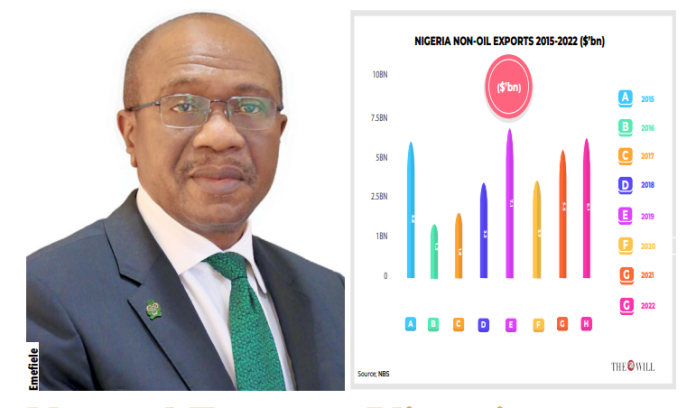
Following an aggressive diversification course championed by the Central Bank of Nigeria (CBN), the country earned a total of $22.6 billion (N8.8 trillion) from non-oil exports between 2019 and 2022, data by the National Bureau of Statistics (NBS) have shown.
The non-oil components, which are categorised differently from ‘Non-Crude Oil”, include agricultural products, solid minerals, raw materials and manufactured goods.
Non-oil exports amounted to $7.1 billion, $3.7 billion, $5.5 billion and $6.1 billion in 2019, 2020, 2021 and 2022 respectively (using average exchange rate for each year). The Naira equivalent was N2.56 trillion, N1.42 trillion, N2.25 trillion and N2.55 trillion respectively.

The major traded agricultural products include cocoa beans, sesame seeds, soya beans seeds, cashew nuts, frozen shrimps and prawns, and natural cocoa butter.
The country also exported in commercial quantities ginger, groundnuts, palm nuts and kernels, and various kinds of flowers.
Solid minerals include tin ores and concentrates, gold and white cement, while floating or submersible drilling/production platforms, unwrought aluminum alloys, cigarettes containing tobacco and beverages constitute manufactured goods.
‘Urea whether or not in aqueous solution’, ‘Nonmonetary gold (including gold plated with platinum) in powder form’ were in the raw material goods sector of the non-oil exports.
The CBN, which reinforced the non-oil export drive through its various intervention programmes and other domestic capacity enhancement initiatives, played a key role in boosting the non-oil export proceeds to $22.6 billion, compared to $12.5 billion (N3.35 trillion) in the previous four years (2015-2018).
The four-year periods correspond almost with the first and second tenures, respectively, of Godwin Emefiele as central bank of Nigeria governor. Emefiele was first appointed in June 2014 and re-appointed in June 2019. No available data was provided for non-oil exports for 2014.
The first four years of Emefiele’s tenure lagged behind his second tenure which kick-started with his 5-year strategic plan unveiled in Abuja on June 24 2019, tagged ‘5 year Policy Thrust of Central Bank of Nigeria 2019 – 2024’. The key components included 95 percent financial inclusion target and expanding the non-oil export ecosystem.
The apex bank has in this period intensified its various interventions aimed at stimulating production and productivity across the real sector. According to the communique on the March 2023 CBN Monetary Policy Meeting (MPC), the Bank disbursed N12.65 billion between January and February 2023, to three agricultural projects under the Anchor Borrowers’ Programme (ABP).
The pay-out brought the cumulative disbursement under the Programme to N1.09 trillion made to over 4.6 million smallholder farmers cultivating or rearing 21 agricultural commodities on an approved 6.02 million hectares of farmland across the country.
The Bank also released the sum of N23.70 billion under the N1.0 trillion Real Sector Facility (RSF) to eight new real sector projects in agriculture, manufacturing, and services. Cumulative disbursements under the RSF currently stands at N2.43 trillion which was disbursed to 462 projects across the country, comprising 257 manufacturing, 95 agriculture, 97 services and 13 mining sector projects.
Under the 100 for 100 Policy on Production and Productivity (PPP) the CBN has disbursed N114.17 billion to beneficiaries since commencement in January 2022. The funds were expended on 71 projects across healthcare, manufacturing and agriculture sectors.
The programme is for select 100 private sector companies with projects that have the potential to significantly increase domestic production and productivity, reduce imports, increase non-oil exports and overall improvements in the foreign exchange generating capacity of the Nigerian economy.
According to the guidelines for the implementation of the initiative, the CBN fixes the maximum loan amount that a participant could get at N5 billion. The initiative which is bank-led, is rolled over every 100 days (that is quarterly) with a new set of companies selected for financing under the initiative.
The Bank also released N3.01 billion under the Nigerian Electricity Market Stabilisation Facility (NEMSF-2) for capital and operational expenditure of distribution companies (Discos) aimed at improving their liquidity status and aid their recovery of legacy debt. The pay-out brouught the cumulative disbursement under the facility to N254.39 billion.
Another non-oil export promotion programme is the RT 200 FX. The scheme which was launched on February 10, 2022 to revolutionise non-oil export drive, stimulate domestic production and expand the frontier of diversification, has proved a success story in its first year. The RT 200 which stands for ‘Race to US$200 billion in Forex Repatriation’ constitutes blueprint that will enable Nigeria to attain the sky-high goal of US$200 billion repatriation, exclusively from non-oil exports over the next 3 to 5 years.
The scheme was created on five anchors, namely Value-Adding Exports Facility, Non-Oil Commodities Expansion Facility, Non-Oil FX Rebate Scheme, Dedicated Non-Oil Export and Terminal, Biannual Non-Oil Export Summit. Each of these anchors constitute a distinct and related channel of implementation of the scheme for measurable outcome.
The RT 200 FX includes a Non-Oil Exports Proceeds Repatriation Rebate Scheme, which incentivises exporters in the non-oil sector to repatriate and sell export proceeds in the official FX market. Under the scheme, CBN pays rebate of N65 for every dollar repatriated and sold in the Investors & Exporters (I&E) window to authorised dealer banks for third party use. The CBN also pays rebate of N35 for every dollar repatriated and sold into I and E for own use for eligible transactions only, provided the spread is not more than 10 kobo.
The apex bank also stipulated that payment of the incentives shall be quarterly with exporters that qualify credited within one week after the end of the quarter.
At the launch of the scheme in 2022, Emefiele, said, “I am mindful that this goal itself may appear unattainable to some people. But I am resolute and determined that we can achieve it. Many countries that are much less endowed than Nigeria are doing it. Consider for example that agriculture exports alone from the Netherlands was about US$120 billion last year. Yet, Netherlands has a land mass of about 42,000 square kilometers, which is much smaller that the land mass of Niger State alone, at over 76,000 square kilometers.”
At the second RT 200 Non-oil Summit in November 2022, the CBN disclosed that it had paid out a total sum of N81 billion to Nigerian exporters in in the year as rebates for repatriating their export proceeds in line with the RT 200 FX policy. It revealed that a total of $4.987 billion had also been repatriated into the country by non-oil exporters, higher than the $3.190 billion repatriated in 2021.
The payments were made in fulfilment of the apex bank’s promise to reward Nigerian exporters who repatriated their export proceeds as spelt out in the ‘Operating Guidelines for RT 200 FX Export Proceeds Repatriation Rebate Scheme’ published in February 2022. It has been stressed that the rebate scheme was designed to incentivise exporters in the non-oil sector to encourage repatriation and sale of export proceeds into the FX market.
The non-oil export promotion campaign has impacted the GDP positively over the years. The PDP non-oil sector grew by 4.44 percent in real terms in Q4 2022. This rate was lower by 0.29 percent points compared to the rate recorded same quarter of 2021 but 0.18 percent points higher than the third quarter of 2022.
According to the NBS, the non-oil sector was driven during the period mainly by Information and Communication (Telecommunication); Trade; Agriculture (Crop Production); Financial and Insurance (Financial Institutions); Manufacturing (Food, Beverage & Tobacco); Real Estate and Construction, accounting for positive GDP growth.
In real terms, the non-Oil sector contributed 95.66 percent to the nation’s GDP in the fourth quarter of 2022, higher than the share recorded in the fourth quarter of 2021 which was 94.81 percent and higher than the third quarter of 2022 recorded as 94.34 percent. Moreover, on aggregate 94.33 percent was contributed in 2022, higher than the 92.76 percent reported in 2021.
On the other hand, the real growth of the oil sector was negative: -13.38 percent (year-on-year) in Q4 2022 indicating a decrease of 5.33 percent points relative to the rate recorded in the corresponding quarter of 2021.
The oil sector contributed 4.34 percent to the total real GDP in Q4 2022, down from the figures recorded in the corresponding period of 2021 and the preceding quarter, where it contributed 5.19 percent and 5.66 percent respectively. The total annual contribution of oil to aggregate GDP in 2022 was 5.67 percent.

Sam Diala is a Bloomberg Certified Financial Journalist with over a decade of experience in reporting Business and Economy. He is Business Editor at THEWILL Newspaper, and believes that work, not wishes, creates wealth.



