
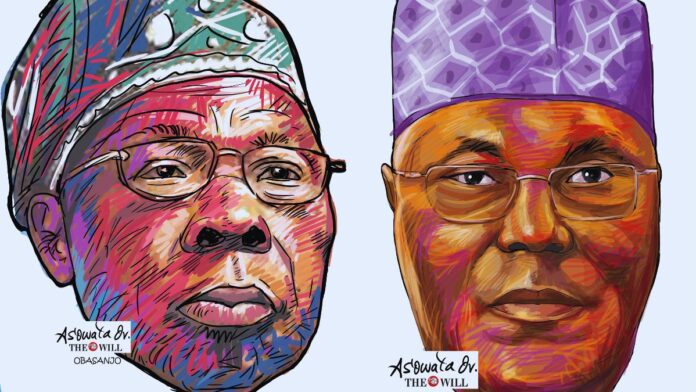
August 02, (THEWILL) — Few weeks before the August 19, 2026 start of electioneering for the 2027 presidential election, a campaign by proxy appears to have started by former President Olusegun Obasanjo regarding his tango with the Presidential candidate of the African Democratic Congress, ADC.
A week ago, Obasanjo alleged that Abubakar who served as his deputy paid N5 million to the late Speaker of the House of Representatives, Ghali Umar Na’Abba, to facilitate an impeachment plot against him. On Friday, he launched another attack. He said one of his biggest mistakes as President was picking former Vice President Atiku Abubakar as his running mate in the 1999 presidential election. They both served till 2007.
Speaking in Lagos during a fireside conversation with entertainer and activist Charles Oputa, popularly known as Charly Boy, at the public presentation of Charly Boy’s foundation and memoir, 999: A Memoir in Tribute to Late Justice Chukwudifu Oputa, Obasanjo said, “What I have found in my own life is that mistakes that could have been fatal, God had taken care of them for me. The man I picked as my running mate, my number two. If I had known him as I came to know him later, I would not have picked him.”

Asked to clarify his statement, he added, “Of course, what I know about him later… I would not have picked him. Thank God that God did not allow his actions and reactions to overwhelm me, divert my focus from Nigeria or harm Nigeria,” he said. Arguing that he habours no personal grudge against Abubakar, Obasanjo, added, “There’s no bitterness because he did what he believed he should do, and God did what God had to do, which enabled me to achieve what I was able to achieve.”
In his response, Atiku said the genesis of Chief Obasanjo’s hostility towards him is well known to Nigerians.
“I am proud that I stood against the third-term agenda. I am proud that I stood by the Constitution of the Federal Republic of Nigeria. I have no apology whatsoever for frustrating every attempt to subvert our democracy for personal ambition.”
“If Chief Obasanjo’s bitterness stems from my refusal to support an unconstitutional third term, then I wear that resentment as a badge of honour. No individual, regardless of his status or accomplishments, is bigger than the Federal Republic of Nigeria. The Constitution is supreme, and I chose Nigeria over personal loyalty.” Atiku noted that the struggle against the third-term agenda was never about two individuals but about preserving Nigeria’s constitutional democracy for future generations.
“The Nigerian people won that battle. Democracy won that battle. History has already delivered its verdict.” The former Vice President said it was therefore unfortunate that the same man whose unconstitutional ambition was resisted now seeks to sit in judgment over those who defended the Constitution. Atiku said it was particularly instructive that barely twenty-four hours before Chief Obasanjo’s latest outburst, the Director-General of the World Trade Organization (WTO), Dr. Ngozi Okonjo-Iweala, publicly paid glowing tribute to the economic management team he led, describing it as “the best Nigeria has ever had.”
“Whether or not the timing is merely coincidental is for Nigerians to judge. What is beyond dispute, however, is that while distinguished Nigerians who served at the highest levels continue to acknowledge my contributions to one of Nigeria’s most successful periods of economic management, Chief Obasanjo appears determined to diminish them.”
“Chief Obasanjo may choose not to appreciate my role in building one of Nigeria’s most prosperous economic eras, but history has been far kinder. The record speaks for itself, and so do the testimonies of those who worked closely with that administration.” Atiku further stated that Nigerians also deserve to remember the other side of history which Chief Obasanjo conveniently omits.
“History records that while Chief Obasanjo was in prison, I stood firmly by him. I supported his family, worked tirelessly with other patriots for his release and never wavered in my belief that he deserved his freedom.”
“When he eventually regained his freedom, he had little to his name. I received him, clothed him, ensured he was properly cared for and extended every support necessary to help him regain his footing. Beyond that, I mobilised political structures, built alliances and made enormous personal and political sacrifices that culminated in his emergence as President of the Federal Republic of Nigeria.”
Coming a week after his impeachment claims levied against Abubakar, analysts however say that delivering these salvo at a time when preparations for the 2027 general election is in top gear, Obasanjo’s remarks are timed to de-market the former Vice-President. While Obasanjo’s impeachment allegation has been robustly defended by Abubakar, the question of choice of a vice-presidential candidate is open to historical analyses.
Available information shows that the emergence of Obasanjo and Abubakar as candidates of the Peoples Democratic Party, PDP, was a marriage of convenience between the military wing of the party, and its civilian counterpart, particularly after the political fallout of the party’s National Convention in Jos in 1999, where Obasanjo defeated Chief Alex Ekwueme and Atiku and both groups need to mend fences. This result was an agreement reached among stakeholders to spring Abubakar from Adamawa where he was awaiting to be sworn in as governor, having won the election in December 1998. Obansajo’s choice was based on the need to have a tested politician who can help him navigate the slippery political terrains that emerged after the exit of the military from 29 years in power.
Their partnership the administration was so smooth that the administration ran like a tag-team champion whereby Abubakar held forth as Chairman of the National Economic Council, the National Council on Privatisation and several economic reform initiatives, enabling Obasanjo to embark on global tour, selling Nigeria as an emergent democracy to investors.
By the second term, however, things fell apart between them. Prominent in their disagreement was the attempt by President Obasanjo and his newfound allies to amend the Constitution to allow the president to secure a third term in office. Abubakar rallied his allies and the National Assembly to stop the move. The ensuing political battle between them was only resolved by the Supreme Court, which ruled against Obasanjo for declaring Abubakar’s seat vacant. Abubakar had to defect to the Action Congress, AC, ahead of the 2007 polls. Subsequent attempts to mend fences between them have been slim. A chance for both of them to embrace peace came during the 2019 general election when Abubakar ran as presidential candidate of the PDP.
But the support Obasanjo accorded Abubbakar during the 2019 polls following a peace deal brokered by Bishop of Sokoto Diocese of the Catholic Church, Hassan Kukah and Islamic cleric, Sheikh Abubakar Gumi, did not last. Accusations of corruption, betrayal and disloyalty have characterised their relationship since then. Election years always present opportunities for Obasanjo to rub in his accusations.
But Abubakar has been equal to the task. Defending his position on the Na’Abba matter, Abubakar described the accusation as an attempt to rewrite history for political gain ahead of the 2027 general election.
According to his Senior Special Assistant on Public Communication, Phrank Shaibu, the presidential candidate of the ADC accused his former principal of making an allegation that could no longer be subjected to public scrutiny because the individual allegedly at the centre of the claim was no longer alive.
According to him, waiting until Na’Abba’s death before making the accusation deprived Nigerians of the opportunity to hear the other side of the story and violated the moral obligation to speak truthfully about those who have passed on.
“As Africans, we understand the solemn duty of speaking truthfully about the dead. It is deeply troubling that former President Obasanjo has chosen this moment to allege that I bribed the late Rt. Hon. Ghali Umar Na’Abba to impeach him. If this allegation were true, why did he not make it while Rt. Hon. Na’Abba was alive? Why wait until the only man who could confirm or refute the claim has departed this world?” he queried. Atiku maintained that accusing a deceased public official of accepting a bribe without giving him an opportunity to defend his integrity amounted to dragging the dead into contemporary political battles.
Felix Ifijeh is a journalist with years of professional reporting experience. Known for his keen news sense, compelling storytelling and commitment to accurate, impactful reporting, he has built a reputation for turning leads into clear, engaging, and well-structured reports that resonate with readers. His work reflects deep newsroom experience and a commitment to accurate, impactful journalism.
