
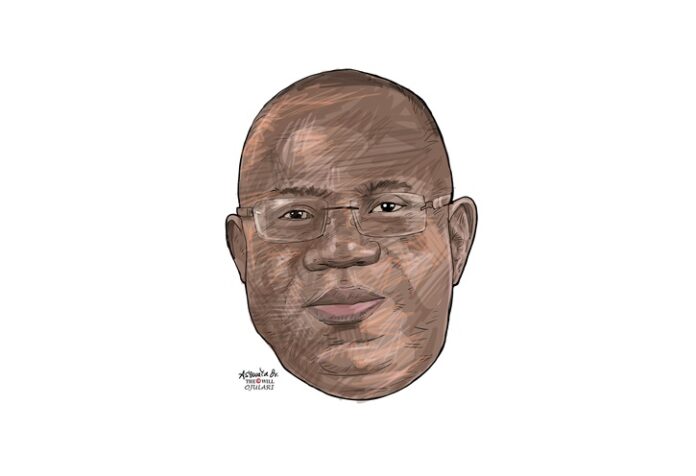
September 01, (THEWILL) — Engr. Bashir Bayo Ojulari, Group Chief Executive Officer (GCEO) of the Nigerian National Petroleum Company (NNPC) Limited, has been on summer lessons in the organisation since August.
Since his appointment to the enviable position last April, the behemoth national oil company, notorious for being Nigeria’s cesspool of corruption, has been in the news with mixed sentiments.
At one time, it was good news about increased oil production or huge remittances to the Federal Government beyond the tardy levels in the previous administration. At the other time was the worrying news of surreptitious moves to oust Ojulari from his coveted seat. This anomaly took a dramatic dimension during the summer month of August when a popular online news outlet packaged the story of Ojulari’s arrest, detention, suspension ….

The story, which congested the social media space and went extremely viral, reported how Ojulari was “ceased” by security and anti-graft fighting operatives and forced to resign. In the end, however, the narrative turned out to be fake news. The new NNPCL GCEO is still in his position. However, events of last week have been quite troubling following alleged threats to Ojulari’s life.
Alarm by the ‘Reformist’
Ojulari had raised the alarm over threats to his life and those of his management team. He made this disclosure on Thursday, August 28, 2025, in Abuja while receiving a delegation of the Petroleum and Natural Gas Senior Staff Association of Nigeria (PENGASSAN) led by its president, Festus Osifo.
According to him, his priorities on assuming office was to carry out a rapid review of the refineries. That exercise revealed that the company was losing between N300 million and N500 million monthly from refinery operations, with Port Harcourt being a major source of the drain.
Ojulari explained to his bewildered audience that about 950,000 barrels of crude were pumped to the facility as cargo, but analysis of inputs and outputs showed that less than 40 percent of what went in was being processed effectively.
This was a normal situation in NNPCL under the immediate past GCEO, Mallam Mele Kyari.
“So, the first thing we then said was that rather than continue to lose, let’s quickly stop and look for a way to put the refinery into a sustainably profitable venture, but also a means of sustainable employment.”
For Ojulari, “There’s no need for us to pretend. So, there was no negative political pressure for NNPC to just continue to run at a loss.”
Ojulari said his only “offence” was introducing reforms in the oil and gas sector in line with the mandate given to him by President Bola Tinubu to revive the nation’s moribund refineries.
The backlash
Ojulari stressed that the reforms had unsettled vested interests, triggering coordinated attacks against him and his management team, including petitions to the Economic and Financial Crimes Commission (EFCC).
“We are under attack. It is real. There are formidable plans to take me out of this seat. But we are determined to stay focused and deliver on the mandate given to us by President Tinubu,” Ojulari said.
The ‘spoiler’ game
It is clear that Ojulari has played the spoiler game. Under the former President Muhammadu Buhari-led 8-year administration, on the platform of the All Progressives Congress (APC), the NNPCL showcased itself as a theatre of bazaar where Nigerian taxpayers’ money was burnt on the crest of waste and corruption.
Before Ojulari’s tenure, the Port Harcourt Refinery was on an endless stream of rehabilitation and constituted a window for massive treasury looting. Different arms of government devised a means to take their own share – ministers, lawmakers, party chieftains, political appointees … Just mention Port Harcourt Refinery. You are on course.
THEWILL recalls that NNPC Ltd had in July 2023 promised that the Port Harcourt Refinery would resume production in December of that year, later shifted to April, August, September … without results.
While Nigerians awaited the outcome of the promises, the Senate on October 24, 2023 constituted an ad-hoc committee to investigate all contracts estimated at over N11.35 trillion awarded for the rehabilitation of the four moribund refineries in the country, without results.
Ten months after the Senate embarked on the elusive probe of the endless maintenance of Nigeria’s moribund refineries, the upper and lower legislative chambers jointly commenced a similar exercise in August, 2024.
Following fresh controversies trailing the nation’s oil and gas industry, especially in the aspects of sabotage, corruption and oil theft, the Speaker of the House of Representatives, Abbas Tajudeen, named a seven-member committee to probe alleged economic sabotage in the oil and gas sector.
On its part, the Senate also raised an Ad Hoc Committee to Investigate the Alleged Economic Sabotage in the Nigerian Petroleum Industry. The upper legislative chamber expressed concerns over the $1.5 billion approved in 2021 for the turn-around maintenance of the Port Harcourt Refinery with little or no result.
In a dramatic twist, the Senate ad-hoc Committee eventually suspended its assignment indefinitely citing the need for broader consultation “in the nation’s interest”. The exercises entered into a voicemail thereafter.
Days of the storyteller
The change of baton at the Nigerian National Petroleum Company Limited (NNPCL) on April 2, 2025, ended the tenure of Mallam Mele Kyari as the Group Chief Executive Officer (GCEO) of the behemoth national oil firm. His over five- year tenure showed him as one with immense energy for storytelling.
With Kyari, it was always a prophecy, a promise, or a vow – something to soothe the nerves of his audience. “I assure you .…” “Let me assure you ….” “I can assure you ….” And he speaks with the strong voice of one interacting with the gods holding the periscope that peeps into tomorrow.
Speaking at the valedictory session for his successor, Dr. Maikanti Baru, on July 6, 2019, in Abuja, Kyari disclosed that the new NNPC management (to be headed by him) would transform the country into a net exporter of petroleum products before the end of the tenure of President Muhammadu Buhari.
He noted (or boasted) that under his watch, the NNPC (as it was called then) would provide the much-needed incentives that would help the petroleum industry grow crude oil production to three million barrels per day and shore up the country’s crude oil reserves to 40 billion barrels.
His words: “I assure you that we will follow up to ensure that within the life of this administration — before President Muhammadu Buhari’s tenure ends in 2023 — we will deliver on the four refineries.” The ovation roared.
Kyari’s storytelling also resonated at another event. Speaking at the Petroleum and Natural Gas Senior Staff Association of Nigeria (PENGASSAN) Energy and Labour Summit 2023 in Abuja on October 9, Kyari said, as a resource-dependent country, Nigeria should not be exporting 100 percent of its crude as it does at present.
“Today, we export 100 per cent of our productions, no resource-dependent country does this and that is why we must deliver on our mandate. I don’t want to speak about it; when it is done, you will see it.
“So, I don’t want to tell you we are going to revamp our refineries. That is too much of PowerPoint talks. So, it will be done and you will see it. I don’t want to speak about it; we are tired of speaking about it.
“But what we must achieve is that this country must be a net exporter of petroleum products and this is within sight,” Kyari said.
This was the nation’s nightmare that Ojulari was determined to terminate and which earned him the August Summer lessons at NNPCL.
Amazing ‘patriots’
Various interest groups such as the Independent Petroleum Marketers Association of Nigeria (IPMAN), the Nigeria Union of Petroleum and Natural Gas Workers (NUPENG) and the Petroleum Products Retail Outlet Owners Association of Nigeria (PETROAN) have been mounting pressure on Ojulari to fix the Port Harcourt Refinery or get out of the system.
“If the GCEO is unable to fix the Port Harcourt Refinery or demonstrate commitment to its rehabilitation, stakeholders and host communities will have no option but to call on President Tinubu to consider replacing him,” said the Eastern Zonal Secretary of IPMAN, Comrade Emmanuel Inimgba, in a statement on Wednesday, August 13, following the continued shutdown of the refinery.
Similarly, the Petroleum Products Retail Outlets Owners Association of Nigeria had also reportedly accused the NNPC GCEO, Bayo Ojulari, of neglecting the revival of the Port Harcourt refinery. PETROAN’s Zonal Chairman for System 2E (Eastern Zone), Sunny Nkpe, said in a statement that he was alarmed at the slow pace of work at the Old Port Harcourt Refinery (Area 5), which was shut down on May 24, 2025, for a 30-day scheduled repair.
These are the facilities which Ojulari revealed drain the nation’s resources to the tune of up to N500 million loss a month.
While Ojulari battles with the inside backlash, his capacity to wade through the dilemma faced by the moribund refineries remains a source of great worry. Nigerians are waiting to see what he wants to do with the refineries which have widely been condemned to be inoperable.

Sam Diala is a Bloomberg Certified Financial Journalist with over a decade of experience in reporting Business and Economy. He is Business Editor at THEWILL Newspaper, and believes that work, not wishes, creates wealth.
