
![Peter Obi has urged President Bola Tinubu to step aside before the 2027 election, arguing that Nigeria needs new leadership to tackle worsening poverty, insecurity and economic challenges. [Photo Credit: Getty Images]](https://staging.thewillnews.com/wp-content/uploads/2026/07/FotoJet-57-696x392.jpg "Peter Obi and Bola Tinubu")
-
Peter Obi condemns attacks on Cardinal John Onaiyekan and the Catholic Bishops’ Conference, urging the Presidency to address Nigeria’s mounting crises instead of attacking critics.
-
NDC presidential candidate says the Catholic Church is speaking for millions of Nigerians battling poverty, insecurity, inflation and economic hardship.
-
Obi insists religious institutions have a moral duty to hold governments accountable and should never be treated as political opponents.
-
Former Anambra governor recalls how constructive criticism from religious and traditional leaders strengthened governance during his administration.
August 5, (THEWILL) — The presidential candidate of the Nigeria Democratic Congress (NDC), Peter Obi, has launched a scathing attack on President Bola Tinubu’s administration over what he described as the sustained harassment of the Catholic Bishops’ Conference of Nigeria (CBCN) and the Archbishop Emeritus of Abuja, Cardinal John Onaiyekan, urging the Federal Government to stop “bullying” religious leaders and focus instead on tackling Nigeria’s worsening economic and security crises.
In a statement posted on his Facebook page on Wednesday, Obi accused the Presidency of attempting to silence uncomfortable truths by attacking respected clerics instead of responding to the issues they had raised about the state of the nation.
According to him, Nigeria’s deteriorating security, deepening poverty, soaring inflation, unemployment and declining public confidence require urgent government attention rather than public exchanges with religious leaders.

“The bishops merely expressed what millions of Nigerians experience daily”, Obi said, stressing that constructive criticism should be welcomed as an opportunity to improve governance rather than dismissed as political opposition.
He described the attacks on Cardinal Onaiyekan and the Catholic Bishops’ Conference following their recent comments on the country’s condition as “deeply troubling”, insisting that the Church had merely fulfilled its moral obligation to speak on behalf of suffering Nigerians
Obi rejected suggestions that the Catholic Church was acting as a political opposition, arguing that the CBCN had consistently maintained an independent and principled position under successive administrations.
He said the bishops’ interventions had always been guided by Christian social teaching, justice, truth and the pursuit of the common good rather than partisan interests.
“The Catholic Church has never acted as an opposition party. It has always spoken truth to power, irrespective of who occupies office”, Obi maintained.
He noted that other major religious organisations, including Jama’atu Nasril Islam (JNI), the Supreme Council for Shari’ah in Nigeria (SCSN), the Christian Association of Nigeria (CAN) and the Nigerian Supreme Council for Islamic Affairs (NSCIA), had also repeatedly expressed concern over insecurity, inflation, unemployment and the rising cost of living.
According to Obi, religious leaders are among the first to witness the devastating impact of government policies because they interact daily with ordinary Nigerians seeking assistance, counselling and hope.
He insisted that political leaders should embrace honest feedback from religious and traditional institutions instead of portraying them as enemies of government.
Reflecting on his tenure as governor of Anambra State, Obi said regular advice and criticism from religious leaders and traditional rulers helped his administration improve governance, particularly in education and healthcare.
He argued that constructive criticism remains an essential ingredient of democratic leadership and should never be mistaken for hostility.
Drawing a historical comparison, Obi recalled that during Pope John Paul II’s visit to Nigeria in 1998, the late pontiff openly challenged the military regime of General Sani Abacha over issues including the detention of Chief Moshood Abiola, yet the Catholic Church was not subjected to the kind of public attacks now directed at its leaders.
He also referenced President Tinubu’s participation in the inauguration of Pope Leo XIV at the Vatican alongside other world leaders, saying it was inconsistent for the administration to publicly honour the Catholic Church abroad while some of its officials criticised the Church at home.
Obi argued that attempts to reduce the controversy to a religious issue ignored the reality that insecurity, inflation, unemployment and poverty affect every Nigerian regardless of faith or ethnicity.
He faulted those who had chosen to attack Cardinal Onaiyekan personally rather than engage with the substance of the bishops’ message, insisting that Nigerians were more interested in solutions than political distractions.
Background
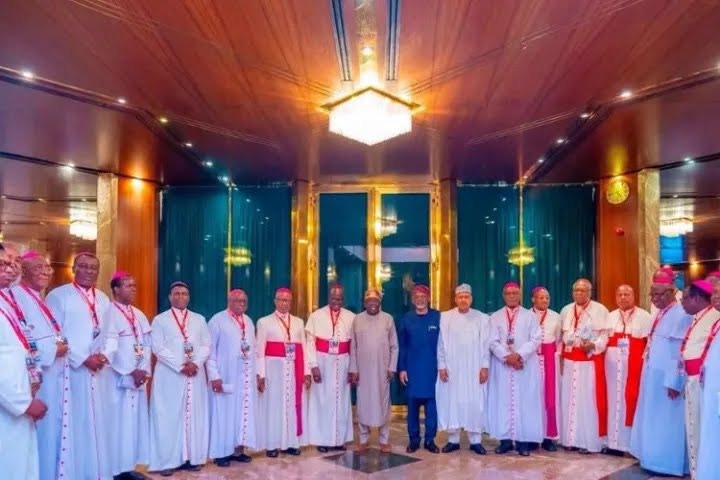
The controversy stems from a closed-door meeting held on July 28, 2026, between President Tinubu and a delegation of the Catholic Bishops’ Conference of Nigeria at the Presidential Villa, Abuja.
During the meeting, the bishops presented their assessment of Nigeria’s worsening economic hardship, rising inflation, widespread poverty and deteriorating security situation. President Tinubu defended his administration’s reforms, insisting that the country was making progress despite prevailing challenges.
The dispute escalated after Cardinal Onaiyekan disclosed details of the meeting during an interview on ARISE News, revealing that the bishops told the President Nigeria was “bleeding” from economic hardship and insecurity, an assessment Tinubu reportedly rejected.
The Cardinal’s remarks drew sharp criticism from presidential aides and some government supporters, who accused him of breaching the confidentiality of the meeting and politicising the discussions.
The controversy has since attracted reactions from opposition figures, including ADC vice-presidential candidate Rotimi Amaechi, who also accused the Presidency of targeting Christian leaders and attempting to intimidate the Catholic Church.
Obi, however, maintained that democratic governance thrives on accountability and constructive engagement, urging the Tinubu administration to stop attacking messengers and instead confront the economic and security challenges confronting millions of Nigerians.

Felix Ifijeh is a journalist with years of professional reporting experience. Known for his keen news sense, compelling storytelling and commitment to accurate, impactful reporting, he has built a reputation for turning leads into clear, engaging, and well-structured reports that resonate with readers. His work reflects deep newsroom experience and a commitment to accurate, impactful journalism.
