
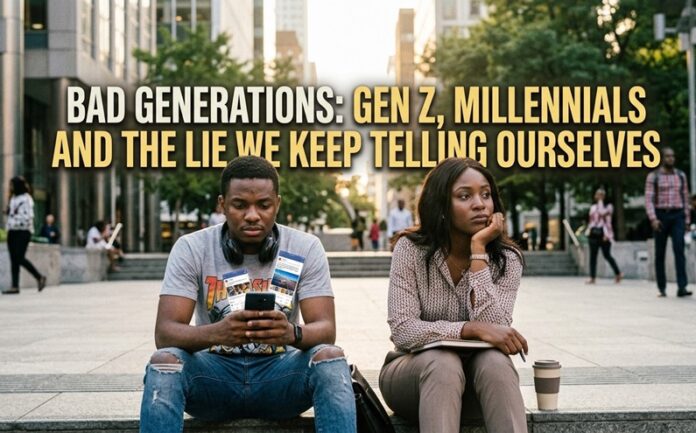
May 15, (THEWILL) — Every few years, society finds a new generation to blame for the decline of morality, culture, discipline, and humanity itself. Today, that target is Gen Z. Tomorrow, it may become Gen Alpha. Before them, it was Millennials. Before Millennials, another generation carried the same burden of criticism.
The pattern never changes.
One generation looks at the next and says:
“They are too exposed.”
“They lack values.”
“They are ruining society.”
“They have no respect.”
“They are too entitled.”
“They are too loud.”

Yet, history constantly reminds us that human beings have never exactly been saints.
This is why the conversation around Gen Z and morality needs honesty instead of emotional generalisations. Because if we are being truthful, what many people describe as a “Gen Z problem” is actually a human problem amplified by technology, visibility, and the rapid evolution of media.
Human beings have always had the capacity for brilliance and destruction at the same time.
Long before social media trends, livestream culture, and viral outrage, mankind had already mastered chaos.
The generation behind ‘The Holocaust’ oversaw the killing of millions of Jews and other minorities under a dangerous political ideology. Another generation engineered the Atomic bombings of Hiroshima and Nagasaki, introducing the world to one of the deadliest displays of human power ever witnessed.
Ancient civilisations often romanticised excess. The Romans were known for indulgence and debauchery. Ancient Indian literature produced the Kama Sutra centuries before modern internet culture existed. Egyptian societies explored aphrodisiacs, sexuality, and symbolic erotic expressions in art and writing long before smartphones entered human existence.
So when people say morality suddenly collapsed because of Gen Z, history quietly disagrees.
The uncomfortable truth is that humans have always battled greed, lust, violence, ego, selfishness, and excess. The difference today is not necessarily that people have become worse. The difference is that technology removed the walls that once hid human behaviour from public view.
Social media did not invent bad behaviour; it industrialised visibility.
Platforms like TikTok, Instagram, and X transformed ordinary people into broadcasters with global reach. Before now, information passed through gatekeepers such as newspapers, television stations, religious institutions, schools, and governments. Content was filtered, edited, delayed, and regulated.
Now, everyone owns a microphone.
That single shift changed human interaction forever.
In previous generations, questionable behaviour still existed, but it often remained private, localised, or socially restricted. Today, one controversial opinion can travel across continents within minutes. One harmful trend can influence millions before parents, teachers, or institutions even realise it exists.
This is why many older people perceive Gen Z as more immoral or rebellious. They are not just seeing behaviour; they are seeing unrestricted exposure to behaviour at a scale never witnessed before in human history.
And to be fair, some concerns are legitimate.
Children today are growing up in environments where digital exposure begins almost immediately. A teenager with a smartphone can access more information in one day than previous generations encountered in years. There is less supervision, weaker digital regulation, and an algorithm-driven culture that rewards outrage, shock value, hypersexualisation, and controversy because attention has become the most valuable currency online.
These create a dangerous imbalance because young people are being exposed to adult realities without emotional maturity, philosophical grounding, or proper guidance systems to process them. The result is a generation navigating identity, morality, relationships, and self-worth under constant digital pressure.
But blaming Gen Z alone oversimplifies a much deeper societal failure.
After all, who built these platforms? Who monetised outrage. Who created the systems where engagement matters more than ethics, Who turned human attention into a commodity?
Ironically, many of the structures Gen Z is criticised for participating in were designed and commercialised by older generations themselves.
This is why generational blame games rarely solve anything. They often become emotional shortcuts that prevent society from addressing the real issues underneath.
The real issue is not simply “Gen Z behaviour”. The real issue is the collision between human nature, technology, capitalism, media influence, and weakened communal guidance.
Humans naturally imitate what they consume repeatedly. Society shapes values through repetition. Culture influences desire. The media normalises behaviour. Algorithms amplify what generates reactions, and none of these realities is exclusive to Gen Z.
Even great thinkers throughout history understood the complexity of human behaviour. Thomas Hobbes famously argued that human beings naturally drift toward chaos without social structure and order. Meanwhile, Albert Einstein often reflected on humanity’s ability to influence and reshape society through ideas, innovation, and collective behaviour.
In simple terms, humans are both creators and destroyers. The same species capable of compassion is also capable of cruelty. The same technology that educates millions can also spread misinformation, exploitation, and addiction.
That duality has always existed; what changes from generation to generation is the environment in which human behaviour operates.
Millennials experienced the rise of the internet.
Gen Z inherited the explosion of social media.
Gen Alpha is now growing up inside algorithmic ecosystems, where digital identity forms before personal identity fully develops.
That should concern everyone, not because one generation is evil, but because society is evolving faster than humanity’s emotional and moral preparedness.
Parents today genuinely fear raising children in environments where unrestricted content is only a click away. Many worry that innocence is disappearing too early. Many fear that social validation now matters more to young people than character itself.
These fears are understandable, but fear should not become historical amnesia.
Older generations cannot pretend their eras were morally pure. Every generation has had its own hypocrisy, violence, addictions, scandals, and cultural damage. Some generations simply operated without smartphones documenting every mistake in real time.
That is the hidden advantage older generations had: PRIVACY!.
Today’s youth are growing up publicly. Their mistakes are archived permanently. Their immaturity becomes content. Their rebellion becomes monetised trends. Their confusion becomes viral entertainment, and society watches all of it in real time.
This is why the conversation should move away from “Which generation is worse?” toward a more useful question: “What kind of society are we building for human beings to grow in?”
Because ultimately, generations do not emerge from thin air. They are products of systems, parenting, economics, media, politics, technology, and culture.
A society obsessed with outrage will produce performative behaviour.
A society addicted to attention will reward extremes.
A society that weakens mentorship and guidance will create confused youth searching for identity online.
Gen Z did not invent humanity’s flaws; they simply inherited a world where those flaws became global content. And perhaps that is the real conversation society has been avoiding, not whether Gen Z is bad, not whether Millennials failed, not whether Gen Alpha is doomed, but whether humanity itself has evolved responsibly enough to handle the power technology has placed in its hands.

