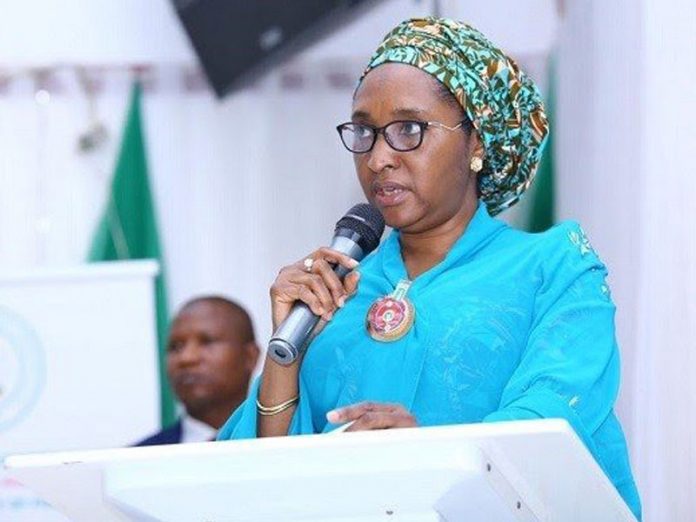
The Federal Government proposed the reduction of oil benchmark, upon which the 2020 budget was predicated, from $ 57 to $ 30 per barrel. The Minister of Finance, Zainab Ahmed, announced this after a meeting between the executive arm of government and the leadership of the National Assembly in Abuja. The meeting was meant to review the 2020 budget and Medium Term Expenditure Framework, particularly against the background of the impact of the Coronavirus pandemic on the global economy.
The meeting, which lasted almost four hours, according to the President of the Senate, Ahmad Lawan, was summoned to “discuss the proposed review of the 2020 budget and the Medium Term Expenditure Framework.” The Finance Minister proposed a review of the 2020 budget using a $ 30 per barrel price benchmark as against $ 57 initially passed in December by the National Assembly. She said it was part of the measures to prepare for the worst- case scenario, as well as insulate the Nigerian economy against any form of unexpected crisis.
She also told the leadership of the National Assembly that budgeted revenues for the Nigeria Customs Service have been reduced from N 1. 5 trn to N 943 bn “due to anticipated reduction in trade volumes”. She also said, “The privatisation proceeds will be cut by 50 per cent, based on the adverse economic outlook on sales of the Independent Power Projects and other assets.” Similarly, Ahmed disclosed that the Federal Government has undertaken cuts to Revenue -related expenditures for the Nigerian National Petroleum Corporation for several projects included in the 2020 Appropriation Act passed by the National Assembly in December 2019.

She said, “The Federal Government is working on Fiscal Stimulus Measures to provide fiscal relief for taxpayers and key economic sectors. “We will incentivise employers to retain and recruit staff during the economic downturn. “We will stimulate investment in critical infrastructure; review non -essential tax waivers to optimise revenues, and compliment monetary and trade interventions to respond to the crisis.”
Brent crude oil prices fell to approximately $33 per barrel (bbl) on Monday 9 March, the worst of its kind fall in a day since 1991. Saudi Arabia, and its erstwhile non-OPEC (OPEC+) ally, Russia failed to agree on the 6th of March on proposed oil production cuts. Earlier in 2020, oil prices had fallen to almost $45 per barrel, the lowest for years. Back then, the combination of shale oil production from the US and predictions about sluggish global demand growth, was to blame. Now the coronavirus, which has slashed Chinese oil demand more up to 20%, has added fuel to the fire. Some OPEC members could decide to go renegade and pump out more barrels in the hope of compensating for the rapid decline in prices. Already the uncertainty has been devastating to oil markets, with the lack of coordination and trust amongst key OPEC and non-OPEC actors, fueling a new era of volatility. For Nigeria, an OPEC member, its path to quickly ramp up production is limited by operational, regulatory and infrastructure challenges. While non-oil GDP growth has shown welcome signs of improvement in recent years, close to 90% of Nigeria’s FX revenues still come from oil exports.
The naira is still a classic petrocurrency whose fate remains intrinsically tied to global oil prices, at least without a seismic shift in economic structure. That shift is not a short-term task. Right now, the stance by Nigeria’s key economic actors to defend the naira will likely be tested by the expected further decline in Nigeria’s foreign reserves – the Central Bank set a $30bn foreign reserves threshold for devaluation. Nigeria is treacherously close All of Nigeria’s 2020 budget indicators; an oil production volume of 2.18 million barrel per day, oil benchmark of $57, N305 exchange rate to the US dollar, GDP growth rate of 2.93%, and inflation rate of 10.81% now appear out of reach, and will most likely result in a downsizing of expenditure plans in 2020.
ALSO READ: FG To Cut 2020 Budget By N1.5trn
Global investment bank Goldman Sachs has lowered its Brent oil forecasts to $30/bbl for Q2 and Q3, and by most estimates, the rest of the year will be gloomy. Demand is weak and dwindling, with cargos of West African crude blends from Nigeria other African countries now heavily discounted to buyers mostly in Europe or remaining unsold. There are no quick fixes for Nigeria, but this may be a good time to plug some of the wastage. Nigeria needs to deregulate the downstream energy with a focus on gasoline subsidies, which promotes rent seeking and has fueled several inefficiencies within the downstream oil network.
Emefiele, had last year, said if crude price drop below $45 per barrel and at the same time the external reserves fell below $30 billion, the bank might be compelled to devalue the naira. Nigeria’s external reserves stood at $36.221 billion as at last Thursday, according to data obtained on the CBN website. The spreading coronavirus has seen the global financial markets plummet.
It has been said that, with the development in the oil market, the rhetoric about an impending naira devaluation would gather momentum, considering the elevated threat to foreign exchange earnings and in turn the nation’s forex reserves, which the CBN relies on to maintain liquidity and support the local currency. The prospect of reconciliation between Saudi Arabia and Russia was uncertain, just as it stated that oil prices trading at current levels for a prolonged period would significantly undermine government revenue considering that the 2020 budget was benchmarked on an oil price assumption of $57 per barrel. “With elevated debt servicing cost, rising recurrent expenditure amidst weak fiscal buffers, we are of the opinion that the nation may be on course for another fiscal crisis. That said, we anticipate a widespread sell-off in the financial markets as investors scale down on their holdings to gain more clarity on the developments in the oil markets,” he added.
He said key policy reforms would be imperative to support and sustain macroeconomic stability. These, it listed to include, among others, a foreign exchange management framework that reflects the market fundamentals, the acceleration of the country’s economic diversification agenda and the oil and gas sector reform, among others. In addition, it advised the federal government to cut overhead and recurrent expenditure, while increasing capital expenditure to total budget ratio. Also, economist and former Director-General, Abuja Chamber of Commerce and Industry (ACCI), Dr. Chijioke Ekechukwu, recommended a possible downward review of the budget as well as eliminate wasteful expenditure as a response to the falling price of oil. He also said the government would need to quickly increase the revenue base from other frontiers like tax efficiency without increasing taxes as well as ensuring that every government revenue-generating agency is held accountable. He said: “There is fear that we may be heading for another recession. The oil price shock like we have today has always been my fear for our economy that does not have control over that major factor that drives its economy, the oil price. “Our reserves will be eroded very fast and give room for a very high exchange rate in the short to long run. Borrowing has become inevitable to fund our budget. We can, however, also review our budget downwards and eliminate unnecessary expenditure items or bloated items in the budget”.
A pointer to the challenges Nigeria is faced with is the fact that, Nigeria is currently struggling to find buyers for about 55 vessels of its April crude oil output. To this end, the Nigerian economy is placed at a disadvantage, as the country would struggle to find buyers for its crude oil output and would have to settle for low prices, when it eventually gets buyers. This would cause a major strain on the country’s finances and its budget, especially as the country is relying heavily on crude oil sales to finance the 2020 budget. In particular, the Federal Government had in the 2020 budget, adopted a crude oil price benchmark of $57 per barrel, on a daily crude oil production estimate of 2.18 million barrels and an exchange rate of N305 per dollar.
Currently, the price of Nigeria’s Bonny Light has dropped to $33.73 per barrel, 40.8 percent below the $57 per barrel budget benchmark. From the $57 per barrel benchmark and 2.18 million barrels of crude oil per day output, the government is targeting oil revenue of N2.64 trillion for 2020. It is also targeting non-oil tax revenues of N1.81 trillion and other revenues of N3.7 trillion. The government is projecting a budget deficit of N2.18 trillion in 2020, including drawdowns on project-tied loans and related capital expenditure. Therefore, with the decline in crude oil price, the ability of the country to meet its N2.64 trillion oil revenue target has been curtailed by about 40 percent, while the country’s budget deficit is expected to rise by about 40 percent. With the inability of the country to meet its revenue target, it would face serious constraints in its ability to pay workers’ salaries, as well as carry out most of the projects listed in the budget. With all these challenges, to avoid a major crisis or shutdown of the country, the government might resort to a drawdown of the already depleted excess crude account or outright borrowing, both locally or internationally, to meet its obligations to its workers and to undertake significant infrastructure projects.
This would worsen the country’s debt situation and plunge it into another debt trap with a high risk of default, as the country’s foreign reserves face the risk of depletion due to an expected devaluation of the naira. With the low foreign exchange earnings from the already-challenged crude oil sales, monies in the foreign reserves would be used to finance the import of other critical goods, thereby, leading to the depletion of the naira. This situation will also make it difficult for the Central Bank of Nigeria, CBN, to effectively defend the naira. With the decline in the value of the naira, the price of goods and services in the country would rise sharply; the inflation rate would skyrocket, unemployment would increase and the poverty rate in the country would worsen.
However, if wastages are drastically reduced, leakages blocked and government prioritise what it wants to do as well as micro-manage the economy, the present economic quagmire can be properly and effectively navigated, the government seems to be moving in this direction.
*** Written by Jide Ayobolu.