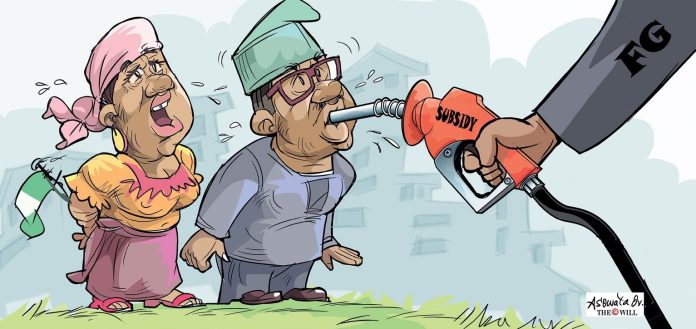
June 14, (THEWILL) – Many people do not understand the politics behind fuel subsidy and its dangers to the development and growth of Nigeria, but the fuel subsidy has been a contentious issue for several years, with some calling for its removal and others advocating for its continuation.
Recently, there has been a renewed debate about the subsidy’s impact on the Nigerian economy, but its postponement to the Nigerian economy brings pain and anguish instead of joy and enthusiasm, thanks to President Bola Ahmed Tinubu for its total removal.
President Muhammadu Buhari announced the removal of the fuel subsidy in June, but it was postponed by the federal government during the Federal Executive Council meeting on April 27, 2023.

One of the primary advantages of removing the fuel subsidy is that it would free up resources for other sectors of the economy. The government currently spends a significant portion of its budget on fuel subsidies, which could be better spent on education, healthcare, and infrastructure development. In his 2023 budget proposal, President Buhari proposes N2.557trn supplementary budget for fuel subsidy.
Furthermore, removing the subsidy could incentivise domestic refineries to produce more petroleum products, reducing Nigeria’s dependence on imported fuel. This, in turn, could boost the country’s economy and create jobs for NigNigerian.
On the other hand, removing the fuel subsidy could lead to an increase in the prices of petroleum products. This, in turn, could lead to inflation and reduced purchasing power for consumers. This could have a ripple effect across the economy, impacting the cost of goods and services.
Additionally, removing the subsidy could lead to social unrest and protests, as people may perceive the government as insensitive to their needs. There is also a risk that the removal of the subsidy could lead to a rise in fuel smuggling and other illegal activities.
While removing the fuel subsidy has some potential advantages, it also has its disadvantages. But, the government must carefully consider the impact of removing the subsidy and take steps to mitigate any negative effects.
Increasing the salary of civil servants is a positive step towards mitigating the impact of removing the fuel subsidy. However, additional measures need to be implemented to ensure that society is adequately prepared for the potential effects of this policy change.
The focus should be on finding a solution that balances the need for economic growth and development with the need to ensure that Nigerians have access to affordable fuel.
However, the initial intention of the government to subsidise petrol was simply to make the product affordable for Nigerians and make life easier. So, the average price of petrol in the world can be as high as N590, however, the Nigerian Government will subsidise the product and fix the price at N185 bringing the total amount of subsidy per litre to N405.
The average consumption of litres of petrol in Nigeria per day is 60 million litres. However, Marketers of the product load as much as 100 million litres and above per day.
This means the Nigerian Government is expected to pay as much as N405 × 100,000,000 (litres) as subsidy per day to the Marketers of the product to keep prices at N185 for instance. This brings the amounts to N40.5 billion daily and about N1.2 trillion monthly. Kindly take note that this amount can either decrease or increase following the prices of petrol at the international market.
So, just try to wrap your head around it and know what Nigeria expends on fuel subsidy alone in a year – obviously some billions of dollars.
The irony of the whole arrangement was that Petroleum Marketers (major petrol dealers with tank farms) usually divert larger quantities of the subsidised petrol to neighbouring countries to resell at the international market price. So, they make the same amount of money the Nigerian Government has paid for the subsidised petrol in the neighbouring countries.
This makes the product relatively scarce in Nigeria as the leftover becomes lower than the daily consumption in the country. The implication is that petrol stations will be selling fairly higher than the fixed price of N185 (some sell N190, N205, N225, N250 and so on depending on the area). And during peak periods of scarcity, which are also engineered by the marketers, Nigerians still buy the same subsidised petrol for as high as N400, N500 and even N800 as the case was in the first quarter of this year while sleeping in filling stations. Again, marketers make double.
The Marketers also import above the daily consumption of 60 million litres as seen above and still force the federal government to pay subsidy on the excesses, which are usually part of what they smuggle to neighbouring countries. Again, marketers dupe Nigeria.
Now, making the entire scenario a mess of the good intention of the Nigerian government to make petrol affordable for Nigerians. This scarcity and high cost of the product despite subsidy leads to arbitrary increases in the cost of living. Transportation, for instance, goes up crazily.
Therefore, successive federal governments, having seen the outright abuse of the subsidy policy, have always tried to cancel the policy so that market forces can determine the cost of petrol.
More so, the huge amount of money paid into the pockets of Marketers can be channelled to other meaningful ventures such as infrastructural development, agriculture, social security, technology, health, etc.
However, whenever the move to remove subsidy is made, the Marketers are quick to shut down their filling stations and deprive Nigerians access to the already subsidised fuel in their possession. This leads to an instant scarcity regime and hardship (like we are already witnessing).
And while the marketers make more money, on the one hand, they force and instigate Nigerians against the federal government with the hardship created on the other hand. Then, the innocent Nigerians who do not understand the politics behind subsidy go on strike, protest, attack the government and force her to continue the subsidy regime. We pay more for our ignorance in the long run.
Marketers are happy; they remain the top billionaires in Africa. Everyone loves them, wishes to be like them, and celebrates them. Whereas the federal government counts her losses, takes the insults, bears the bad name and pity uninformed/suffering Nigerians like you and me.
Will you support Tinubu to break this cartel, this subsidy syndicate and give us freedom or will you remain adamant and spread hate?
*** Written by Balogun Ibrahim, a public affairs analyst and commentator, wrote in from 17, Ajanasi Street, off Ajagannabe Road, Oke-Posun, Epe, Lagos State.
Can be reached via: balogunibrahim1777@gmail.com or 08060799328.