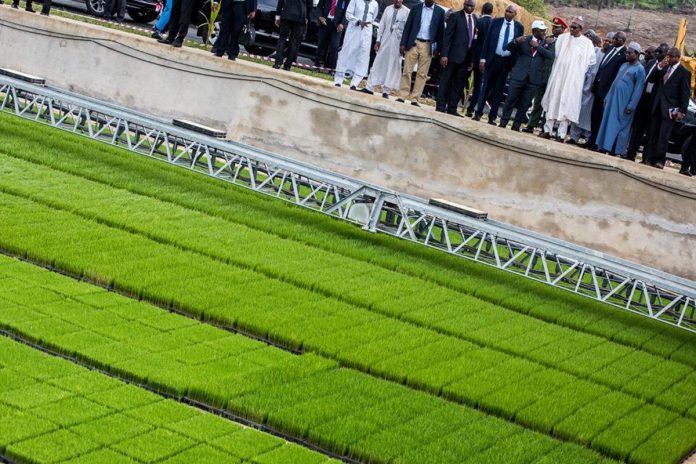
Minister of Works and Housing, Babatunde Fashola said many countries asked Nigeria to supply them food during the recent coronavirus-enforced lockdown. The former Governor of Lagos state said the countries requested foods but Buhari told them to wait because Nigerians must be fed first. He maintained that the countries made the requests because of the success of the Agriculture programme of the Federal Government. He said, “Agriculture is another critical part of the Economic Sustainability Plan. We want to increase the cultivatable lands in the country. “We are currently cultivating just about one-third and I stand to be corrected on that figure. The minister of agriculture knows the numbers better than I do. But in his presentation, as I recollect it, we are not cultivating enough lands. We want to double cultivation, increase food output, not just for local use but for export. “I must say to Nigerians that because of the success of the agriculture programme which is still evolving, during this COVID exercise, many countries were writing to us from near and far, asking us to please supply them food. This is not in the public space but President Buhari’s priority was, tell them to wait, we must feed our people first before we send out food, we don’t know when this is going to end. “So, we want to see more value-added in the sector in terms of processing and cultivation. We are losing an unsatisfactory quantity of our agro produce too many factors: transport, cooling, heating and so on. These are some of the components that the Ministry of Agriculture will share in the next few months about how to ensure that we preserve many more of what we produce and lose less.”
It is important to note that, well over ten thousand farmers have so far been supported financially and technically to grow 12 crops under the Anchor Borrowers Programme (ABP) of the Central Bank of Nigeria (CBN). The initiative, operated through the Nigeria Incentive-Based Risk Sharing System for Agricultural Lending (NIRSAL), has also created about millions of indirect jobs along the agricultural value chain.
CBN Governor, Godwin Emefiele, made the disclosure at the weekend in Calabar at the flag off of input distribution for 2018 wet season farming done in collaboration with the state government. Emefiele, who was represented by the apex bank’s spokesman, Mr. Isaac Okorafor, commended Cross River State, saying the 12 crops include rice, soybeans, maize, palm produce, cotton, and cassava, among others. He advised genuine farmers to key into the technology-driven input distribution system with a view to benefiting from the low interest rate of 9 per cent facility.

ALSO READ: OPINION: INSECURITY: BUHARI HAS RUN OUT OF IDEAS
According to the CBN governor, the biometric capturing, which identified farmers to specific farmland through mapping has eliminated the issue of “absentee” or non-practicing farmers from benefiting from the inputs and other facilities.
Also speaking, the Cross River State Governor, Prof. Ben Ayade, who was represented by the State’s Commissioner for Agriculture, Prof. Egrinya Eneji, reiterated that agriculture remains the channel for sustainable development for Nigeria hence the state government was pragmatic in leveraging the value chain opportunities offered by sector. With regards to delay in loan disbursements, NIRSAL said farmers’ funds approved by CBN within five days of receipt of loan term sheets from CBN are treated.
It also assured that as always, farmers under the NIRSAL PFI window of the CBN ABP, who comply with the conditions precedent to drawdowns, can have access to their credited accounts after meeting such conditions. “This is in line with NIRSAL’s policy stance to always expedite the funds access process of all applicants who have met conditions precedent to draw down.
Recall that the Nigerian president, Muhammadu Buhari has said he will launch a N10 billion agriculture environmental impact fund to support women farmers to increase access to food production. According to the president, the fund is to cover women, whose farmlands were affected by environment degradation and terrorism. A statement made on Sunday, December 18, in Abuja by Dean, Agriculture Faculty, University of Abuja Prof. A.A. Adeniyi said the event by the Women Association for National Agriculture Environment Impact Fund (WAEIF), would focus on food increase to reduce the impact of recession. He explained that pollution of the environment led to importation of genetics modified organism food, which often caused cancer. “The WAEIF launch of N10 billion agriculture environmental impact fund will serve as alternative funding option for women who could not have access to land, collateral for bank loan, especially women from Northeast that have been displaced due to terrorism and cultural factors,” he added. Nigeria and the rest of Africa must brace up to meet the challenges of food shortage which comes to the continent soon if nothing is done fast. President Muhammudu Buhari said this while urging African countries to focus more on agriculture to avert the looming food shortage. Daily Trust reports that while speaking on Monday, December 12 at the annual Meeting of the Food Crisis Prevention Network (RPCA) of the Sahel and West African Club Week, holding in Abuja, Buhari said: “Your excellences, the threat of food crisis in our sub-region is real. “Accordingly, we must recognize the urgent need to develop mechanisms to curtail the impact of food crises on our people. “We are currently facing some shortages on staple food because of our inability to modernized agriculture over the years.”
Also, the Federal Government, launched the agricultural sector roadmap, known as The Green Alternative, for promotion of agriculture from 2016-2020. The presentation was made by the Vice President, Prof. Yemi Osinbajo, who said the government would deploy 100,000 agric extension workers to assist farmers implement the policy. Osinbajo maintained that the move to diversify the economy through the agriculture sector had become necessary due to the huge food importation bill and the need to create jobs for the teeming population of youth in the country. He also expressed optimism that the roadmap would address challenges in the sector and reposition it for economic growth and development. He said: “The present administration came into office to meet an economy in a meltdown and we have to take difficult decisions on short, medium term in order to repair the huge damage done, especially by the dependence on oil, the worst not investing in infrastructure or deepening the diversification of our economy, or even building our reserves when oil sold at over a $100 per barrel. “We knew that we had to set aright and put back the economy on a fast lane, inclusive growth, job creation for our huge population. One of the most critical components of that plan is to position agriculture, the arrowhead of our economic recovery efforts. “There is no question at all that if we get agriculture right, we will get our economy right. The great clarity, ‘The Green Alternative, sets out strategies to resolve these challenges and particularly impressed that the roadmap does not dismiss the agric policies ‘building on the successes of the agricultural agenda’. “This particular issue of alignment is crucial. For instance, there is no way we can encourage agriculture than to encourage food production when we allow unbridled importation of the same things we are trying to produce. “Still on the issue of policy of alignment, as part of our 500,000 teacher corps that we will be engaging 100, 000 of them that will be trained as extension workers for our farms. “I, hereby, launch the Agriculture Sector Roadmap: The Green Alternative; Agriculture Promotion Policy 2016-2020.” According to the Vice President, the home-grown school feeding programme will have one meal a day for pupils and specifically the food will be from farms in each state. He also assured that the Bank of Agriculture would be recapitalized and repositioned to meet farmers’ financial need by giving them a single digit interest rate and low interest. Speaking earlier, the former Minister of Agriculture and Rural Development, Chief Audu Ogbeh, said the roadmap for the sector was all encompassing and would salvage the economy from collapse. He said: “In this policy, you will see us navigating through the agricultural terrain, trucking on virtually every aspect. The emphasis on ‘Green’ is to capture the essence, spirit and orientation of this new policy/strategy document.”
It is important to note that, the immediate past the minister of agriculture and now the President of African Development Bank (ADB), Dr. Akinwumi Adesina lamented that, Nigeria spends over N356 billion yearly on the importation of rice, similarly, Nigeria spends over N100 billion annually to import fish. And, the country spends N1.6 trillion on the importation of wheat, sugar, rice and fish on a yearly basis. The former minister also regretted that Nigeria has the third absolute number of stunted children in the world with 41 per cent of children under age of five stunted, 23 percent under-weight and 14 percent wasted.
Also, he said, Nigeria’s import and export ratio has remained at 92 per cent import and 8 per dent export. It for this reason that President Buhari said recently in an economic retreat, as it relates to agriculture that, it has been neglected over the years, and veritable government intervention is required in the crucial sector, that if carefully managed, can lead to self-sufficiency in food production, solve the problem of mass unemployment, increase the country’s foreign earnings, and grow our per capita income. In his words, he stated that, “for too long government policies on agriculture have been half-hearted, suffering from inconsistencies. Yet our real wealth is in farming, livestock, hatcheries, fishery, horticulture and forestry”.
He further explained the some of the challenges in the sector, such as rising cost of food, lack of agricultural inputs at affordable prices, high cost of fertilizers, pesticides and labour compound the problem of extension services, import of food items that can be easily produced locally, wastages because of the absence of adequate storage facilities as well as lack of feeder rods to transport foods produced in rural areas to urban centres, just to mention but a few of the difficulties encountered in the sector.
He also said that, in solving the problem the public must be carried along and educated about the plans of government so that, they can key into it and benefit maximally from it, in addition, he reasoned that, there must be close working relationship between the federal government and the state governments, to really boost agriculture and solve some of the problems in the sector, for example, the massive availability of feeder roads to make transportation of food from the country-sides to the city centers less cumbersome, there should also be the availability of soft loans to farmers with the CBN bearing some of the risk as well as the exigent need intermittent stakeholders meeting on how to move the sector forward. Agriculture in Nigeria is one area that can turn the fortunes, destiny, direction and dynamics of this great country around for the very best with the shortest space of time. It is also important to note that President Buhari has said that the Federal Government is making efforts to ensure that Agriculture becomes more attractive to foreign investors.
He made this assurance while speaking on the theme of the 8th annual Bola Tinubu Colloquium “Agriculture, work and revolution” at the International Conference Centre, ICC, Abuja. The President, who chaired the event stated that there were many opportunities in the agricultural sector and expressed his disappointment at the fact that food is imported into the country rather than being exported.
According to the president, “Nearly all our crop-based farming activities are dependent on rain-fed agriculture, and this makes our agricultural productivity entirely vulnerable to the effects of climate change. In the past few years, on the average, we have spent in excess of $11bn annually importing wheat, rice, sugar and fish. We need not, and indeed we cannot afford to continue on this trajectory”. He added, “Agriculture is the key to our economic growth and social investment policies. Our administration’s key strategy is to ensure that Nigeria becomes self- sufficient in the foods that we consume the most. Maize, rice, corn, millets, fruits, poultry products and their derivatives can all be produced at home if we put our hearts into it. Our policy is simple: We will produce what we eat! It is not only logical, it is necessary.” He then implored everyone to work together thus: “I am declaring that we need a new approach that challenges more states and local governments, more organizations, companies and non-governmental organizations and individuals, some of the younger people, who are here to step up and play a role because government cannot and should not do it alone. All hands should be on deck.
*** Written by Jide Ayobolu.