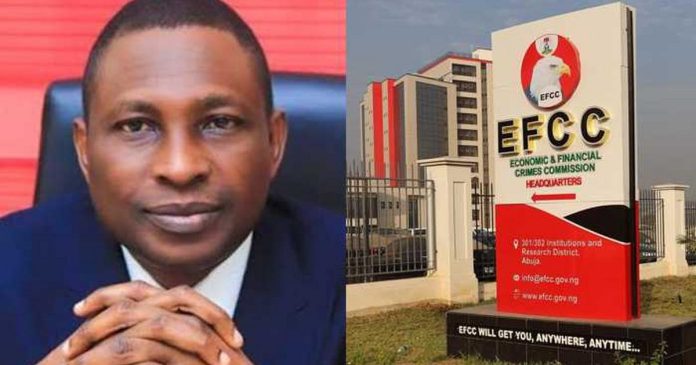
July 23, (THEWILL) — On Friday, July 18, the Chairman of the Economic and Financial Crimes Commission (EFCC), Ola Olukoyede, hosted a sensitization programme on Naira Abuse at the Colonades Hotel, Ikoyi, Lagos.
What grabbed the headlines was his revelation that 18 serving governors are currently under EFCC investigation, and that once they’re out of office and their immunity ends, the Commission would waste no time in moving against them.
But he stopped short of naming names, the part Nigerians would have found most delicious.

With citizens groaning under the burden of petrol subsidy removal and high living costs, at a time state governors are receiving more revenue than ever, the thought that many are possibly looting the treasury is infuriating.
Yes, the EFCC can investigate sitting governors, deputy governors, the President and the Vice President, but they’re protected from prosecution by Section 308 of the 1999 Constitution.
The spirit of this clause is to shield public officials from distractions due to numerous petitions. Yet, this level of immunity doesn’t apply in many parts of the world.
In South Africa, Israel, the US, Brazil, and France, not even a President is above the law. France’s former President, Nicolas Sarkozy, was jailed in 2021 for corruption. In 1974, Gerald Ford was booted out of office over Watergate.
South Korea has sent more than one President to prison, from Yoon Suk-Yeol to Lee Myung-bak. Brazil’s Lula da Silva served time. The message is clear: misdeeds must not go unpunished.
In Nigeria, however, Section 308 offers an immunity so powerful it might as well last for life. It’s no surprise it has barely featured in ongoing constitutional reform debates.
Nigerians would love to see that clause reviewed, public office holders should be held accountable, regardless of rank.
Olukoyede also noted the trend of governors fleeing the country as soon as their tenure ends — the infamous “japa” syndrome. Many don’t even wait to hand over before disappearing.
But back to the original reason for the Lagos event, the Naira.
The EFCC boss was in town not just to talk governors, but to highlight his campaign against the abuse of Nigeria’s currency. The event, he said, was held in close partnership with the Central Bank of Nigeria.
Under Section 21 of the CBN Act, 2007, acts like spraying, stepping on, dancing on, or mutilating the Naira are punishable by up to six months in jail or a fine of no less than N50,000, or both.
Also included is the common but unlawful act of selling Naira notes. Banks often fail to supply new notes, yet at every weekend party, hawkers sell them openly. One wonders if there’s a secret Mint somewhere printing cash for these vendors.
Olukoyede’s EFCC has taken this fight seriously. Celebrities, in particular, have been targeted.
Take Idris Okuneye, aka Bobrisky, who spent six months in Ikoyi Correctional Centre for spraying Naira at a public event. He pleaded guilty.
Pascal Okechukwu (Cubana Chief Priest) was arraigned in April 2024. He pleaded not guilty, and his lawyers even challenged the EFCC’s jurisdiction. In the end, he walked away with a N10 million fine.
Neither man has been seen abusing the Naira since. Bobrisky, in particular, has gone noticeably quiet — “Mummy of Lagos” was humbled by the college of imprisonment.
In May 2025, Okoli Frank Emeka was jailed for six months for trampling on the Naira in Lagos. That same month, Kelly Okungbowa, aka Ebo Stone, was arraigned in Benin for similar offences.
In Kaduna, TikToker Muhammad Kabir Sa’ad dared the EFCC online to arrest him for Naira abuse. They did.
But the crackdown hasn’t been limited to ordinary Nigerians. In January 2025, billionaire businessman Razaq Okoya’s sons, Wahab and Raheem, were invited for questioning after spraying N1,000 notes in a music video.
In May, Nollywood actress Iyabo Ojo was summoned for spraying Naira during her daughter Priscilla’s wedding. She got off lightly and hasn’t been caught doing it again.
Actress Oluwadarasimi Omoseyin wasn’t so lucky. She got six months in prison for spraying Naira at an event in 2023.
Even comedian Ayo Makun (AY) got invited. Grateful for the EFCC’s leniency, he released a statement saying he had learnt his lesson.
Still, despite these high-profile arrests and convictions, many Nigerians continue to flout Section 21(1) of the CBN Act. What’s changed is the brazenness.
The once-common sight of partygoers trampling on or spraying money with reckless abandon has reduced.
The practice, which began in the Yoruba-dominated South West, spread nationwide, with Igbo elites adding a flamboyant twist, using spraying guns and a showy flair. I once criticised this in my 2021 piece “Obi Cubana and the Oba Funeral”.
But many Nigerians don’t listen. Their excuse? It’s “culture.” Actor Deyemi Okanlawon said EFCC should focus on bigger crimes.
To this, Olukoyede responded: “There is nothing cultural about spraying or stamping on the Naira. Nowhere in the world is that tolerated. Nobody who works hard would throw their money in the air. As a salary earner, I can’t imagine doing that!”
To him, the Naira is a national symbol — a reflection of our sovereignty and economic strength — and its desecration must not be condoned.
He recalled how a former Nigerian governor, after leaving office, hosted a birthday bash in a London hotel. He began spraying £10 and £50 notes. The hotel manager, thinking he was mad, called 911.
The Metropolitan Police responded. Only the intervention of his colleagues, including two serving governors, saved him from being taken away in an ambulance.
It’s baffling how what is normal here is seen as insanity abroad.
Olukoyede, a Pentecostal pastor, has brought evangelical passion to his role. More importantly, he’s reviving the EFCC’s often-forgotten public enlightenment mandate under Section 6(p) of its Establishment Act.
Present at the Lagos event were musicians, actors, content creators, event organisers, and hospitality sector stakeholders. Notable guests included King Alabi Pasuma, MI, Ill Bliss Goretti, Osas Ighodaro, Pretty Mike, Terry Apala, Mercy Aigbe, Kazim Adeoti, Funke Bucknor-Obruthe, and Anto Lecky.
The spraying of Naira has become a cash cow for event organisers and entertainers.
But the EFCC, under Olukoyede, is pushing back with aggressive awareness campaigns. The agency now runs EFCC 97.3 FM in Abuja, with global livestreaming via www.efcc.gov.ng.
Olukoyede is not your average EFCC chairman. He rose through the ranks.
He’s prioritising education, not just prosecution. His predecessors rarely took public engagement this seriously.
And to his credit, the agency under his leadership hasn’t been mired in the usual allegations of political witch-hunting.
That alone is remarkable. In 2024, he sacked 27 EFCC staff members for corruption. He also ordered a probe into a $400,000 scandal involving a top official.
Yes, he’s been criticised, as seen in Steve Osuji’s July 10 article, “EFCC’s Alarming Impunity”. But the EFCC fired back in a July 21 rebuttal by Dele Oyewale titled “Campaign of Calumny Against EFCC”.
Olukoyede has insisted the war on corruption requires collective effort. He was the first to admit publicly that the EFCC itself has a corruption problem. That’s transparency in action.
Much credit also goes to President Bola Ahmed Tinubu, who has so far given the EFCC boss the freedom to act without interference.
Will Olukoyede win the war against Naira abuse? Probably not entirely. The spraying of Naira may be a cultural sickness, a chronic affliction. Still, he deserves commendation. He is doing well.

Reuben Abati