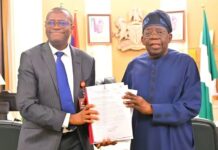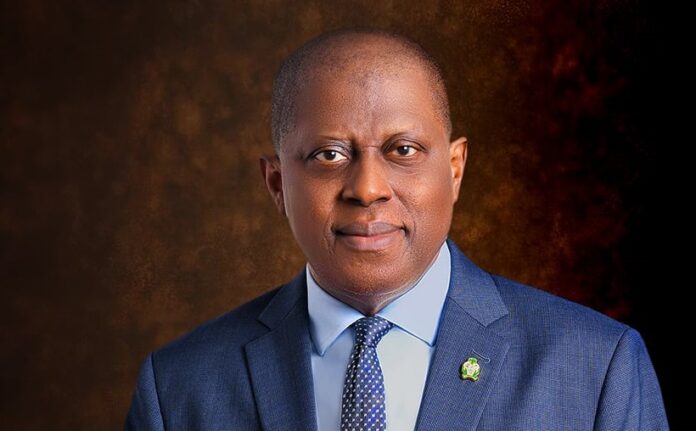
December 28, (THEWILL) — Governor of the Central Bank of Nigeria, Dr Olayemi Cardoso, is THEWILL Person of the Year. We extensively reviewed the turbulent phase that beguiled Nigeria’s economic landscape following years of monetary policy missteps and fiscal rascality in the governance space, to arrive at the choice.
When Cardoso took over the leadership of the nation’s apex bank, it was obvious that he and his team were braced for the uncertainty. However, the economic recovery that followed the bold, creative, strategic reforms brought tremendous calm to the troubled economy.
The Old Order
The success story of Nigeria’s economic recovery cannot be appreciated without first recalling where Cardoso and his team started, because the reforms of today were borne out of a determination to change the conditions they met.

In his words: “When this leadership team assumed office, our economy faced severe macroeconomic distortions.” He recalled that inflation was surging. FX liquidity had evaporated. External reserves were non-existent. Trust in economic management had weakened. Unorthodox monetary practices had eroded confidence. Businesses could not plan or price. Investors could not commit.
According to him, “The foreign exchange market was in paralysis. A backlog of over US$7 billion in unmet FX obligations undermined market integrity. The spread between official and parallel market rates had blown out to more than 60 per cent, creating distortions and rentseeking opportunities.
“High inflation had become normalised, stuck in double digits for most of the last 35 years and risen to 34.6 percent as of November 2024. Food prices were crippling households. Liquidity conditions were unstable. Many businesses faced an existential threat.
“Also, the banking sector, though fundamentally sound, was at risk of being dragged into distress by a deteriorating macro environment and inconsistent policy signals.
“This was the Nigeria we inherited, not one standing at the edge of a macroeconomic precipice, but one that had already gone over the cliff. It is important to recall this not for drama, but for context: the progress we cautiously acknowledge today is meaningful only when measured against the depth of the challenges that came before it.”
The Revolution
Upon assuming office in October 2023, the apex bank leadership under Cardoso had prioritised reforms to rebuild Nigeria’s economic buffers and strengthen resilience. Radical CBN’s policies – mostly unimagined, including the revolutionary currency reforms, boosted investment inflows.
The historic unification of the exchange rates and the clearing of over $7 billion FX backlog were the masterstroke. There was reduced intervention in the domestic forex market that raised the country’s investment outlook, with multilateral organisations like the World Bank describing it as a bold intervention to improve the economy’s sustainability in the long run.
Also, Nigeria’s sovereign risk spread had fallen to the lowest level since January 2020, erasing the premium accumulated during the pandemic and subsequent strain on its economy. All these are deliberate efforts meant to woo investors and sustain capital inflows to the economy.
Cardoso’s introduction of initiatives, such as the Nigerian Foreign Exchange Code (FX Code), have helped entrench accountability, compliance and transparency in the country’s foreign exchange market, while the Electronic Foreign Exchange Matching System (EFEMS), has set clear and enforceable standards for ethical conduct and governance in the forex market.
Dividends of Turnaround
The results are real. Over the past year, the apex bank has sustained the unification of the multiple exchangerate windows boosting inflow from abroad and reduced interventions in the domestic forex market.
The multi-billion-dollar FX backlog has been fully cleared, restoring credibility and giving businesses the confidence to plan. Foreign capital inflows reached US$20.98 billion in the first 10 months of 2025, a 70 per cent increase over total inflows for 2024 and a 428 percent surge, compared to the US$3.9 billion recorded in 2023, reflecting a clear resurgence in investor confidence.
The surge in FX inflows reflects a clear resurgence in investor confidence in the economy and greater milestones expected in the months ahead.
Already, the financial markets are witnessing interest in Nigerian assets from domestic and global investors, as seen in the latest capital inflows to the country. The rising investors’ interest is linked to a fallout of crucial reforms instituted by the CBN under Cardoso leadership.
Under Cardoso, over the past 12 months, Nigeria’s economy has transitioned from crisis management to laying the groundwork for a sustainable recovery.
After nearly a decade in which real GDP growth averaged about 2 per cent, reforms have restored momentum and confidence in the nation’s broad macroeconomic environment. The economy grew by 4.23 percent in the second quarter of 2025, the strongest pace in four years, driven by improvements in telecommunications, financial services and oil production.
In terms of long-term stability, inflation, while still high, has moderated consistently. From a peak of 34.6 percent in November 2024, it has more than halved to 14.45 percent in November 2025. This marks eight consecutive months of disinflation. Food inflation, the largest single component of the basket, fell to 11.05 percent in November, down from 13.12 per cent in October.
This significant, steady decline in inflation is restoring real purchasing power for households and businesses. It also demonstrates disciplined execution and Nigeria’s return to orthodox monetary policy.
“We continue with determination to bring inflation down further. The current double-digit rate cannot be acceptable. Price stability is the foundation of sustainable growth. Our transition to an inflationtargeting framework is gaining traction. We have improved data analytics, strengthened communication and ended monetary financing of fiscal deficits. These actions have strengthened monetary policy transmission and anchored expectations.
“Our models project continued disinflation in 2026, helped by stronger domestic production, improved FX liquidity and more disciplined liquidity management. As inflation moderates and becomes firmly anchored, we will calibrate the policy rate in line with evolving data.
“Domestic and international observers alike have noted Nigeria’s ‘huge turnaround’ in macroeconomic management. Our commitment remains clear: Monetary policy will stay evidence-based, data-driven and unwavering in its pursuit of price stability,” Cardoso explained.
The $1trn Economy Pursuit
Under Cardoso’s leadership of the apex bank, Nigeria’s hope of achieving the much touted $1 trillion economy by 2030 will gain significant support from the banking sector.
Nigeria’s Statistician-General, Adeyemi Adeniran, had explained how the economy fared in the rebased Gross Domestic Product (GDP) report. He said: “In nominal terms, the rebased GDP for 2019 stood at N205.09 trillion, N213.63 trillion in 2020, N243.30 trillion in 2021, N274.23 trillion in 2022, N314.02 trillion in 2023, and N372.82 trillion in 2024”.
The NBS noted that in 2019, the rebased nominal GDP at basic prices represented an increase of 41.7 per cent over the nominal GDP of 2019 of the old base year (2010), 39 per cent in 2020, 38.7 per cent in 2021, 36.1 per cent in 2022, 34.6 per cent in 2023 and 35.4 per cent in 2024.
“The results show that the structure of the Nigerian economy has changed significantly with a rise in the share of agriculture and services sectors and a fall in the share of the industries sector in nominal terms, indicating a shift in the structure of the Nigerian economy than earlier reported,” the NBS said.
Adeniran further explained that the rebasing allows the country to better reflect the realities of the economy. “It’s not just about a bigger number but about accurate, timely data that supports smarter policy and economic planning,” he said.
The Cardoso-led monetary policy strategies are in sync with this development and would easily fit into the structure to consolidate the gains of the past two years.
Banking Sector Reform
Recognising that a well-recapitalised banking sector is undeniably crucial for the growth of the domestic economy, Olayemi in March 2024, advised banks to prepare for a new round of recapitalisation to ensure they have the necessary capital to support the Federal Government’s plan to achieve the $1 trillion GDP target by 2030.
He said the Federal Government’s economic plan to reach a $1 trillion GDP by 2030, could not be achieved with the banks’ insufficient level of capitalisation then.
In addition, to strengthen the level of corporate governance in the industry, the Cardoso-led Central Bank has also directed all Domestic Systemically Important Banks to secure its approval for the appointment of successor managing directors six months before the exit of incumbents. The CBN also ordered that such appointments must be made public at least three months before the outgoing chief executive formally leaves office.
Strong Reserves, Outlook
Two years into Olayemi Cardoso’s five-year tenure at the CBN, gross reserves have improved sharply from $33bn in September 2023 to over $42bn, an increase of about $8 billion; and inflation is falling.
Well-managed external reserves provide resilience for any economy, as they enable it to absorb the adverse effects of a crisis in the event of one. That is why an oil producing and exporting country like Nigeria, which depends heavily on exports for its foreign exchange, absolutely needs to effectively and efficiently manage its reserves.
Hence, understanding the management of external reserves becomes very critical, especially in relation to its effect on the country’s sovereign risk as well as credit ratings. That is apparently why, since assuming office on September 15, 2023, Cardoso has continued to take deliberate steps to ensure accretion in the country’s reserves.
Particularly, the increase in the country’s gross external reserves was largely due to the trade surplus it has continued to enjoy, given the exchange rate and price stability achieved by the country under Cardoso.
For instance, Nigeria recorded a trade surplus of N7.5 trillion in the second quarter of 2025 (Q2) as its total exports were valued at N22.751 trillion, reflecting a 28.43 percent rise when compared to the N17.714 trillion recorded by the country in the corresponding quarter of 2024 and 10.45 percent increase when compared to N20.598 trillion in Q1, 2025.
Also, in the period under review, the value of the country’s total imports stood at N15.287 trillion in Q2 2025, representing a 9.43 percent increase from the value recorded in the corresponding quarter of 2024 (N13,969.34bn) and a 0.90 percent decrease, compared to the value recorded in Q1 2025 (N15,426.17bn).
The current accretion in reserves represents the highest level recorded since December 3, 2021 and it has continued to maintain the upward trajectory in recent weeks.
Amid huge debt service obligations and revenue challenges, the stability in external reserves movement, coupled with a marked deceleration in the inflation rate, as well as the naira’s relative stability, offer hope that better days lie ahead.

Sam Diala is a Bloomberg Certified Financial Journalist with over a decade of experience in reporting Business and Economy. He is Business Editor at THEWILL Newspaper, and believes that work, not wishes, creates wealth.