
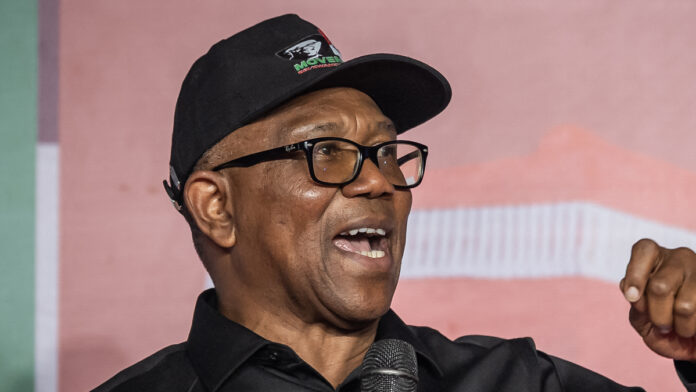
- Atedo Peterside says his decision to back Peter Obi in the 2023 presidential election was rooted in leadership capacity and execution
-
The Stanbic IBTC founder maintains that Bola Tinubu, Atiku Abubakar and Peter Obi all campaigned on broadly similar economic policies
-
Peterside says he never believed Obi was flawless, acknowledging the Labour Party candidate’s shortcomings while insisting his record of fiscal discipline.
-
Reaffirming positions he advanced before the election, the economist says an Obi presidency would have promoted stronger accountability through legislative checks and balances.
August 4, (THEWILL) — Renowned economist, investment banker and founder of Stanbic IBTC Bank, Atedo Peterside, has reaffirmed why he threw his weight behind Labour Party presidential candidate, Peter Obi, in the 2023 general election.
He said his endorsement was based on the former Anambra State governor’s perceived ability to execute difficult economic reforms rather than any belief that he possessed extraordinary abilities.
Speaking during a recent interview on Channels Television, Peterside dismissed suggestions that his support for Obi was driven by emotion or blind admiration, stressing that his assessment was anchored on leadership, discipline and the capacity to implement policies that all the leading presidential candidates had largely agreed upon.

“Not that he had the magic wand, but I thought he had the best chance at the time when I looked at the candidates. I thought he had the best chance in terms of execution,” Peterside said.
According to him, the three major contenders in the 2023 presidential election (President Bola Tinubu of the All Progressives Congress (APC), former Vice President Atiku Abubakar of the Peoples Democratic Party (PDP), and Peter Obi of the Labour Party), shared similar positions on the broad economic reforms Nigeria urgently required.
“There was not a lot of difference between the three major candidates in terms of their pronouncement of bold economic reforms like eliminating petrol subsidy and doing away with multiple exchange rates,” he stated.
‘Execution Was the Difference’
Peterside argued that while the candidates largely agreed on the direction of economic policy, the real issue before Nigerians was determining who possessed the credibility and leadership capacity to translate those promises into tangible results.
“So my choice at the time was influenced partly by who had the ability to execute best. And to execute, you have to lead by personal example. You also have to be willing to sacrifice,” he said.
The economist explained that Nigeria needed a leader capable of asking citizens to endure difficult reforms while demonstrating restraint and discipline from the highest levels of government.
According to him, such leadership would require visible reductions in the cost of governance and a willingness by those in power to share in the sacrifices demanded of ordinary Nigerians.
He said, “I never thought Peter Obi had two heads, for goodness sake. I know his weaknesses. It was about whether I thought at the time he could lead by example. And I thought the country needed leaders that would demonstrate some belt-tightening at the centre and all that. And he seemed to have the profile for that.”
His latest remarks are widely seen as his clearest explanation yet of the reasoning behind one of the most closely watched endorsements by a leading figure in Nigeria’s financial sector during the 2023 election.
Consistent Position Before the Election
Peterside’s latest comments align with positions he consistently advanced throughout the 2022 and 2023 election campaigns.
During several interviews, including appearances on ARISE Television, he argued that Peter Obi represented the strongest candidate to undertake difficult but necessary economic restructuring without plunging Nigerians into deeper hardship.
He maintained that Obi’s record as governor of Anambra State reflected fiscal discipline, prudent management of public resources and a commitment to reducing institutional waste.
According to Peterside, Nigeria required a departure from traditional governance models towards a system driven by accountability, efficiency and responsible management of scarce public funds.
No Major Difference in Economic Policies
Throughout the election campaign, Peterside repeatedly maintained that the leading presidential candidates were broadly united on the major economic reforms required to revive Nigeria’s struggling economy.
He noted that Tinubu, Atiku and Obi all supported ending the costly petrol subsidy regime, unifying Nigeria’s multiple exchange-rate system, reducing the cost of governance and implementing broader structural reforms to restore fiscal stability.
For Peterside, therefore, the decisive issue was not the content of their manifestos but the personality, credibility, and administrative discipline of the individual expected to implement them.
He argued that successful reforms depended more on trust in leadership than on policy documents.
Legislative Oversight as a Strength
Another major argument Peterside advanced before the election was that an Obi presidency would likely enjoy healthier democratic accountability because the Labour Party was unlikely to command an overwhelming majority in the National Assembly.
He argued that such an arrangement would compel the executive to negotiate and justify its policies before lawmakers rather than rely on automatic legislative approval.
According to him, stronger parliamentary scrutiny would ultimately produce better public policies and prevent the passage of measures that did not serve the national interest.
ANAP Foundation Polls
Peterside also attracted national attention through opinion polls conducted by the ANAP Foundation, which consistently showed Peter Obi leading voter preference across several demographics in the months preceding the 2023 presidential election.
The surveys indicated that growing concerns over Nigeria’s worsening economy, insecurity, unemployment and governance challenges were driving increased support for the Labour Party candidate, particularly among younger voters and urban populations.
Although the Independent National Electoral Commission (INEC) eventually declared Bola Tinubu winner of the election, the ANAP polls significantly shaped public discourse throughout the campaign and highlighted changing political dynamics in the country.
Debate Over Economic Reforms Continues
Peterside’s latest intervention comes as debates continue over the implementation of economic reforms introduced by the Tinubu administration, particularly the removal of fuel subsidies, liberalisation of the foreign exchange market and efforts to reduce fiscal distortions.
Ironically, many of the reforms now being pursued by the Federal Government were among the policies all three major presidentialThe candidates advocated during the 2023 campaign.
For Peterside, however, the central question has never been whether such reforms were necessary.
Rather, he believes the enduring challenge remains identifying leaders with the credibility, discipline, and moral authority to implement painful economic decisions while earning the confidence and trust of the Nigerian people.
Felix Ifijeh is a journalist with years of professional reporting experience. Known for his keen news sense, compelling storytelling and commitment to accurate, impactful reporting, he has built a reputation for turning leads into clear, engaging, and well-structured reports that resonate with readers. His work reflects deep newsroom experience and a commitment to accurate, impactful journalism.
