
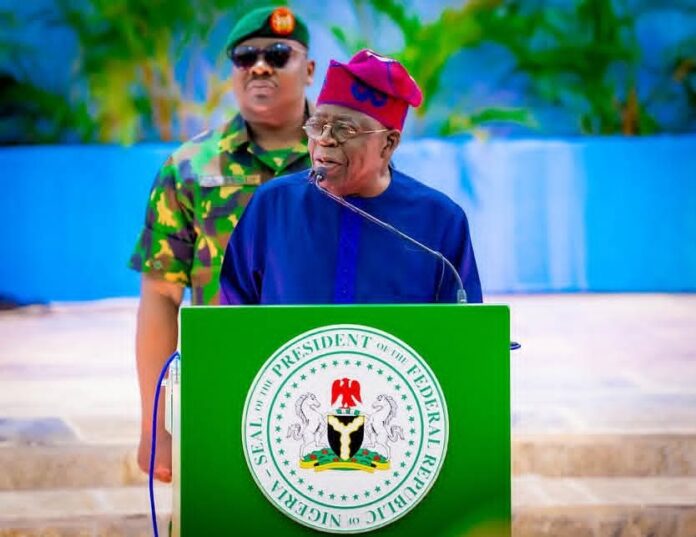
February 12, (THEWILL) — President Bola Ahmed Tinubu has commended the Bank of Industry (BoI) for achieving ₦636 billion in loan disbursement to businesses in 2025, the highest annual financing volume in the institution’s history.
In a statement signed by Bayo Onanuga, the Special Adviser to the President on Information and Strategy, on Thursday, February 12, 2026, President Tinubu described the milestone as concrete evidence that ongoing macroeconomic reforms are strengthening development finance institutions and unlocking capital for productive sectors of the economy.
The ₦636 billion was disbursed to more than 7,000 enterprises nationwide. A breakdown of the financing shows that ₦202 billion was allocated to agro-allied enterprises, ₦100 billion to critical national infrastructure, including broadband, power, aviation, and transportation, ₦79 billion to manufacturing, ₦77 billion to extractive industries, and ₦55 billion to services.

In addition, the Bank deployed ₦73 billion in managed and matching funds on behalf of state governments and institutional partners.
According to President Tinubu, “The ₦636 billion disbursed by the Bank of Industry in 2025 translates directly into productive capacity across Nigeria. It financed agro-processing expansion, strengthened manufacturing output, supported infrastructure delivery, and empowered thousands of enterprises across our states.
“At a time of global financing constraints, Nigeria expanded access to long-term capital for its businesses. That is a direct outcome of reform, credibility, and institutional discipline.”
Disbursement by business size reflects a deliberate inclusion strategy. Nano enterprises received ₦51 billion. Micro businesses accessed ₦32 billion. Small and medium enterprises received ₦178 billion in financing, while large enterprises accounted for ₦375 billion.
Under the Federal Government’s ₦200 billion MSME intervention programme, BOI recorded over 95 percent performance as the disbursing institution. The Presidential Conditional Grant Scheme reached 957,400 beneficiaries in 2025 alone.
In addition, BoI’s financing activities led to the creation and retention of approximately 1.6 million jobs. The bank supported more than 7,000 MSMEs and 570 startups during the year.
Inclusive financing initiatives also recorded a measurable impact. Through the Guaranteed Loans for Women Programme, a ₦10 billion gender-focused facility providing up to ₦50 million per beneficiary, women-owned enterprises expanded access to affordable credit. Youth-owned enterprises received ₦12 billion in financing. Under the Rural Area Programme on Investment for Development, 880 rural-based enterprises across the 36 states and the FCT accessed over ₦6.5 billion.
Under the BoI 2025 disbursement, strategic interventions included upgrading a tomato processing facility from 3.1 metric tonnes per hour to 10 metric tonnes per hour and linking 47,508 smallholder farmers to formal processing value chains. The bank also supported the deployment of 100 mini-grids in partnership with global development finance institutions, connecting 11,777 new customers to electricity. BoI-financed projects contributed to an estimated annual reduction of over 20,000 tonnes of carbon emissions.
Through the Investment in Digital and Creative Enterprises programme, 500 founders were prepared for investment, 100 technology ventures received funding, and 400 youths were trained through innovation initiatives targeting over 300,000 Nigerians.
The President further noted that BoI maintained strong asset quality, recording a non-performing loan ratio below 1.5 percent despite macroeconomic headwinds. He also acknowledged the €2 billion syndicated facility secured in 2024 and the additional €210 million mobilised from international partners in 2025, which strengthened the Bank’s lending capacity.
“Development finance must be disciplined, measurable, and aligned with national priorities. What we are witnessing is the transition from strategy to scale. Our economic transformation will be built on production, value addition, and enterprise growth. We will continue to crowd in capital, deepen institutional reform, and ensure that access to finance supports real sector expansion across Nigeria”, President Tinubu added.
The President also welcomed BoI’s designation as Nigeria’s first National Implementing Entity to the United Nations Adaptation Fund and its recognition for sustainable finance and financial inclusion, describing these achievements as strengthening Nigeria’s global development finance standing.
Tinubu reaffirmed his administration’s resolve to consolidate reform gains and expand credit access to enterprises as part of a long-term strategy to accelerate industrialisation and inclusive economic growth.

Felix Ifijeh is a journalist with years of professional reporting experience. Known for his keen news sense, compelling storytelling and commitment to accurate, impactful reporting, he has built a reputation for turning leads into clear, engaging, and well-structured reports that resonate with readers. His work reflects deep newsroom experience and a commitment to accurate, impactful journalism.
