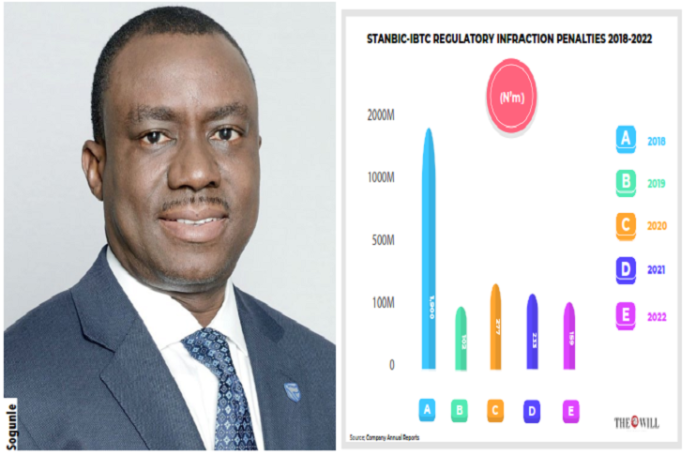
Stanbic IBTC Holdings Plc paid a total of N159 million as punishment against its subsidiaries for breaching various regulatory guidelines in the 2022 financial year. The penalties were imposed by the Central Bank of Nigeria (CBN), National Pension Commission (PenCom), National Insurance Commission (NAICOM), Securities and Exchange Commission (SEC) and the Federal Inland Revenue Service (FIRS).
Although the penalties were 32 percent less than the N233 million collectively slammed on the Group in 2021, stakeholders have expressed concern over the habit of incurring regulatory infraction penalties by the financial services institutions, and using investors’ funds to settle them.
Data gleaned from the 2022 audited financial statement of Stanbic IBTC Group showed that the highest penalties were incurred by the pension subsidiary, Stanbic IBTC Pension Managers Limited, which was slammed with a N79.6 million fine by PenCom.

“PenCom imposed a penalty of N69,600,000 on Stanbic IBTC Pension Managers Limited for contravening the provisions of the Revised Registration Guidelines.
PenCom imposed a fine of N10,000,000 on Stanbic IBTC Pension Managers Limited as an administrative sanction for the publication of an unapproved advert by Stanbic IBTC Group,” the Group revealed in its 2022 audited financial statement.
For failing to report export proceeds and Certificate of Capital Importation to CBN and NFIU, amid efforts to boost non-oil export revenue, the apex bank punished Stanbic IBTC Bank with a penalty of N44,850,000. The CBN also imposed a fine of N5,000,000 on the financial services institution for late rendition of daily returns.
The regulatory hammer of SEC fell on Stanbic IBTC Trustees Limited for misinformation of the income earned on the investment of Bond sinking funds on the year 2020 returns. The subsidiary coughed out N8,205,000 to settle this penalty during the year.
The financial statement further stated that “The SEC imposed a fine of N500,161.25 on Stanbic IBTC Capital Limited for not depositing all the proceeds of the Stanbic Infrastructure Fund issue in an interest-yielding account with the custodian.”
During the year, NAICOM “imposed a fine of N15,250,000 on Stanbic IBTC Insurance Brokers Limited for alleged failure to avail an on-site inspector with the full representation of KYC/CDD documents conducted on customers.”
NAICOM also imposed a fine of N250,161.25 on Stanbic IBTC Insurance Limited for late upload of online real-time data of policies booked. It also punished the subsidiary “with a fine of N250,161.25 on Stanbic IBTC Insurance Limited for late upload of online real-time data of policies booked.”
The Group’s audited performance report also revealed that the financial services institution breached the tax regulations of the country which earned it a N50,000 fine by the FIRS for late filing and remittance of Value Added Tax (VAT).
THEWILL had published last year that Stanbic IBTC Group coughed out a total of N2.76 billion on penalties imposed on it by the authorities for contravening various industry regulations within five years (2017-2021),
Among the major penalties the bank paid in 2021 was N200 million for flouting the CBN directive on Cryptocurrency, a sanction the bank said it would press for reversal.
In 2020, the financial services institution paid a “Penalty on Involvement in Textile Importation Using FX Sourced from the Nigerian Market. The CBN imposed a penalty of N152 million on the bank following the investigation which was conducted on foreign exchange used to import textiles for the period of 02 and 15 October 2019,” the company revealed.
The highest penalty of N1.9 billion the bank paid during the 5-year period related to capital importation documentation which earned it the CBN’s hammer: “Penalty arising from CBN investigation on ‘irregular’ Certificates of Capital Importation (“CCI’s”) issued to MTN Nigeria Communications Limited (MTN Nigeria), between 2007 and 2015 – N1,885,852,847.46.”
Reacting to the report, the Chairperson, Pragmatic Shareholders Association of Nigeria, Mrs Bisi Bakare had described the development as unfortunate and worrying, though not peculiar with Stanbic IBTC Bank. She said some of the penalties are avoidable if the banks can be more proactive. “It is not peculiar with Stanbic IBTC Bank; other banks pay penalties. My candid advice to the management is to be proactive in their dealings,” she said in a note to THEWILL then.
Despite a challenging environment, Stanbic IBTC Holdings Plc in its 2022 audited financial statements for the period ended December 31, 2022, reported significant improvement in key financial parameters to maintain its position as one of the leading Tier-2 banks in the country.
The Group in the review period announced a significant increase in balance sheet position that impacted on its bottom-line: Its total assets hit N3.03trillion in 2022, an increase of 10 per cent from N2.74trillion in 2021, driven majorly by growth in gross loans & advances and customer deposits.
The Group’s gross loans & advances was up by 31 percent to N1.24 trillion in 2022 from N946.26 billion in 2021, while customer deposits increased by 11 percent to N1.25 trillion in 2022 from N1.13 billion achieved in 2021.
Commenting on the results, the Chief Executive Stanbic IBTC Holdings, Dr Demola Sogunle in a statement said, “2022 was a peculiar year for us as a financial services provider within the Nigerian operating environment. Despite the volatile macro-economic indicators, coupled with varying regulatory burdens, we made substantial progress towards achieving our set financial goals based on our guidance for the year.
“We recorded growth in our profit metrics, loans and advances, and deposits during the year. The Group’s profit after tax increased by 42 percent to N80.81billion, being the second highest PAT in the history of the organisation.
“This was largely attributable to significant increase in net interest income and growth in non-interest revenue. The 50 percent YoY increase in net interest income resulted from growth in the volume and average yield on cumulative risk assets while growing our loan book.
“In addition, non-interest revenue was driven by growth in trading revenue following an improvement in trading activities as well as 9 percent growth in fees and commissions compared to the prior year.
“The improvement in our earnings led to an increase in our return on equity to 20.4 per cent from 14.7 per cent in 2021, well above our target range. Increased focus on our cost savings initiatives led to a moderation in our cost-to-income ratio to 53.9per cent from 62.3 per cent in 2021, which is in line with our target of at most 55per cent for the year.
“We particularly exceeded our guidance for loan growth as gross customer loans increased by 31 percent to N1.24 trillion, attaining the one-trillion-mark as we continue to support our clients in achieving their financial goals.
“The non-performing loan ratio moved up to 2.4per cent, still within the acceptable limit of five per cent, as the total non-performing loans increased YoY due to proactive recognition of increased credit risks in specific clients. We will continue to extend loans in a responsible manner and in line with our established credit risk management practices.
“The increase in our loan book was funded by a 11 percent YoY growth in customer deposits. The current account to savings account ratio increased to 71.7per cent, exceeding our target of at least 70 percent due to accelerated growth in low-cost deposits.”
He added that, “We demonstrated our commitment towards promoting sustainable finance and climate action during the year as 32 bank branches and seven pension locations now run on solar powered energy solutions.”

Sam Diala is a Bloomberg Certified Financial Journalist with over a decade of experience in reporting Business and Economy. He is Business Editor at THEWILL Newspaper, and believes that work, not wishes, creates wealth.