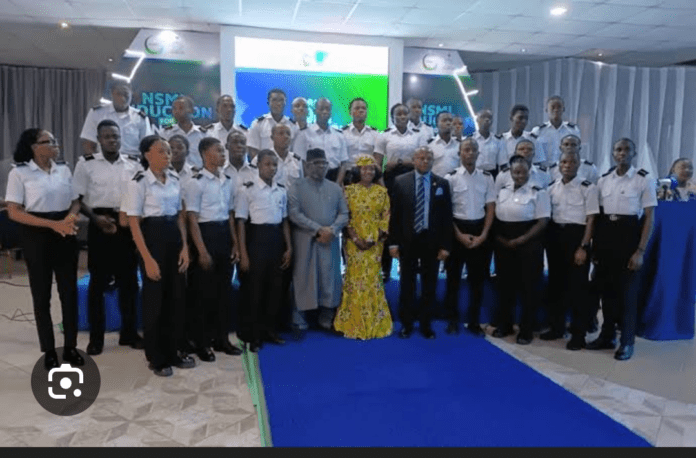
February 22, (THEWILL) — On February 20, 2026, in Port Harcourt, Rivers State, the induction of 30 cadets from the Maritime Academy of Nigeria, Oron, into the fleet of NLNG Shipping and Marine Services Limited (NSML) marked more than a ceremonial send-off. It signalled the restoration of a structured sea-time pathway that has long defined the difference between graduation and professional certification in Nigeria’s maritime sector.
The ceremony, attended by industry leaders, regulators and families, effectively consolidated a renewed partnership first formalised on December 19, 2025. With an earlier batch of 13 cadets already inducted in December, the total number of MAN Oron cadets placed on NSML vessels now stands at 43 within two months.
For an academy where sea-time placement has historically been the most critical bottleneck, the figure carries institutional weight. Under the International Convention on Standards of Training, Certification and Watchkeeping for Seafarers (STCW), cadets must complete mandatory onboard service before progressing to certification as officers. Without it, academic achievement remains incomplete.

Acting Rector of MAN Oron, Kevin Okonna, described the event as a defining moment for the academy. “Today is one of my happiest days as the Acting Rector & CEO. This is the day that the Academy and the NLNG Shipping and Marine Services Limited, through the execution of the MOA signed on 19th December, 2025, have re-established the special relationship that has existed between both organisations over the years”, he said.
He underscored the practical outcome of the agreement: “This is in addition to the 13 MAN, Oron cadets earlier inducted for onboard training by the NSML on the 19th December, 2025. The hope and motivation that these events have generated amongst seafaring cadets in the Academy cannot be underestimated.”
The partnership revives a model that dates back to 1992, when Nigeria LNG inducted its first batch of eleven cadets; all from MAN Oron. That initiative became a benchmark for structured industry-academy collaboration before it paused in 2015 amid financial constraints, widening the gap between classroom training and sea-time availability.
In his remarks, NSML’s Managing Director, Ahmed Abdulkadir Kere, framed the revival as deliberate and strategic. Recalling internal discussions that preceded the agreement, noting that the central question was, “How do we restart the training of Nigerian cadets?”
The renewed intake, he indicated, answers that question with action rather than intent.
Okonna placed the development within a global context. “Through the MAN, Oron–NSML partnership Nigeria is assuring the global maritime industry that the country has the capacity and is committed to making its contributions to the supply of quality seafarers”, he stated, reminding participants that ships operated by seafarers carry “about 90 percent of global trade”.
Representing the Honourable Minister of Marine and Blue Economy, Adegboyega Oyetola, officials linked the initiative to federal policy direction.
In a message delivered on behalf of the minister, the ministry noted that the collaboration “perfectly aligns” with the national agenda prioritising job creation and indigenous capacity development.
The statement added that the initiative will not only strengthen indigenous maritime capacity but will supply globally competitive seafarers.
The ministry also called on other shipowners to provide sea-time opportunities, arguing that sustained industry participation is essential to scale the impact beyond a single operator.
The Chairman of the Governing Council of MAN Oron, Kehinde Akinola, addressed the structural gap the programme seeks to close. “Without sea-time, certification remains incomplete, without industry partnership, training remains theoretical. Today, we celebrate the bridge between both”, he said.
For the cadets, the induction represents the transition from theory to practice. Akinola described long-sea training as “the defining phase in the life of every maritime professional”, adding that it is where “knowledge is tested by waves, discipline is measured by routine, and character is refined by responsibility.”
The institutional implications are measurable. If NSML sustains an annual intake averaging 40 to 50 cadets consistent with the 43 already inducted within two months; between 200 and 250 MAN Oron cadets could complete sea time through this channel over the next five years.
Given annual seafaring enrolment that industry observers estimate at 400 to 500 cadets, even a 25 percent absorption rate through structured partnerships could produce more than 1,000 additional certified officers over a decade. Such a trajectory would significantly improve the academy’s certification throughput and strengthen Nigeria’s maritime manpower profile.
For NSML and its parent company, Nigeria LNG Limited, the programme reinforces workforce continuity. Training cadets within their operational ecosystem ensures familiarity with fleet standards, safety systems and compliance requirements.
Okonna reminded the cadets that performance during sea time carries institutional consequences. “The Academy, the NSML, Nigeria, the IMO and the global shipping industry need you to be successfully certificated as seafaring officers”, he said, tying individual conduct to national credibility.
“The February 20 ceremony in Port Harcourt, therefore, stands as both a restoration and a projection. Forty-three placements establish a baseline. Whether that baseline evolves into a sustained pipeline will depend on consistency, regulatory compliance and industry commitment.
“For MAN Oron, however, the trajectory has shifted. The reopened sea-time channel narrows the gap between training and certification and positions the academy more firmly within the global conversation on maritime workforce supply”, Okonna stressed.