
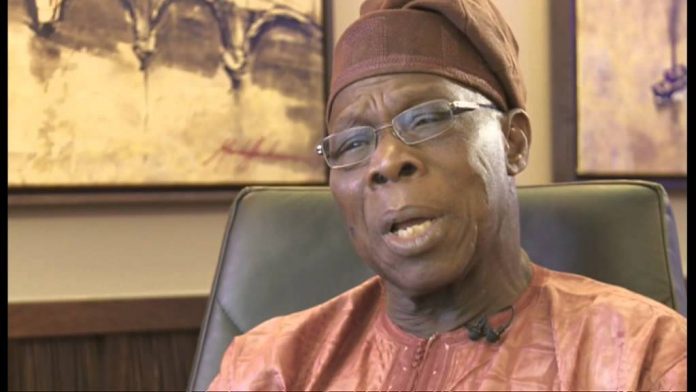
October 25, (THEWILL) – Former President, Olusegun Obasanjo, has refuted speculations that he sought a third term as Nigeria’s democratic president, saying “If I had wanted a third term, I would have got it”.
Speaking in an exclusive interview with News Central, the former president explained that if he had pursued a third term, some state governors harbouring similar ambitions would have followed suit.
“If I had wanted a third term, I would have got it. I didn’t want a third term. I know some governors, who were working for this, believing that if I, as president, got a third, they would also get it”, he said.

Obasanjo ruled both as a military head of state and later as a civilian president from 1999 to 2007.
The former President emphasised that his administration prioritised securing debt relief for Nigeria, an effort that required diplomatic negotiations with countries including France, the United Kingdom, Japan and the United States.
He stressed that achieving debt relief was a more challenging task than seeking a third term as a democratic president.
“Getting debt relief is much more difficult than getting a third term. Getting a third term wouldn’t involve me going to France, America, Japan, Italy and Germany to virtually beg”, he said.
THEWILL reported on Thursday that Nigeria’s public debt increased to N134.3 trillion ($91.3 billion) in the second quarter of 2024, representing a 10.35% increase from the N121.7 trillion ($91.5 billion) recorded in the first quarter.
While multilateral loans accounted for the largest portion, making up 50.4% of external debt, debt servicing payments, however, surged by 69% in the first half of 2024, reaching N6.04 trillion, up from N3.58 trillion in the same period of 2023.
Obasanjo expressed concern over the mounting debt, highlighting that despite leaving behind an estimated $70 billion in reserves and excess crude oil savings when he left office in 2007, the country now faces an even greater debt burden.
He recounted how he met $3.7 billion in the country’s foreign reserves and a significant debt burden of $36 billion when he assumed office in 1999.
“When I came in 1999, I met $3.7 billion in reserves. And as I told you, we were spending $3.5 billion to service debt. That’s how we had it. By the time I left eight years later, with debt relief… the quantum of debt that I left was about $3.5 to $3.6 billion from over $36 billion.
“At the same time, we had what we called excess crude – this is the amount between what we budgeted that we would sell the crude oil and what we actually sold it. We had around $25 billion. When you add that to the reserve, we are talking about $70 billion.
”The point is that I left in 2007, and today in 2024, just 17 years after, all that amount of money has gone. Today, we owe more than we owed when I came to government in 1999″, he lamented.
Felix Ifijeh is a journalist with years of professional reporting experience. Known for his keen news sense, compelling storytelling and commitment to accurate, impactful reporting, he has built a reputation for turning leads into clear, engaging, and well-structured reports that resonate with readers. His work reflects deep newsroom experience and a commitment to accurate, impactful journalism.
