
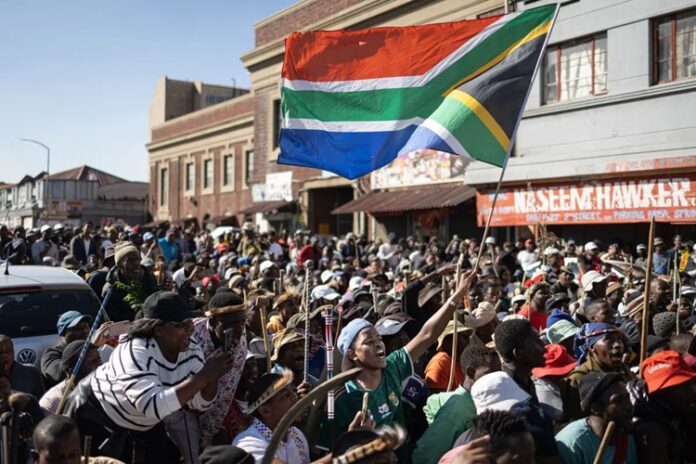
June 30 (THEWILL) — South Africa witnessed heightened tensions on Tuesday as thousands of anti-immigration protesters took to the streets across major cities, prompting authorities to deploy police tactical units and helicopters to prevent the nationwide protests from descending into widespread xenophobic violence.
The demonstrations coincided with an unofficial June 30 deadline declared by anti-immigration campaign groups demanding that undocumented foreign nationals leave the country.
While the protests remained largely peaceful in many areas, authorities confirmed several arrests linked to looting and attempted looting, while violent incidents, intimidation and destruction of property were reported in parts of Johannesburg, Benoni and other flashpoints.

Reports monitored by THEWILL saw the South African Police Service (SAPS) deploying officers across Johannesburg, Durban, Soweto, Benoni, Brakpan, George, Mossel Bay, Hermanus and several other communities where tensions had been building for weeks.
Police helicopters conducted aerial surveillance, tactical response teams patrolled key locations, while roadblocks, vehicle checkpoints and business inspections were intensified as authorities sought to reassure residents and protect businesses, foreign nationals and critical infrastructure.
In Johannesburg’s central business district, usually bustling with commercial activity, many businesses remained shut while major streets were lined with police vehicles and officers in riot gear.
The Ministry of Police said demonstrations were generally peaceful nationwide but acknowledged isolated incidents of violence, vandalism and criminality.
“Whilst policing operations have been effective thus far, with demonstrations remaining largely peaceful across the country, police have responded to isolated incidents of looting and attempted looting”, the ministry said.
The ministry confirmed that several people had been arrested in connection with criminal activities arising from the protests.
Acting Police Minister Firoz Cachalia warned that anyone attempting to exploit the demonstrations to commit crimes would be dealt with decisively.
“We urge citizens to exercise their constitutional rights responsibly and to ensure that demonstrations remain peaceful and lawful. Those who choose to exploit the marches to commit criminal acts will face the full might of the law. Police will continue to identify, arrest and prosecute all those responsible for criminal conduct”, he said.
Authorities disclosed that five suspects were arrested in Soweto after allegedly looting a foreign-owned shop, while another five were detained in Hammarsdale, KwaZulu-Natal Province, for allegedly breaking into a tuck shop.
The Eastern Cape Provincial Police Commissioner, Lieutenant-General Vuyisile Ncata, conducted aerial inspections across the Buffalo City District as officers maintained visible patrols throughout the province.
Police spokesperson Brigadier Nobuntu Gantana said only small groups of demonstrators had gathered in parts of the province, adding that no major incidents had been recorded.
The largest demonstration unfolded in Durban, where more than 5,000 protesters converged at King Dinuzulu Park before marching approximately 4.3 kilometres to the Point Police Station.
The crowd swelled significantly after the arrival of leaders of the “March and March” movement, with supporters chanting slogans and carrying placards demanding stricter immigration enforcement.
Many demonstrators carried traditional Zulu fighting sticks and sjamboks despite police warnings that traditional weapons would not be permitted during the protests.
Police officers repeatedly formed human barricades to prevent marchers from leaving approved routes or confronting foreign-owned businesses.
At several points along the route, protesters pointed at residential buildings believed to house migrants and shouted threatening remarks, including “Sizokulimaza” (“We will hurt you”), prompting officers to tighten security around affected areas.
Despite moments of tension, organisers repeatedly appealed to supporters to remain disciplined, preventing several situations from escalating into violence.
In Hillbrow, Johannesburg, demonstrators were seen throwing stones, although organisers affiliated with Operation Dudula and members of the MK Party intervened to stop further violence and discourage attempts to attack buildings.
Private security personnel also prevented protesters from entering residential complexes occupied by migrants after an attempted looting of a liquor outlet was foiled.
The most volatile confrontation occurred in Benoni, where more than 500 demonstrators marched through the central business district. Witnesses reported that some protesters carried bottles of alcohol while others threatened journalists, police officers and private security personnel.
The crowd eventually overwhelmed security forces, forcing officers to retreat temporarily before police fired shots to disperse aggressive demonstrators.
Authorities have yet to clarify whether rubber bullets or live ammunition were used, and no official casualty figures have been released as of Tuesday evening.
In Yeoville, a Johannesburg suburb with a significant migrant population, protesters threw bricks that smashed windows in residential buildings.
Brakpan witnessed a small march under close police supervision, while community representatives, law enforcement officers and protest leaders jointly inspected a local meat market after concerns were raised about the documentation status of some employees.
In George, protesters moved from one informal shop to another, demanding closures while shouting “Vala!” meaning “Close!” Small children accompanying the march threw stones before police intervened.
Unlike in Durban, demonstrators in George voluntarily surrendered sticks after police requested that traditional weapons be handed over.
In Hermanus, about 50 protesters gathered in Zwelihle township demanding the removal of undocumented migrants, accusing foreign nationals of taking jobs and fuelling crime and drug trafficking.
President Cyril Ramaphosa, who held talks with protest leaders before the demonstrations, urged South Africans to exercise restraint and warned against targeting migrants.
In his weekly newsletter, the President acknowledged public frustration over illegal immigration but reminded citizens that millions of foreign nationals live legally in South Africa.
“Some foreign nationals who live in South Africa are here lawfully. They work, study, raise families, invest in our economy and contribute positively to our society. They too are entitled to the protection of our laws and our Constitution”, Ramaphosa said.
He added that constitutional rights to protest did not include threatening or intimidating others or engaging in acts of vandalism and violence.
Official figures indicate that more than three million documented foreign nationals currently reside in South Africa, although authorities acknowledge that many undocumented migrants are also living in the country.
Police said approximately 50,000 undocumented migrants had been arrested since January as immigration enforcement intensified nationwide.
The demonstrations have accelerated voluntary departures by foreign nationals fearful of renewed xenophobic violence.
According to police, about 25,000 migrants have already been repatriated, while government figures indicate that more than 12,000 undocumented immigrants have either been deported or voluntarily returned to their home countries since anti-immigration protests intensified earlier this year.
Nigeria on Tuesday received another 269 citizens aboard an Air Peace evacuation flight from Johannesburg, following an earlier evacuation of hundreds of Nigerians, while Ghana, Malawi, Mozambique and Zimbabwe have also coordinated the return of thousands of their nationals.
In Durban, authorities have begun dismantling temporary transit camps after approximately 7,000 Malawians returned home.
Many migrants described painful decisions to abandon businesses, employment and families built over several years.
One undocumented Malawian told the BBC he was relieved to return home but heartbroken to leave behind his four children.
Another migrant, Nelson Mbewe, said he had travelled to South Africa seeking employment but was now returning after repeated hostility and being labelled “Makwerekwere,” a derogatory term commonly used against African migrants.
Another Malawian, Hassan Phiri, appealed for unity across the continent.
“Africa can’t be Africa without South Africa, without Malawi, without anywhere. Whatever happens, we must love each other and stick together as Africa”, he said.
The protests have reignited debate over immigration and unemployment in South Africa, where organisers argue that undocumented migrants are responsible for worsening joblessness and crime.
South Africa’s latest Quarterly Employment Statistics showed that the country lost about 80,000 formal jobs in the first quarter of 2026, with community services and the trade sector recording the steepest declines.
Felix Ifijeh is a journalist with years of professional reporting experience. Known for his keen news sense, compelling storytelling and commitment to accurate, impactful reporting, he has built a reputation for turning leads into clear, engaging, and well-structured reports that resonate with readers. His work reflects deep newsroom experience and a commitment to accurate, impactful journalism.
