
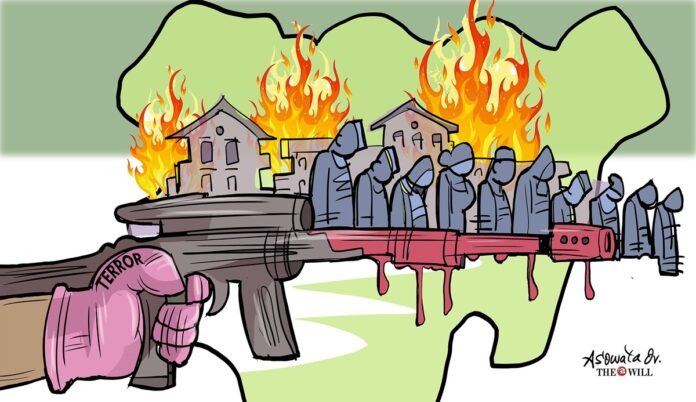
July 26, (THEWILL) — Northern Nigeria, once regarded as the nation’s agricultural powerhouse and demographic engine, is facing what may be its deepest socio-economic crisis in decades.
The cause: Insecurity. Across the North-East, North-West and parts of the North-Central geo-political zones, insecurity has evolved beyond a security challenge into a full-scale economic emergency that is steadily dismantling the foundations of development. And the end appears not in sight.
Banditry, terrorism, kidnapping, farmer-herder conflicts and organised criminality are no longer merely claiming lives. They are destroying businesses, shutting schools, shrinking financial inclusion, discouraging investments, reducing agricultural productivity, worsening poverty and accelerating human capital flight.

Beyond the North
The impact of the worsening insecurity extends far beyond the Northern Region. The bigger picture is that it portends grave danger to the continued existence of the country as a whole. Because the region accounts for well over half of Nigeria’s landmass and a substantial share of its population, its economic decline threatens the country’s long-term growth, food security, political stability and fiscal sustainability. International institutions are increasingly warning that while Nigeria’s macroeconomic reforms are showing encouraging signs nationally, poverty and food insecurity remain particularly severe across the northern states.
The International Monetary Fund, IMF, estimates that poverty reached about 63 percent, while roughly 27 million Nigerians experienced food insecurity in late 2025. It means that the celebrated macroeconomic improvements in the areas of stable exchange rate and foreign reserves exceeding $50 billion, for instance, do not capture the economic realities in the North.
Gradual economic erosion
Agriculture, the region’s greatest comparative advantage and its economic backbone, is under siege. The territory produces maize, sorghum, millet, rice, tomatoes, onions, beans, livestock, groundnuts, sesame – among others, now it hosts vast stretches of farmland that have become inaccessible. Farmers in Zamfara, Katsina, Sokoto, Kaduna, Niger States and parts of Borno increasingly pay illegal levies to armed groups before accessing their farms. In some cases, the indigenes are forced to share their produce with the armed groups who have remained the “landlords”.
Many have abandoned cultivation entirely to live in IDP camps as refugees and a liability to the nation, contrary to what used to be their productive status. According to UNDP, the estimated number of internally displaced persons (IDPs) in camps across northern Nigeria is roughly 912,881 to 1.1 million in formal and informal camps, compared to about 650,000 to 750,000 encamped individuals in 2015. Total displacement across the entire northern region has grown significantly, as insecurity escalates.
The consequence is severe, as lower farm output means declining rural incomes, rising food inflation, higher dependence on imports, shrinking agro-processing activities and worsening unemployment. The World Food Programme (WFP) warns that conflict and the collapse of local food systems have pushed millions into severe food insecurity, particularly in Borno, Adamawa and Yobe States.
Investors’ Nightmare
Northern Nigeria increasingly offers uncertainty instead of opportunities in investments like agriculture, processing, transportation and backward integration. Manufacturers dread establishing factories in insecure locations, which accounts for economic decline in the North. Transport companies charge risk premiums, insurance costs escalate, construction projects are delayed, while micro, small and medium enterprises – the engine of the economy – gradually disappear.
Official surveys by the National Bureau of Statistics (NBS) and Small and Medium Enterprises Development Agency of Nigeria (SMEDAN) reveal that Nigeria’s MSMEs dropped from 41.5 million in 2017 to 39.7 million in recent times, mainly resulting from insecurity. “Boko Haram insurgency caused widespread business closures and severe asset destruction, particularly in agriculture and retail trade, as insecurity severely impaired rural farming, supply chains and market access, forcing many small enterprise owners into displacement camps. Even indigenous entrepreneurs increasingly prefer Lagos, Ogun, Rivers or Abuja rather than expanding deeper into troubled northern communities. Without private investment, job creation inevitably slows,” a report stated.
Education in historic reversal
Perhaps nowhere is the damage more devastating than education. School closures have become recurring. Parents increasingly fear sending children to school as teachers avoid rural postings. Thousands of pupils have experienced repeated interruptions to learning because of insecurity.
UNICEF reports that Nigeria has an estimated 18.3 to 20 million out-of-school children, holding the highest number globally, with educational deprivation concentrated in northern states (about 80 percent), particularly affecting girls. It emphasised that insecurity across northern states has significantly disrupted education, displaced communities and reduced access to basic services. The implications are profound.
Today’s educational disruption becomes tomorrow’s productivity crisis. Human capital being destroyed, experts say economic growth depends less on natural resources than on skilled people. “Northern Nigeria is steadily losing both as young professionals relocate, doctors leave, engineers migrate, teachers resign, and entrepreneurs move their businesses elsewhere. The region suffers not only ‘brain drain’ but also ‘hope drain’,” the World Bank warned, adding that Nigeria’s deficiencies in nutrition, education and workforce skills, particularly in the North, are dramatically reducing future earnings potential.
Reports indicate that an estimated 52 to 56 percent of Nigerian professionals express a willingness or plan to leave the country due to economic hardship and insecurity.
Financial inclusion in reverse
Northern Nigeria has historically recorded lower banking penetration. Insecurity is worsening the situation. Bank branches in vulnerable communities close earlier. Agent banking becomes risky. Cash movement attracts criminal attention. Digital financial services struggle where telecom infrastructure is repeatedly attacked. The result is reduced access to savings, credit, insurance, payments and investment products. Without finance, entrepreneurship cannot flourish. Data from the CBN showed that traditional banking in Northern Nigeria faced heavy constraints in 2015 due to regional security challenges, lower urbanisation and sparse infrastructure, leaving most northern local government areas (LGAs) with fewer than five physical bank branches. In 2026, the situation remains serious.
The current landscape
Out of 12 states in Nigeria with more than 100 commercial bank branches nationwide, only a few top northern hubs (such as Kano and Kaduna) cross that threshold, while vast areas in the North-East and North-West remain heavily underserved by physical bank halls.
Humanitarian Dimension
The statistics are sobering. The Integrated Food Security Phase Classification (IPC), a global partnership of different organisations that uses common standards to measure and classify the severity of food insecurity and malnutrition crises, projects that nearly 6.4 million children in northern, north-western and north-central Nigeria are suffering acute malnutrition through 2026, including around 2 million with severe acute malnutrition, driven by insecurity, poor health systems and inadequate food consumption.
UNICEF’s assessments further show that insecurity has disrupted schooling, displaced families and weakened access to education across several northern states. These are not merely humanitarian indicators; they are leading indicators of future economic weakness.
Ways out
International agencies have emphasised that restoring security to farming communities can be achieved through intelligence-led policing and community security partnerships. Also, expanding mechanised agriculture and irrigation to reduce production risks, and rebuilding schools with comprehensive safe-school programmes, are priority areas to focus on.
Other areas to consider include accelerating financial inclusion using secure digital banking infrastructure, investing aggressively in vocational and technical education, establishing special economic zones with enhanced security guarantees, reforming livestock production through ranching and modern value chains, as well as creating labour-intensive industries linked to agriculture.
Also, improving rural roads and telecommunications infrastructure and strengthening governance, accountability and local institutions should be vigorously pursued.
Governors React
Aware of the urgency of these social and economic threats to the region, governors of the northern states met in joint sessions in Kaduna and Abuja on June 16, 2026, lamented the destruction of schools, farms and local communities and agreed to pool resources through a regional security fund, “committing ₦1 billion monthly per state to upgrade surveillance and rapid responses.” The governors, who met under the aegis of the Northern Nigeria Governors’ Forum, declared that the ongoing terrorism, banditry, and kidnapping pose an existential threat to Northern Nigeria, disrupting livelihoods and halting regional development.
On July 9, 2026 when they again met, this time to inaugurate the Board of Trustees of the Northern Security Trust Fund, the Chairman of the group, who is the governor of Gombe State, Muhammadu Inuwa Yahaya, lamented that “the insecurity confronting Northern Nigeria is a stark and grave reality, destroying communities, weakening agriculture, discouraging investment, displacing families and threatening the future of the people. “We must also continue to address the root causes of insecurity. Poverty, illiteracy, unemployment and the challenge of out-of-school children all contribute to the conditions that allow insecurity to thrive. Security operations are necessary, but they must be reinforced by investment in education, livelihoods, agriculture, youth empowerment and skills development,” the governor said.
Northern Nigeria at critical crossroads
Northern Nigeria’s immense agricultural potential, youthful population, mineral resources and strategic location should position it as one of Africa’s fastest-growing economic regions, say analysts. Instead, insecurity has become a destructive force eroding virtually every pillar of development—education, agriculture, commerce, manufacturing, financial inclusion and human capital. The region’s crisis is no longer just about security; it is about economic survival. Every abandoned farm, every shuttered school, every displaced family and every business relocation represents lost productivity and diminished national prosperity.
Collectively, multilateral organisations and reports agree that if these trends persist, Nigeria risks entrenching a cycle in which conflict fuels poverty, poverty fuels instability, and instability drives away the investment needed for recovery. Reversing this trajectory, they submit, demands more than military operations. It requires sustained investment in education, rural infrastructure, agricultural modernisation, financial inclusion, job creation and accountable governance.
Security must become the foundation upon which economic renewal is built. The future of Northern Nigeria is inseparable from the future of Nigeria itself. A prosperous North would strengthen national food security, expand industrial output, deepen domestic markets and contribute significantly to inclusive economic growth. Conversely, allowing the region’s economic erosion to continue would undermine Nigeria’s ambition to become one of Africa’s leading economies. The choice confronting policymakers and Northern leaders is therefore stark: arrest the decline through bold, coordinated reforms, or watch one of the country’s greatest economic assets slip further into regression, with consequences that will reverberate far beyond the North.

Sam Diala is a Bloomberg Certified Financial Journalist with over a decade of experience in reporting Business and Economy. He is Business Editor at THEWILL Newspaper, and believes that work, not wishes, creates wealth.
