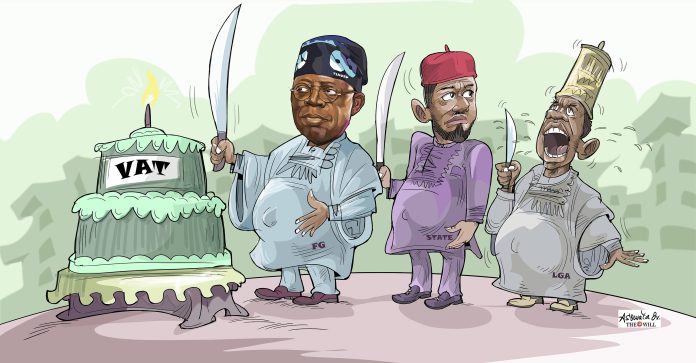
November 10, (THEWILL) – The maxim, ‘A house divided against itself cannot stand’ may have played a major role in the ongoing tax war between the federal government and governors of the 19 states of the North, some traditional rulers from the region, as well as some northern federal lawmakers who are opposed to the central government’s proposed four reform tax bills before the National Assembly.
President Bola Tinubu had on October 13 asked the National Assembly to consider and pass four tax reform bills, namely, “The Nigerian Tax Bill, the Nigeria Tax Administrative Bill, the Nigeria Revenue Services Bill and the Joint Revenue Board Establishment Bill,” over a year after he set up the Taiwo Oyedele Presidential Committee on Tax and Fiscal Policy Reform in August 2023.
According to checks by THEWILL, the source of discord over the proposals emanated from the FIRS. The appointment of Dr Zacch Adedeji as Executive Chairman of the agency is said to have unsettled some entrenched interests in the agency.

To make matters worse, Adedeji is said to have ‘offended’ those in-house experts, who expected to be consulted and carried along on the new tax reforms, by his decision to consult the renowned ‘Big Four’ accounting, auditing consulting firms, namely PWC, KPMG, Ernst and Young and Deloitte, on best practices for progressive tax reforms in Nigeria. The last tax reform in the country was done in 1993. An urgent need to carry out a comprehensive tax overhaul was the major reason that Adedeji decided to consult the four firms.
“Some of these entrenched interests in FIRS were the ones who started the disinformation by telling governors in the North who they had access what is really not,” a dependable agency source told this newspaper.
According to the source, “The tax reform bills are a 256- page document and all that these interests within chose to misinterpret and misinform their people about what does not exceed one page of the document and that is the Value- Added Tax, VAT. They deliberately sold the idea that the derivation principle in the VAT bill will punish states that do not produce anything whereas VAT is a consumption tax.”
Expatiating further, the source who asked for anonymity, gave an example with a producer-consumer matrix. “That 100 industries produce goods, in say Ogun State, does not mean that all the goods will be consumed in Ogun. Assuming the goods are taken to Kano, sold and consumed there by its very large population, that means VAT for goods consumed in Kano but produced in Ogun.
“But as soon as the disinformation went out, the reaction from the supposedly affected quarters was swift and acerbic.”
NORTHERN GOVERNORS, TRADITIONAL RULERS REACT
On Monday, October 28, 2024, the Northern Governors Forum (NGF) rejected the proposed Tax Reform Bill. The Governors of Zamfara, Borno, Bauchi, Adamawa, Kogi, Yobe, Gombe, Kaduna, Nasarawa and Kwara States attended the meeting, while the governors of Kebbi, Taraba and Niger States were represented by their deputies and secretaries to their state governments. Traditional rulers from the region, led by the Sultan of Sokoto, His Eminence Muhammadu Sa’ad Abubakar III, attended the meeting, too.
As it turned out, the VAT, one of the four proposed taxes, was the point at issue. The gathering frowned at the proposed amendment to the distribution of Value Added Tax (VAT) to a Derivation-based Model, saying the bill was antithetical to the interests of the North and other sub-nationals. They called on members of the National Assembly to oppose the bill on the premise that it will jeopardise the well-being of their people.
According to Governor of Gombe state, Mohammed Yahaya, who read the communique at the end of their meeting, “the contents of the Bill are against the interests of the North and other sub-nationals, especially the proposed amendment to the distribution of Value Added Tax (VAT) to a Derivative-Based Model. This is because companies remit VAT, using the location of their headquarters and tax office and not where the services and goods are consumed. In view of the foregoing, the Forum unanimously rejects the proposed Tax Amendments and calls on members of the National Assembly to oppose any bill that can jeopardise the well-being of our people.”
Despite the presidency’s reassurance that the proposed four bills are not targeted at the North, but new policy initiatives aimed at streamlining Nigeria’s tax administration processes, enhancing efficiency and eliminating redundancies across the nation’s tax operations, the North stuck to its guns.
Two days after their meeting, the National Executive Committee, NEC, chaired by Vice President Kashim Shettima, met and asked the federal government to withdraw the bills from the National Assembly to make room for wide consultations. At the meeting, the state governors from the North insisted that the bills were anti-North.
TINUBU MAINTAINS STAND
Reacting to the call to withdraw the bills, President Tinubu said that the legislative process on the Tax Reform Bills before the National Assembly will continue and urged those opposing the bills to make inputs during its public hearing. He welcomed further consultations and engagement with key stakeholders to address any reservations about the bills while the National Assembly
considers them for passage.
Tinubu said the committee worked for over a year and received inputs from various segments of the society across the geo-political zones, including trade associations, professional bodies, different ministries and government agencies, governors, traders, students, business owners and the organised private sector.
Special Adviser to the President on Information and Strategy, Bayo Onanuga, who took time to explain the contents of the four bills, said the Tax Bills seeks to eliminate multiple taxation and make Nigeria’s economy more competitive by simplifying tax obligations for businesses and individuals nationwide.
According to Onanuga, the Nigeria Tax Administration Bill (NTAB) proposes new rules governing the administration of all taxes in the country. Its objective is to harmonise tax administrative processes across federal, state and local jurisdictions to ease taxpayers’ compliance and enhance the revenue for all tiers of government.
The Nigeria Revenue Service (Establishment) Bill seeks to re-establish the Federal Inland Revenue Service (FIRS) as the Nigeria Revenue Service (NRS) to better reflect its mandate as the revenue agency for the entire federation, not just the federal government.
The Joint Revenue Board Establishment Bill proposes creating a Joint Revenue Board to replace the Joint Tax Board, covering federal and all state tax authorities. The fourth bill will also establish the Office of Tax Ombudsman under the Joint Revenue Board, protecting taxpayers’ interests and facilitating dispute resolution.
“The bills’ overarching objective is to effectively coordinate federal, state and local tax authorities, thereby eliminating the overlapping responsibilities, confusion and inefficiency that have plagued tax administration in Nigeria for decades,” said Onanuga.
NORTHERN OPPOSITION PERSISTS
Despite the presidential assurance, the North is not backing down. Checks show that governors and many federal lawmakers are mobilising to frustrate the bills at the National Assembly. Senator Ali Ndume, who has been very critical of the bills, is said to be the rallying point for other lawmakers opposed to the bill. The Senator representing Borno South at the NASS, referred to the bill as “dead on arrival at the National Assembly” if the president fails to heed the call of the Northern Governors Forum and the NEC to do more consultation and carry Nigerians along.
But how far the mobilisation would go is yet to be seen. Although most of the 19 state governors attended that Monday, October 28 Northern Governors Forum, those who stayed away appeared to have conveyed a different message by their non-attendance. The states are six, namely, Kano, Katsina, Jigawa, Sokoto, Benue and Plateau. States like Plateau and Benue, in particular, do not seem to know what the opposition to the reform bills is all about, according to THEWILL’s checks. A senior government official from one of these states even asked to be briefed on the meeting and the issues raised there.
Then at the House of Representatives, nothing seems to be afoot for now. This appears to be because opposition to the President may not be as strong as Ndume is making it seem. Moreover, there is a political capital to be drawn by President Tinubu, a source told this newspaper. It derived from last month’s overture by the President to the House.
THEWILL recalls that last month President Tinubu bowed to pressure from the House of Reps to withdraw the Commander of the Order of the Niger, CFR, national honours for the Speaker and bestowed on him the second highest national honour of Grand Commander of the Order of the Niger, GCON. That bestowal was against historical precedence. Past Speakers since 1999 had always received the CFR award. The concession was part of high stakes politics which held an undertaking.
Efforts to get comments from the spokespersons of both chambers of the NASS failed as they did not respond to phone calls from THEWILL correspondent. The spokesperson of the Senate, Adaramodu Adeyemi did not pick up multiple calls. Also, the Deputy spokesperson for the House of Reps, Phillip Agbese, failed to answer his phone.
Besides, Senator Ndume appears to be facing a backlash for his stand. An aide who spoke under anonymity hinted at a plan by his party, the All Progressives Congress, APC, to sponsor his recall by his constituents. Temporary respite came his way because of the intervention of the Borno Elders Forum, which is standing by him. Felix Morka, the National Publicity of the APC, did not respond to calls for comments.
HIDDEN ISSUES
A source at the FIRS told this newspaper that what he referred to as ‘hidden issues’ may actually be fuelling the opposition of stakeholders from the North, regardless of the explanation on VAT.
“For some of these states where religion influences policy decisions on some vatable items like alcohol which a relevant agency regularly destroys, consumption tax may fall on deaf ears. Yet some of these states have a very large population that could consume products from across the country and so stand to benefit more because statistics from the National Bureau of Statistics shows that VAT contribution comes from consumption.”
WHO BLINKS FIRST?
Explaining at the weekend why President Bola Tinubu would not withdraw the bills as demanded by NEC, Northern Governors and their traditional rulers, Coordinating Director, Compliance and Enforcement at the FIRS, Matthew Mojibola said that taking such a step on the bills could pose a danger to the economy.
“Bills are not laws until they are passed, meaning that the bills could be amended and changed by the National Assembly, which is empowered by the Constitution to do so. Therefore, withdrawing them is not the solution. Let those who are against it go to the National Assembly and present memoranda during public hearings. VAT which is attracting so much opposition is only one part of the bills having over 200 sections.”
He explained that the VAT bill is based on fairness whereby everybody contributes to the ‘baking of the cake’ just as everybody participates in sharing. Still pursuing his arguments on the fairness in VAT, Mojibola, said that the majority of VAT comes from services or fast consumer goods like sugar, milk, seasoning and phones consumed by both the poor and rich, unlike luxury items like vehicles, iPhone, which contributes little in comparison. “So, you see VAT is derived from what everybody consumes. Indeed, the issue of derivation is being overplayed. Derivation is one of the ways used in sharing VAT revenues. Equity and population are also used. Under the new bill, 60 per cent is tied to derivation, 20 per cent to equity and another 20 per cent to population. That is the basis of fairness in the bill. This way, states that find themselves getting less on derivation are compensated by the other 40 percent. Many people are yet to read the bills and are basing their decisions on hearsay.”
Insisting that the four bills are designed to ensure that people pay less than in the past, as more cuts have been done in the area of food, medications, assets, public transportation, children and schooling items, Mojibola ended on a rhetorical note: “Making all those opposed to the bill happy is not possible. Making everybody agreeable is feasible. The way to do this is to educate everyone about the provisions of the bills.”
Educating everyone about the bills is a task that must be done because of their ultimate benefits, according to Senator Shehu Sani in his reaction to the growing opposition from the North. Arguing that Senator Ndume’s trenchant comments do not reflect the position of the North, let alone that of Nigerians, the Senator who represented Kaduna South in the eight NASS, said, “People should put sentiments aside and read the bills carefully. They are a comprehensive effort and bold move to harmonise and simplify tax administration and streamline their enforcement and enforcement.” He called on the 19 Northern governors to promote their passage.
Notice: Function wpdb::prepare was called incorrectly. Unsupported value type (object). Please see Debugging in WordPress for more information. (This message was added in version 4.8.2.) in /home/thewilln/public_html/staging.thewillnews.com/wp-includes/functions.php on line 6170
Notice: Function wpdb::prepare was called incorrectly. Unsupported value type (object). Please see Debugging in WordPress for more information. (This message was added in version 4.8.2.) in /home/thewilln/public_html/staging.thewillnews.com/wp-includes/functions.php on line 6170
Notice: Function wpdb::prepare was called incorrectly. Unsupported value type (object). Please see Debugging in WordPress for more information. (This message was added in version 4.8.2.) in /home/thewilln/public_html/staging.thewillnews.com/wp-includes/functions.php on line 6170
Warning: Undefined variable $show_related in /home/thewilln/public_html/staging.thewillnews.com/wp-content/plugins/molongui-authorship/views/author-box/parts/html-tabs.php on line 30
Amos Esele is the Editor of THEWILL Newspaper. He has over two decades of experience on the job.