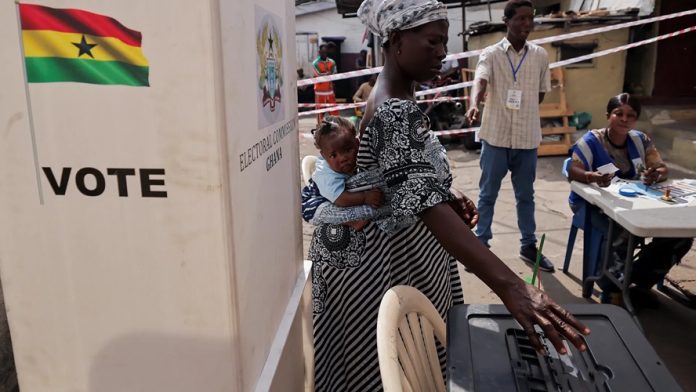
December 15, (THEWILL) – On December 7, 2024 Ghanaians went to the poll and voted for a new president and parliamentarians. The election was not only smooth; it was peaceful and fair. The Electoral Commission cleared 12 candidates for the presidential ballot drawn from eight political parties and four independents, but in reality, only two political parties featured in the poll to elect 276 lawmakers and a new President.
The two rival parties are the opposition National Democratic Congress, NDC, and the governing New Patriotic Party, NPP, both of which have alternately shared power since January 1993 when the West African country transitioned to democratic governance. This was the ninth poll.
Last Monday the electoral umpire declared ex-President John Dramani Mahama winner of Saturday’s presidential election with 56.55 per cent of the vote, having polled 6, 328, 397 to beat the Vice President and candidate of the NPP, Dr Mahamudu Bawumia who scored 41.61 per cent of the votes at 4, 657,304.

Notably, the ruling party’s Bawumia conceded defeat and congratulated the opposition party’s Mahama, even before the electoral commission officially announced the results last Monday. Once he saw that his party was trailing its rival as the commission had counted votes from 267 out of 276 constituencies, he threw in the towel on Sunday in both presidential and legislative elections. That singular act of brinksmanship eased tensions in the election that had been predicted to turn violent, particularly when the incumbent president had campaigned against allowing the rival NDC, which in turn vowed to probe officials of the governing party for corruption. Voter turnout was 60.9 per cent.
For Mahama who lost his bid for re-election to outgoing President Nana Akufo-Addo in 2016, becoming the only Ghanaian President thus far to suffer defeat after one term in office, the victory was a sweet one but certainly not one to seek revenge as the matured response from his main challenger had provided a consequential soothing balm.
This gesture is quite similar to ex-President Goodluck Jonathan’s action in 2019 when he conceded victory and congratulated his successor, Muhammadu Buhari, following the results announced by INEC.
Unfortunately, the succeeding election management crisis has since rolled back that political gain for the country, as intense disputes leading to litigation all the way to the Supreme Court, has characterised each election since 2019.
Another lesson from the Ghana poll is that violence, vote-buying, ballot snatching and unnecessary security presence were practically absent.
Since 2019, when parliament in a bi-partisan vote passed a new law to outlaw violent prone party-associated ‘vigilantes’ and imposed criminal penalties on violators, election related violence has greatly reduced to its barest minimum in Ghana.
Just like Nigeria, Ghana election is a winner-takes-all, the President appoints chairpersons of the electoral commission and Justices of the Supreme Court. Remarkably, however, the ability of defeated candidates to concede defeat and congratulate the winner has reduced the meddling of the courts, as often happens in Nigeria, in determining who eventually emerges winner in Ghana.
Even when on two occasions as in the 2012 and 2020 general elections that generated so much accusation of rigging and violence that the Supreme Court had to litigate on the presidential poll, the verdict which was settled, on both occasions, in favour of the originally declared winner, was accepted with such decorum that the polity was unaffected and power was peacefully handed over. This inter-party acceptance of the outcome of electoral results not only makes for orderliness in governmental structure and system but also confers the voter with certainty and the power that their voices count in the choice of their elected representatives. In the end, democracy grows and governance takes root in the country. Gradually, a tradition of peaceful conduct of polls and orderly transfer of power after the constitutionally allowed two-term expires impacts the system multi-dimensionally for the good of all.
It is no surprise that in spite of reported cases of fraud and corruption in the country, choice firms like Guinness, Dunlop left Nigeria for a more enabling environment in Ghana. Fintech companies and media outfits like Google and FaceBook have taken firm root there. These are big lessons for Nigerian and its election and political managers.