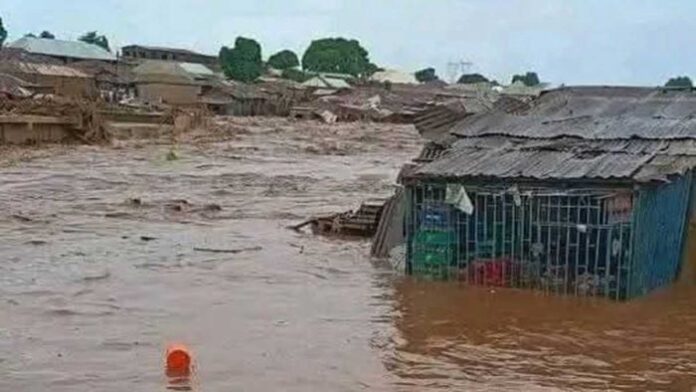
June 08, (THEWILL) – The recent flood disaster in Mokwa in Niger State has once again reminded Nigerians of the need to be proactive in matters relating to flooding. With over 200 persons reportedly dead, an estimated 500 declared missing and an unaccounted amount of property loss, the flooding, in the words of the Minister of State for Agriculture and Food Security, Senator Aliyu Adam, was “devastating and unprecedented.”
According to the Minister, Mokwa is not on a known floodplain, yet it suffered catastrophic flooding due to torrential rainfall—a clear indication of worsening climate realities.
The reality is that the much-vaunted climate change is here with us in full force. Hitherto, flooding in Niger State was usually tied to water released from either the Kainji dam or Jebba dam. But both dams are currently intact and safe.
The deadly Mokwa flooding incident would have been compounded by clogged drainage systems, a recurring feature of many urban areas in Nigeria, as well as unregulated building and construction over drainage easement coupled with either lack of diligence or compromise by building approving authorities.
The implication of this statement is that every Nigerian community is vulnerable to flooding this year. Rain is the main culprit, if the early warning being issued by the Nigerian Meteorological Agency, NiMET and Annual Flood Outlooks AFO, by the Nigeria Hydrological Services Agency, are anything to go by.
The 2025 AFO 2025 report indicated that 1,249 communities in 176 Local Government Areas in 33 states and the FCT fall within the High Flood Risk Areas, while 2,187 communities in 293 LGAs in 31 states, including the Federal Capital Territory, fall within the Moderate Flood Risk Areas
The high-flood risk states are: Abia, Adamawa, Akwa Ibom, Anambra, Bauchi, Bayelsa, Benue, Borno, Cross-River, Delta, Ebonyi, Edo, Gombe, Imo, Jigawa, Kebbi, Kogi, Kwara, Lagos, Nasarawa, Niger, Ogun, Ondo, Osun, Oyo, Rivers, Sokoto, Taraba, Yobe, Zamfara and the Federal Capital Territory FCT.
Considering the death and displacement of people and loss of several hectares of farmland caused by flooding in the last few years, it is obvious that a better approach is needed to address this yearly menace that is looking like a national scandal.
In 2022, floods killed more than 600 people, displaced about 1.4 million and destroyed 440,000 hectares of farmland.

in 2024, flooding reportedly killed more than 1,200 people and displaced 1.2 million persons. The flooding, which impacted 31 of the country’s 36 states, also destroyed more than 1.4 million hectares of farmland.
We urge the authorities, agencies and communities to collaborate in tackling this menace. These relevant stakeholders need to be more proactive in heeding professional warning signs, acting on them and further developing and maintaining mitigating physical structures.
It is commendable that the National Emergency Management Agency, NEMA, has deployed its officials in 15 high-risk states on a public enlightenment mission on the impending floods and the need to relocate from flood-prone areas before we witness a repeat of the Mokwa case on a wider scale.
The Mokwa tragedy should serve as part of the campaign.
Head of the Press Unit at NEMA, Manzo Ezekiel, who said the states on target include Kogi, Imo, Enugu, Adamawa, Taraba, Borno, Zamfara, Katsina and the Federal Capital Territory, disclosed that Mokwa people in Niger State “lived in gully areas and were caught unawares by the recent flooding disaster in the state despite official warnings.”
This early campaign, we hope, would help to further sensitise Nigerians living in flood prone communities and in expectation of heavy rains, of the need to heed early warning signals and make the necessary adjustments. We should not make flooding look unpreventable.