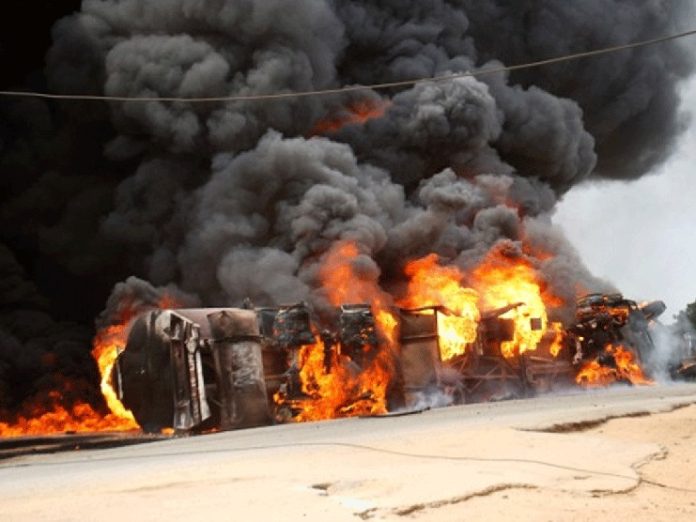
October 27, (THEWILL) – Nigerians are still mourning the 153 people who died after an overturned petrol tanker exploded about a week ago in Majia, a small town in Jigawa State.
As always, many of the victims were scooping petrol from the overturned vehicle when it exploded and burnt them to death, some beyond recognition, while others barely survived with severe burns.
The tragic incident occurred at about 11.30 pm, at a time most residents of the remote town had gone to bed. Apparently the driver of the tanker had lost control and crashed, spilling its contents.

This is not the first time that an accident of such magnitude has occurred in the country. In fact, deadly fuel tanker accidents, often caused by a number of factors, including bad roads and poorly maintained vehicles, are a recurring disaster in this part of the world.
According to available data, over 1,500 such accidents resulting in 600 deaths were recorded in 2020 alone. Majority of the dead were residents attempting to collect petrol from the overturned tanker to store in their homes. Most of them were struggling with persistent hikes in the prices of petrol, which have rendered living in Nigeria a nightmare.
On June 28, 2018, a fuel tanker laden with petrol on its way out of Lagos suddenly fell on Otedola Bridge at the Lagos end of the Lagos-Ibadan Expressway, leaked petrol and exploded. The resulting fire caught other vehicles on the bridge and burned them, killing an unspecified number of people believed to be more than the official 12 announced by the Lagos State Government, including the drivers and passengers of over 50 vehicles that were trapped.
In Onitsha, Anambra State, a petrol tanker driver reportedly lost control, rammed into a public motor park and exploded. About 85 persons were killed and several buildings, vehicles and property worth millions of naira were consumed by the ensuing fire.
Before the Jigawa tragedy, the Federal Road Safety Corps (FRSC) had issued a nationwide statement to implement the minimum safety standards for fuel tankers before they are allowed on the roads.
Also, in a recent statement issued by the presidency, President Bola Tinubu said he is committed to a comprehensive review of fuel transportation safety protocols across the country. This shows how seriously the Federal Government views the issue of petrol tanker explosions and the carnage they wreak on our roads. The conduct of many fuel tanker drivers on our roads gives cause for concerns about their mental state, particularly those ones among them who drive recklessly in total disregard for the safety of other road users.
One of the major causes of petrol tanker accidents is that many tankers that ply our roads are not designed according to international best practices. Also, tanker drivers are not properly trained on safety measures, such as the need to avoid overloading and keep to speed limits.
Apart from the absence of a government policy to effectively check the excesses of errant tanker drivers on the roads, the lack of formal training to determine the competency level of registered drivers makes it difficult to effectively tackle the problem.
While government presumably is willing to do everything possible within its power to curtail the menace, it is necessary to warn that Nigerians are tired of this endless cycle of death and destruction and they desire an end to it. They cannot continue to suffer from the reckless actions of a few citizens. Enough is Enough.
Government should understand that explosions and fire resulting from petrol tanker accidents often lead to large casualties, severe environmental pollution and huge economic losses. This is why it cannot afford to fold its arms and do nothing.